
Angle Bisector
Loading the math board and drawing, please wait…
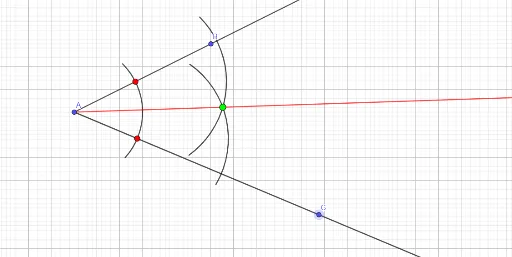
This example demonstrates the construction of an angle bisector. It involves the concept of angles and how to use GeoGebra commands such as Ray, Circle, and Intersect for geometric construction. Suitable for middle school and above students to learn about angle bisectors and related geometric concepts.
GeoGebra Commands & Parameters
Ray(A, B) → fRay(A, C) → gCircle(A, 3) → cPoint(c) → DPoint(c) → ECircleArc(A, E, D) → dIntersect(d, f, 1) → FIntersect(d, g, 1) → GCircle(F, 4) → eCircle(G, 4) → hPoint(h) → HPoint(h) → IPoint(e) → JPoint(e) → KCircleArc(F, K, J) → kCircleArc(G, I, H) → pIntersect(k, p, 1) → LRay(A, L) → i
AI Drawing Prompt Reference
Draw two rays from a common vertex to form an angle. Place a circle centered at the vertex, and pick two points on the circle to create an arc between them. This arc intersects the two rays at two points. From each intersection point, draw a circle of equal radiuscars, and on each of these circles select two points to form two arcs. These arcs intersect at a single point. Finally, draw a ray from the vertex through this intersection point, which bisects the original angle.
The prompt above was compiled from the original drawing commands and is for reference only.