
Angle Bisector Demonstration
Loading the math board and drawing, please wait…
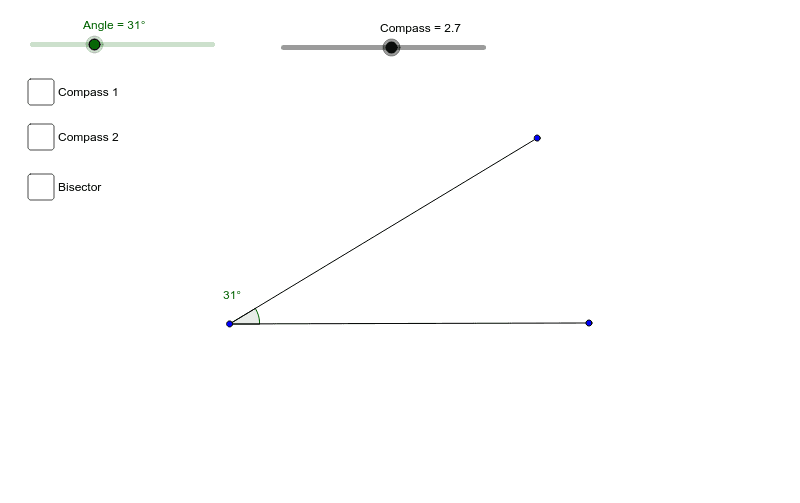
This example demonstrates how to accurately bisect any angle using geometric methods. It involves core math concepts like angles, line segments, circles, rotation, and intersection points. Key GeoGebra commands used include Segment, Rotate, Angle, Point, CircleArc, Intersect, and Line. Suitable for middle school students and above for learning geometric constructions and for teaching purposes.
GeoGebra Commands & Parameters
Segment(A, B) → aRotate(B, Angle, A) → B'Angle(B, A, B') → αSegment(A, B') → bPoint(Circle[A, abs(Compass)]) → CSegment(A, C) → cCircleArc(A, C, D) → dIntersect(d, b) → E,Intersect(d, a) → F,Point(Circle[E, abs(Compass)]) → GSegment(E, G) → eCircleArc(E, G, H) → fPoint(Circle[F, abs(Compass)]) → ISegment(F, I) → gCircleArc(F, I, J) → hIntersect(f, h) → K, , ,Line(A, K) → iAngle(a, i) → β
AI Drawing Prompt Reference
Draw an angle and find the midpoints of its two sides. Draw circles centered at these midpoints. The intersection points of the circles connect back to the angle's vertex to form the angle bisector. Label the angle and its bisector.
The prompt above was compiled from the original drawing commands and is for reference only.