
Angle Bisector Construction Demo
Loading the math board and drawing, please wait…
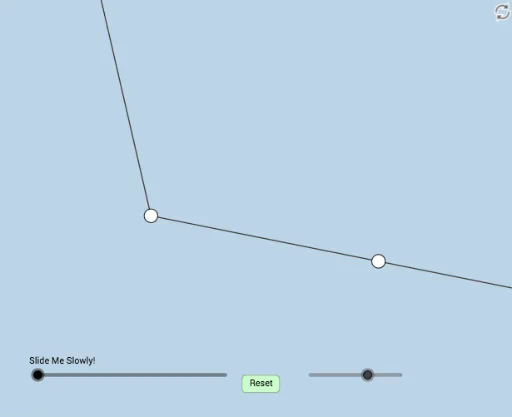
This example demonstrates the dynamic construction of an angle bisector using compass and straightedge. It involves core math concepts like angles, circles, intersections, and geometric construction. Key GeoGebra commands/objects used include Ray, Rotate, Circle, Intersect, OrthogonalLine, Distance, CircleArc, Dilate, Segment, Vector, Translate, and CircleSector. Suitable for middle school students and above for learning geometric construction techniques or for classroom demonstrations.
GeoGebra Commands & Parameters
Ray(A, B) → fRotate(B, (a * π / 180), A) → B'Angle(B, A, B') → αRay(A, B') → gCircle(A, b) → cRotate(B, (a / 2 * π / 180), A) → B'_1Angle(B, A, B'_1) → βRay(A, B'_1) → hIntersect(c, f, 1) → CIntersect(c, g) → D,OrthogonalLine(C, h) → iIntersect(i, h) → EDistance(C, E) → dCircle(C, e) → kCircle(D, e) → pIntersect(k, p, 2) → FRotate(C, If[1 < j ≤ 2, (((j - 1) * 2) * π), (2 * π)], A) → C'CircleArc(A, C, C') → qIntersect(k, f, 1) → GDilate(A, If[0 < j ≤ 1, 1 - j, 0], C) → A'Segment(A, A') → lDilate(C, If[2 < j ≤ 3, 3 - j, 0], G) → C'_1Segment(C, C'_1) → mRotate(G, If[3 < j ≤ 4, (((j - 3) * 2) * π), (2 * π)], C) → G'CircleArc(C, G, G') → rDilate(C, If[4 < j ≤ 5, 5 - j, 0], D) → C'_2Vector(C, C'_2) → uTranslate(C, u) → C'_3Translate(C'_1, u) → HSegment(C'_3, H) → m'Rotate(H, If[5 < j ≤ 6, (((j - 5) * 2) * π), (2 * π)], D) → H'CircleArc(D, H, H') → sAngle(H, D, F) → γAngle(H, D, H') → δCircle(F, 2) → tIntersect(t, h, 2) → ICircle(A, (0.3 * b)) → c_1Intersect(c_1, h, 1) → JIntersect(f, l) → KIntersect(c_1, f) → L,CircleSector(A, L, J) → d_1Ray(F, I) → nDilate(A, If[6 < j ≤ 7, 7 - j, 0], F) → A'_1Segment(A, A'_1) → f_1Rotate(L, If[7 < j ≤ 8, (((j - 7) * a / 2) * π / 180), (a / 2 * π / 180)], A) → L'CircleSector(A, L, L') → e_1Rotate(e_1, If[9 < j ≤ 10, (((j - 9) * a / 2) * π / 180), (a / 2 * π / 180)], A) → g_1
AI Drawing Prompt Reference
Draw the angle bisector of an angle, demonstrating the dynamic construction with compass and straightedge. Start by drawing the two sides of the angle, then draw two equal circles centered at the vertex. Connect the intersection points with the sides, draw a perpendicular line to one side, find the intersection point, and connect it to the vertex to complete the bisector.
The prompt above was compiled from the original drawing commands and is for reference only.