
Angle Addition Postulate Demonstration
Loading the math board and drawing, please wait…
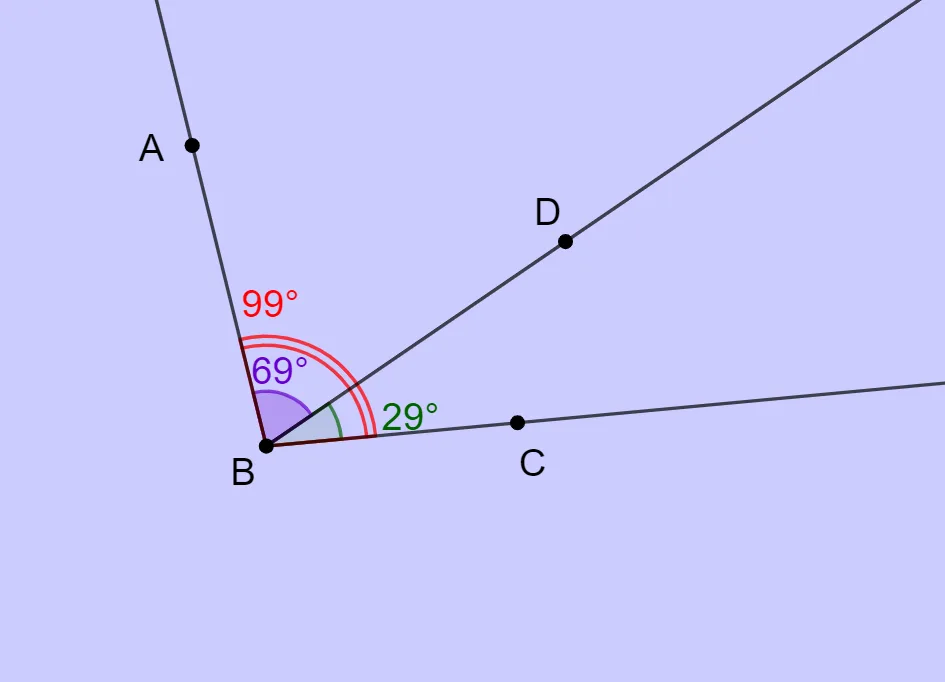
This GeoGebra example demonstrates the Angle Addition Postulate by constructing adjacent angles that share a common vertex and common ray, visually showing that the measure of a larger angle equals the sum of the measures of its non-overlapping parts. The core mathematical concepts involved include angle measure, adjacent angles, ray definition, and the additive property of angles. The construction employs GeoGebra commands Ray and Angle to create rays f, g, h determined by points A, B, C, D, and to label angles α, β, γ, dynamically illustrating angle decomposition and composition. It is suitable for middle school geometry instruction and high school geometry review, helping students understand angle composition and measurement through interactive visualization.
GeoGebra Commands & Parameters
Ray(B, A) → fRay(B, D) → gRay(B, C) → hAngle(C, B, D) → αAngle(D, B, A) → βAngle(C, B, A) → γ
AI Drawing Prompt Reference
Draw a demonstration of the angle addition postulate: start with a common vertex at point B, and from it draw three rays passing through points A, C, and D, with ray BA on the left, ray BD in the middle, and ray BC on the right. This creates two adjacent angles: a smaller angle α between rays BC and BD, another smaller angle β between rays BD and BA, and a larger angle γ between rays BC and BA. Mark all three angles with arcs, ensuring α and β are adjacent and non-overlapping, visually showing that the measure of γ equals the sum of the measures of α and β. The figure should clearly show the vertex, ray directions, and angle labels.
The prompt above was compiled from the original drawing commands and is for reference only.