
Angle Addition Postulate: Decomposing a Large Angle with Rays
Loading the math board and drawing, please wait…
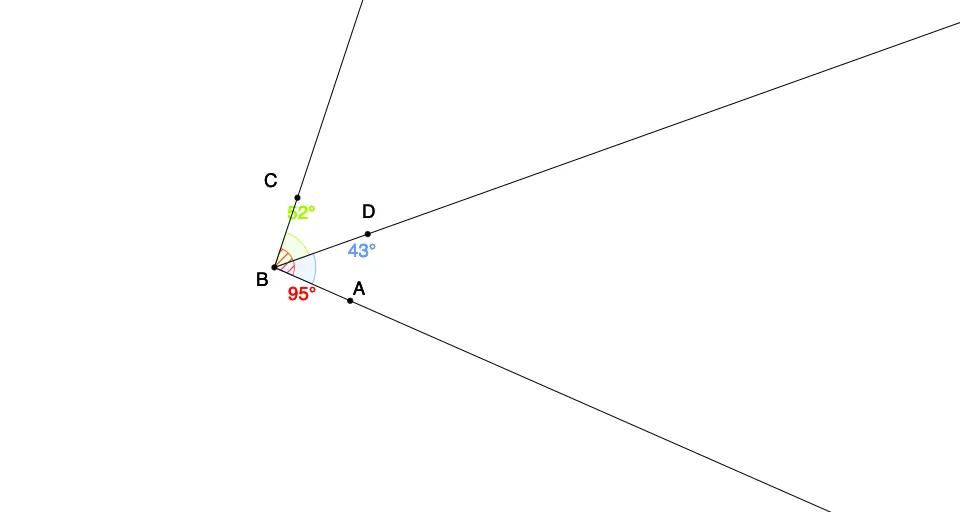
This GeoGebra example demonstrates the Angle Addition Postulate by constructing a configuration where a larger angle is split into two adjacent angles using an internal ray. The key mathematical ideas are angle construction and measurement, adjacent angles, and the relationship that the whole angle equals the sum of its parts. Construction-wise, it relies on GeoGebra’s “Angle, Ray” command to build the involved ray structure and define angle objects (α, β, γ) around the relevant points (A, B, C, and D). The objects a, b, c are used to represent angle measures/labels associated with those angles. The result is an interactive geometry setup suitable for classroom demonstration and student exploration to verify angle addition visually. Best for middle to early high school geometry learners and for teaching foundational angle relationships.
GeoGebra Commands & Parameters
Angle(A, B, C) → αAngle(A, B, D) → βAngle(D, B, C) → γRay(B, A) → aRay(B, D) → bRay(B, C) → c
AI Drawing Prompt Reference
Draw a large angle and split it into two adjacent angles using an internal ray to demonstrate that the whole angle equals the sum of its parts. First, construct two adjacent angles and label their measures, then draw the internal ray that splits the large angle, label the measures of the three angles, and finally show the relationship between them.
The prompt above was compiled from the original drawing commands and is for reference only.