
Alternate Angles
Loading the math board and drawing, please wait…
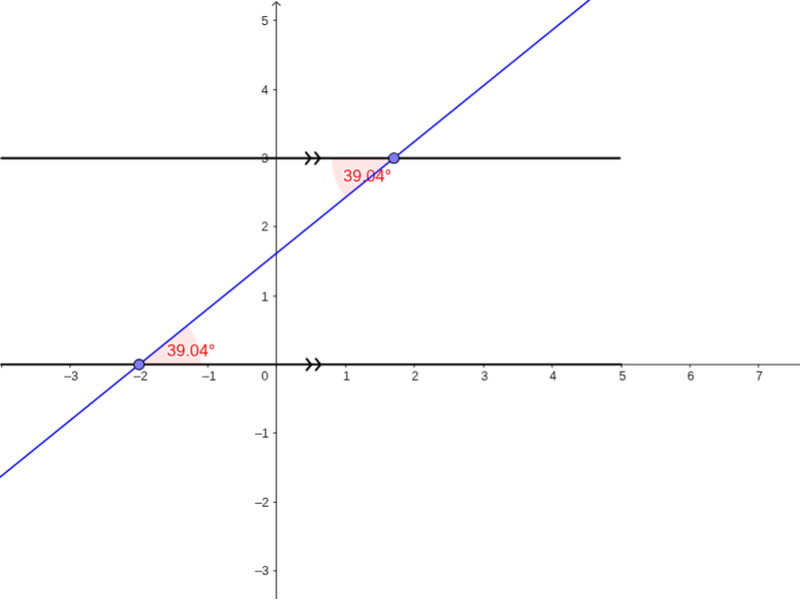
① This example demonstrates alternate angles formed by a transversal intersecting two parallel lines. ② The core mathematical concepts include angle definition, parallel line postulate, and relationships between corresponding and alternate angles. ③ The construction uses GeoGebra commands Line, Point, Angle, and Segment to create points (A, B, C, …) and segments (a, b, …), drawing the parallel lines and transversal, and labeling angles (α, β, …). ④ It is suitable for high‑school geometry students and teachers, providing an interactive way to explore and verify angle properties.
GeoGebra Commands & Parameters
Line(A, B) → aLine(C, a) → bPoint(b) → DPoint(a) → ELine(D, E) → cPoint(b) → FPoint(b) → GPoint(a) → HPoint(a) → IAngle(G, D, E) → αAngle(I, E, D) → βSegment(G, F) → dSegment(H, I) → e
AI Drawing Prompt Reference
Draw two parallel lines and a transversal line that intersects them. Mark points D, E, F, G, H, and I at the intersections. Connect points D and E, E and F, and H and I to form angles α and β.
The prompt above was compiled from the original drawing commands and is for reference only.