
Adrian Kloskowski - 2nd Liu Hui Pythagorean Proof
Loading the math board and drawing, please wait…
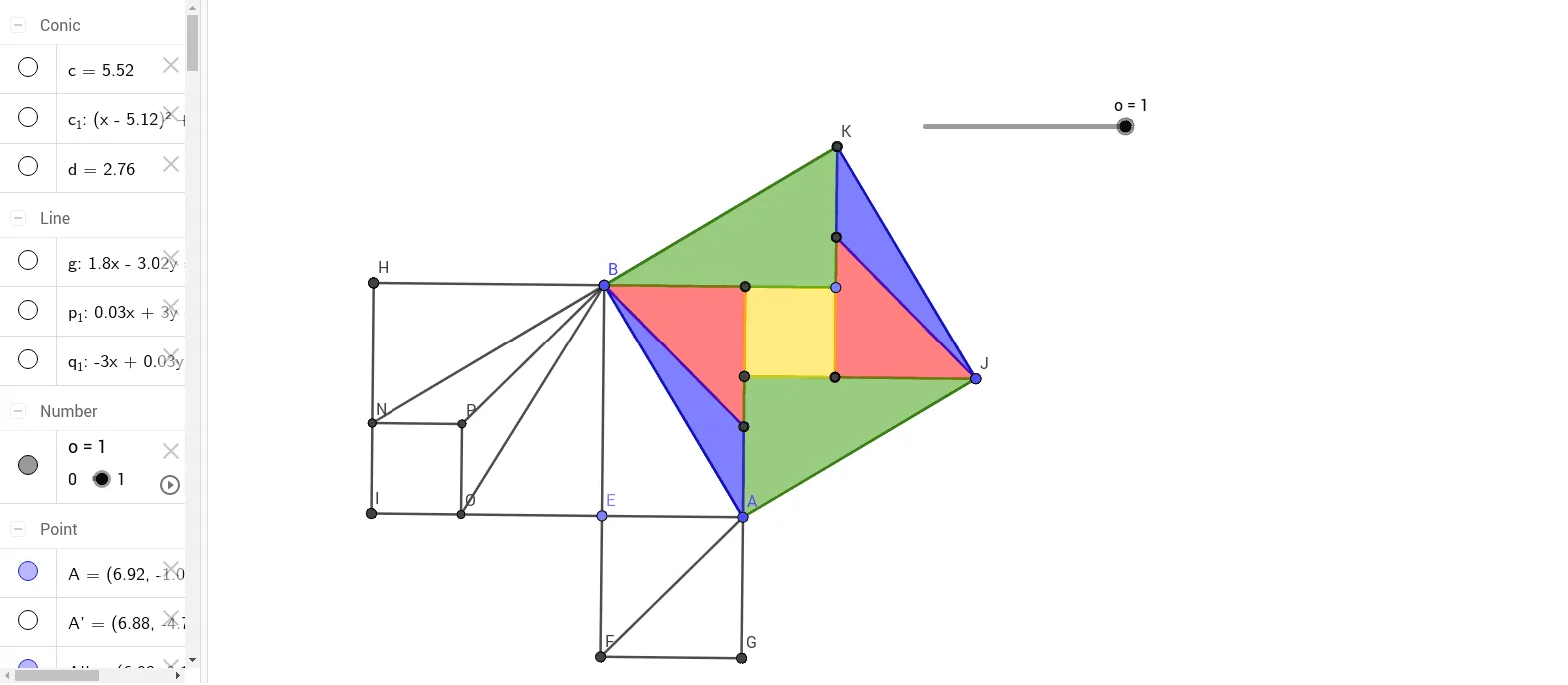
This example demonstrates the second proof of the Pythagorean Theorem by Liu Hui, illustrating the theorem's validity through geometric figures and auxiliary lines. Core mathematical concepts include the Pythagorean Theorem, linear equations, cone, sphere, linear programming or linear optimization, median value. Construction highlights involve using commands and objects in GeoGebra such as Segment, Midpoint, OrthogonalLine, Semicircle, Intersect, CircleArc, Point, Polygon, Rotate, Dilate, Vector, Translate, Circle, Mirror. Suitable for high school mathematics learning and geometric construction practice.
GeoGebra Commands & Parameters
Segment(A, B) → fMidpoint(f) → COrthogonalLine(C, f) → gSemicircle(A, B) → cIntersect(c, g) → D,CircleArc(C, D, A) → dPoint(d) → ESegment(B, E) → hSegment(E, A) → iPolygon(A, E, 4) → poly1, j, k, l, m, F, GPolygon(E, B, 4) → poly2, n, p, q, r, H, IPolygon(B, A, 4) → poly3, s, t, a_3, b, J, KSegment(B, H) → eSegment(H, I) → f_1Segment(I, E) → g_1Segment(E, F) → h_1Segment(F, G) → i_1Segment(G, A) → j_1Segment(A, J) → k_1Segment(J, K) → l_1Segment(K, B) → m_1Segment(F, A) → n_1Polygon(F, E, A) → t1, a_1, f_2, e_1Rotate(F, (-(((90 * o))°)), F) → F'Rotate(E, (-(((90 * o))°)), F) → E'Rotate(A, (-(((90 * o))°)), F) → A'Polygon(F', E', A') → t1', a', f', e'Dilate(B, o, F) → B'Vector(F, B') → uTranslate(F', u) → F''Translate(E', u) → E''Translate(A', u) → A''Polygon(F'', E'', A'') → t1'', a'', f'', e''Polygon(F, A, G) → t2, g_2, f_3, a_2Rotate(F, (-(((90 * o))°)), A) → F'_1Rotate(A, (-(((90 * o))°)), A) → A'_1Rotate(G, (-(((90 * o))°)), A) → G'Polygon(F'_1, A'_1, G') → t2', g', f'_1, a'_1Dilate(J, o, A) → J'Vector(A, J') → vTranslate(F'_1, v) → LTranslate(A'_1, v) → MTranslate(G', v) → G''Polygon(L, M, G'') → t2'', g'', l_2, m_2Circle(B, Distance[A, B]) → c_1Intersect(c_1, f_1) → N,Intersect(c_1, g_1) → O,OrthogonalLine(N, f_1) → p_1OrthogonalLine(O, g_1) → q_1Intersect(q_1, p_1) → PSegment(N, P) → r_1Segment(P, O) → s_1Segment(P, B) → t_1Segment(N, B) → b_1Segment(O, B) → d_1Polygon(N, H, B) → t3, b_2, n_2, h_2Dilate(A, o, N) → A'_2Vector(N, A'_2) → wTranslate(N, w) → N'Translate(H, w) → H'Translate(B, w) → B'_1Polygon(N', H', B'_1) → t3', b'_1, n', h'Translate(N, u_1) → N'_1Translate(H, u_1) → H'_1Translate(B, u_1) → B'_2Polygon(N'_1, H'_1, B'_2) → t3'_1, b'_2, n'_1, h'_1Polygon(N, B, P) → t4, p_2, n_3, b_3Rotate(N, ((90 * o))°, B) → N'_2Rotate(B, ((90 * o))°, B) → B'_3Rotate(P, ((90 * o))°, B) → P'Polygon(N'_2, B'_3, P') → t4', p', n'_2, b'_3Dilate(H', o, I) → H''Vector(I, H'') → v_1Polygon(N, P, O, I) → q1, n_4, p_3, o_1, i_2Translate(N, v_1) → N'_3Translate(P, v_1) → P'_1Translate(O, v_1) → O'Translate(I, v_1) → I'Polygon(N'_3, P'_1, O', I') → q1', n'_3, p'_1, o', i'Dilate(A, o, O) → A'_3Polygon(B, A'_3, E) → t5, e_2, b_4, a'_3Rotate(B, ((90 * o))°, B) → B'_4Rotate(A'_3, ((90 * o))°, B) → QRotate(E, ((90 * o))°, B) → E'_1Polygon(B'_4, Q, E'_1) → t5', e'_1, b'_4, q_2Mirror(P, e) → P'_2Mirror(O, e) → O'_1Segment(P'_2, O'_1) → j_2Dilate(P'_2, o, P) → RDilate(O'_1, o, O) → SPolygon(B, S, R) → t6, r_2, b_5, s_2Vector(B, B'_1) → w_1Translate(B, w_1) → B'_5Translate(S, w_1) → S'Translate(R, w_1) → R'Polygon(B'_5, S', R') → t6', r', b'_5, s'