
Addition und Multiplikation: A Geometric and Algebraic Example
Loading the math board and drawing, please wait…
In collections
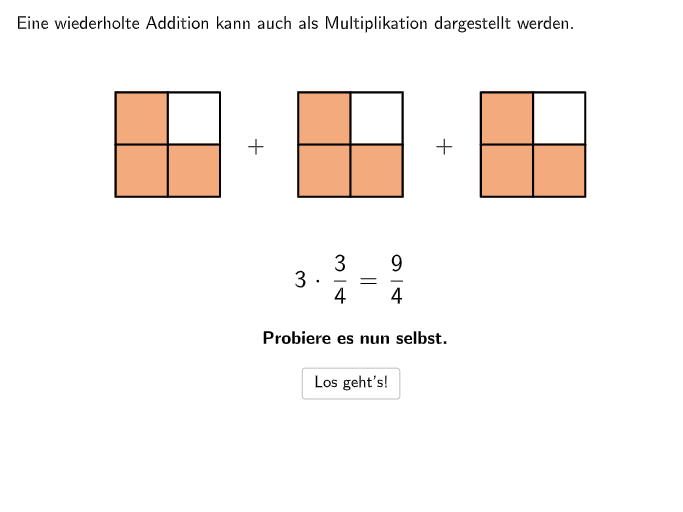
Natürliche Zahl mit Bruchzahl multiplizieren
This example demonstrates the connection between addition and multiplication through geometric figures and algebraic operations. Key mathematical concepts include rational numbers, fractions, ratios, and midpoints in geometry. Construction involves GeoGebra commands such as Shuffle, Join, DivisorsList, Factors, and others. Suitable for middle or high school mathematics to reinforce the link between algebra and geometry.
GeoGebra Commands & Parameters
Shuffle({2, 3, 4, 5}) → HelperListNatZahl, {2, 4, 5, 3}Join({{3}, HelperListNatZahl}) → NatZahlListeShuffle(Sequence[i, i, 2, 12]) → HelperListNenner, {2, 7, 3, 12, 9, 11, 6, 5, 8, 10, 4}Join({{4}, HelperListNenner}) → NennerListeDivisorsList(nenner) → TNennerFactors(nenner) →Shuffle(Join[{Shuffle[Sequence[i, i, 1, nenner - 1]], {1}}]) → HelperListZaehler, {1, 3, 1, 2}Join({{1}, HelperListZaehler}) → ZaehlerListeDivisorsList((natzahl * zaehler)) → TProdFactors((natzahl * zaehler)) →Sequence(FrameL + (Vector[FrameL, FrameR] * i / unt), i, 1, unt) → l1Shuffle({1, 2, 3, 4}) → LayoutList, {2, 3, 1, 4}Sequence(Rotate[M5Start, (60° * i), M5], i, 1, 6) → Exi5PunkteSequence(Segment[Exi5Punkte(i), Exi5Punkte(Mod[i, 6] + 1)], i, 1, 6) → Exi5Sequence(Rotate[M4Start, (60° * i), M4], i, 1, 6) → Exi4PunkteSequence(Segment[Exi4Punkte(i), Exi4Punkte(Mod[i, 6] + 1)], i, 1, 6) → Exi4Sequence(Rotate[M3Start, (60° * i), M3], i, 1, 6) → Exi3PunkteSequence(Segment[Exi3Punkte(i), Exi3Punkte(Mod[i, 6] + 1)], i, 1, 6) → Exi3Sequence(Rotate[M2Start, (60° * i), M2], i, 1, 6) → Exi2PunkteSequence(Segment[Exi2Punkte(i), Exi2Punkte(Mod[i, 6] + 1)], i, 1, 6) → Exi2Sequence(Rotate[M1Start, (60° * i), M1], i, 1, 6) → Exi1PunkteSequence(Segment[Exi1Punkte(i), Exi1Punkte(Mod[i, 6] + 1)], i, 1, 6) → Exi1Shuffle(Sequence[Random[0, 10], i, 1, 100]) → randomNosQuestion, {9, 2, 5, 5, 6, 3, 3, 10, 1, 1, 10, 3, 10, 4, 10, 1, 8, 8, 3, 1, 9, 4, 3, 2, 10, 6, 3, 0, 9, 5, 1, 8, 1, 7, 5, 8, 6, 9, 5, 0, 7, 4, 1, 4, 10, 4, 9, 10, 6, 3, 0, 10, 0, 1, 2, 10, 3, 8, 4, 8, 2, 1, 9, 7, 1, 6, 3, 2, 3, 7, 1, 4, 7, 6, 5, 10, 0, 3, 9, 9, 5, 6, 9, 7, 3, 8, 7, 9, 6, 6, 9, 2, 8, 10, 4, 3, 10, 10, 10, 10}If(nenner ≟ 12, 1, If[nenner ≟ 6, 2, If[nenner ≟ 4, 3, If[nenner ≟ 3, 4, 6]]]) → exihelpvarSequence(Segment[M2, Exi2UPunkte(If[nenner ≟ 12, (exihelpvar * i), (exihelpvar * i) - 1])], i, 1, 12) → Exi2StreckenSequence(Segment[M4, Exi4UPunkte(If[nenner ≟ 12, (exihelpvar * i), (exihelpvar * i) - 1])], i, 1, 12) → Exi4StreckenSequence(Segment[M1, Exi1UPunkte(If[nenner ≟ 12, (exihelpvar * i), (exihelpvar * i) - 1])], i, 1, 12) → Exi1StreckenSequence(Segment[M5, Exi5UPunkte(If[nenner ≟ 12, (exihelpvar * i), (exihelpvar * i) - 1])], i, 1, 12) → Exi5StreckenSequence(Segment[M3, Exi3UPunkte(If[nenner ≟ 12, (exihelpvar * i), (exihelpvar * i) - 1])], i, 1, 12) → Exi3StreckenSequence(V5DL + (Vector[V5DL, V5DR] / nenner * i), i, 1, nenner - 1) → Balken5PunkteUntenSequence(V4DL + (Vector[V4DL, V4DR] / nenner * i), i, 1, nenner - 1) → Balken4PunkteUntenSequence(V3DL + (Vector[V3DL, V3DR] / nenner * i), i, 1, nenner - 1) → Balken3PunkteUntenSequence(V1DL + (Vector[V1DL, V1DR] / nenner * i), i, 1, nenner - 1) → Balken1PunkteUntenSequence(V2DL + (Vector[V2DL, V2DR] / nenner * i), i, 1, nenner - 1) → Balken2PunkteUntenSequence(V5TL + (Vector[V5TL, V5TR] / nenner * i), i, 1, nenner - 1) → Balken5PunkteObenSequence(Segment[Balken5PunkteOben(i), Balken5PunkteUnten(i)], i, 1, nenner - 1) → Balken5StreckenSequence(V4TL + (Vector[V4TL, V4TR] / nenner * i), i, 1, nenner - 1) → Balken4PunkteObenSequence(Segment[Balken4PunkteOben(i), Balken4PunkteUnten(i)], i, 1, nenner - 1) → Balken4StreckenSequence(V3TL + (Vector[V3TL, V3TR] / nenner * i), i, 1, nenner - 1) → Balken3PunkteObenSequence(Segment[Balken3PunkteOben(i), Balken3PunkteUnten(i)], i, 1, nenner - 1) → Balken3StreckenSequence(V1TL + (Vector[V1TL, V1TR] / nenner * i), i, 1, nenner - 1) → Balken1PunkteObenSequence(Segment[Balken1PunkteOben(i), Balken1PunkteUnten(i)], i, 1, nenner - 1) → Balken1StreckenSequence(V2TL + (Vector[V2TL, V2TR] / nenner * i), i, 1, nenner - 1) → Balken2PunkteObenSequence(Segment[Balken2PunkteOben(i), Balken2PunkteUnten(i)], i, 1, nenner - 1) → Balken2StreckenSequence(Rotate[M5Start, (360° * i / nenner), M5], i, 0, nenner) → Kreis5PunkteSequence(Segment[M5, Kreis5Punkte(i)], i, 1, nenner) → Kreis5StreckenSequence(Rotate[M4Start, (360° * i / nenner), M4], i, 0, nenner) → Kreis4PunkteSequence(Segment[M4, Kreis4Punkte(i)], i, 1, nenner) → Kreis4StreckenSequence(Rotate[M3Start, (360° * i / nenner), M3], i, 0, nenner) → Kreis3PunkteSequence(Segment[M3, Kreis3Punkte(i)], i, 1, nenner) → Kreis3StreckenSequence(Rotate[M2Start, (360° * i / nenner), M2], i, 0, nenner) → Kreis2PunkteSequence(Segment[M2, Kreis2Punkte(i)], i, 1, nenner) → Kreis2StreckenSequence(Rotate[M1Start, (360° * i / nenner), M1], i, 0, nenner) → Kreis1PunkteSequence(Segment[M1, Kreis1Punkte(i)], i, 1, nenner) → Kreis1StreckenTextfield(input1) → InputBox1Textfield(input2) → InputBox2Polygon(VR1E1, VR1E4, VR1E3, VR1E2) → VR1, ptopleftcornerfeedback, ptoprightcornerfeedback, pbottomrightcornerfeedback, pbottomleftcornerfeedbackElement(randomNosQuestion, Mod[questionCount, 100] + 1) → questionNumCircle(M1, radius) → Kreis1Circle(M2, radius) → Kreis2Circle(M3, radius) → Kreis3Circle(M4, radius) → Kreis4Circle(M5, radius) → Kreis5If(nenner ∈ {2, 3, 4, 6, 12}, Random[1, 4], Random[2, 4]) → layoutMidpoint(M1, M2) → Operator1PosMidpoint(M2, M3) → Operator2PosMidpoint(M3, M4) → Operator3PosMidpoint(M4, M5) → Operator4PosTextfield(input3) → InputBox3Polygon(VR2E1, VR2E2, VR2E3, VR2E4) → VR2, vr2e1, vr2e2, vr2e3, vr2e4Corner(CalcText1, 3) → ATextfield(input4) → InputBox4Textfield(input5) → InputBox5Textfield(input6) → InputBox6Textfield(input7) → InputBox7Textfield(input8) → InputBox8Polygon(VR3E1, VR3E2, VR3E3, VR3E4) → VR3, vr3e1, vr3e2, vr3e3, vr3e4Textfield(input9) → InputBox9Polygon(V4E1, V4E2, V4E3, V4E4) → VR4, v4e1, v4e2, v4e3, v4e4Polygon(V5E1, V5E2, V5E3, V5E4) → VR5, v5e1, v5e2, v5e3, v5e4Polygon(V6E1, V6E2, V6E3, V6E4) → VR6, v6e1, v6e2, v6e3, v6e4Length({Exi2Strecken, Balken1, Balken2, Balken3, Balken4, Balken5, Balken1PunkteOben, Balken1PunkteUnten, Balken1Strecken, Balken2PunkteOben, Balken2PunkteUnten, Balken2Strecken, Balken3PunkteOben, Balken3PunkteUnten, Balken3Strecken, Balken4PunkteOben, Balken4PunkteUnten, Balken4Strecken, Balken5PunkteOben, Balken5PunkteUnten, Balken5Strecken, BalkenFlächen, Exi1, Exi2, Exi3, Exi4, Exi5, Exi1Punkte, Exi1Strecken, Exi1UPunkte, Exi2Punkte, Exi2UPunkte, Exi3Punkte, Exi3Strecken, Exi3UPunkte, Exi4Punkte, Exi4Strecken, Exi4UPunkte, Exi5Punkte, Exi5Strecken, Exi5UPunkte, ExiFlächen, Kreis1Punkte, Kreis1Strecken, Kreis2Punkte, Kreis2Strecken, Kreis3Punkte, Kreis3Strecken, Kreis4Punkte, Kreis4Strecken, Kreis5Punkte, Kreis5Strecken, KreisFlächen, LayoutList, NatZahlListe, NennerListe, ZaehlerListe, l1, randomNosQuestion}) → bIf(zaehler > 9, 2.95, 2.75) → helpervarOrthogonalLine(B, xAxis) → fPoint(f) → EMidpoint(B, F) → HMidpoint(E, F) → IMidpoint(G, F) → JMidpoint(E, G) → KMidpoint(B, E) → L
AI Drawing Prompt Reference
Create a geometric figure demonstrating the relationship between addition and multiplication. Start by generating some natural numbers and fractions randomly. Then, construct multiple hexagons by rotating and connecting points, with each side length determined by the generated fractions. Next, draw a series of equally divided line segments and corresponding rectangles to illustrate fraction addition and multiplication. Finally, draw two circles with points generated by rotation, connecting the center and points on the circumference to form circular segments.
The prompt above was compiled from the original drawing commands and is for reference only.