
Adding Two Vectors
Loading the math board and drawing, please wait…
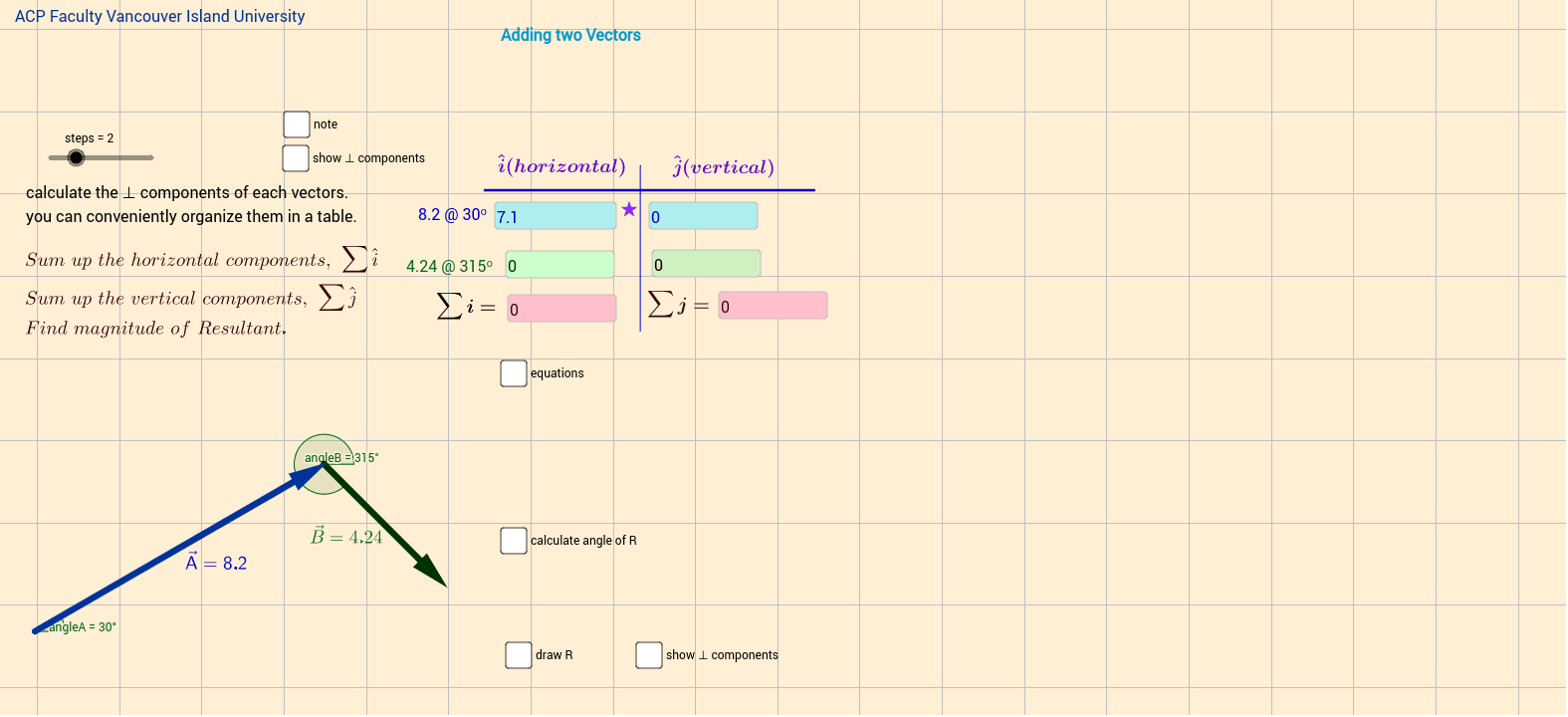
This example demonstrates how to use GeoGebra to illustrate the addition of two vectors. Key mathematical concepts include vector addition, length, and angle. Using commands like Vector, Length, and Angle, the geometric meaning of vectors is vividly shown. Suitable for students at the junior high school level and above to learn basic vector operations.
GeoGebra Commands & Parameters
Vector(c, d) → BLength(B) → magBAngle(Line[c, xAxis], Line[c, d]) → angleBVector(a, b) → AVector(a, (x(b), y(a))) → AiVector((x(b), y(a)), b) → AjAngle(Line[a, xAxis], Line[a, b]) → angleASegment(C, D) → fSegment(F, G) → gVector(c, (x(d), y(c))) → BiVector((x(d), y(c)), d) → By_1Length(A) → magATextfield(A_i) → inputAxTextfield(A_j) → inputAyTextfield(sumi) → sum_iTextfield(sumj) → sum_jTextfield(B_i) → InputBxTextfield(By) → InputByVector(Rstart, Rend) → RvecVector(Rstart, (x(Rend), y(Rstart))) → RxVector((x(Rstart) + sumi, y(Rstart)), Rend) → Ry
AI Drawing Prompt Reference
Draw two vectors A and B, and their resultant vector. First, draw vector A, then draw vector B, and next calculate and draw the resultant vector of A and B. Also, mark the length and angle with the x-axis for each vector.
The prompt above was compiled from the original drawing commands and is for reference only.