
Adding Decimal Numbers and Shortest Path Strategies
Loading the math board and drawing, please wait…
In collections
Arithmetic and Algebra
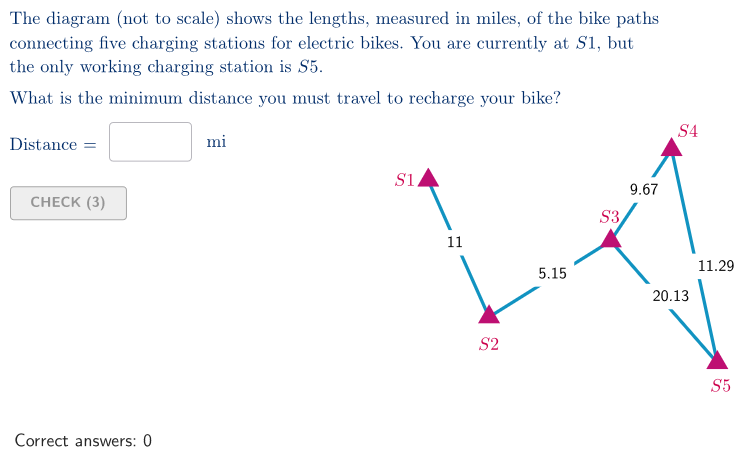
This GeoGebra activity demonstrates how to combine addition of positive decimal numbers with strategic reasoning to determine a shortest route in a given network. It highlights the idea that path length can be modeled as the sum of decimal edge weights and that comparing sums across candidate routes leads to an optimal (shortest) choice. The core concepts include arithmetic operations on positive decimals, accumulation of quantities along paths, and optimization by selecting the minimum among feasible route strategies. Construction uses GeoGebra commands reflected in the provided command set: Shuffle, Random, and RandomElement to randomize questions/parameters; Textfield to enter and display decimal values; Segment and Polyline/Polygon to create edges and candidate paths; Element and If to manage conditional logic such as feasibility checks and shortest-route selection; Midpoint to generate intermediate points when needed; Corner and onboarding text/offset helpers to structure the on-screen instructions. It is suitable for secondary school (advanced) through early university learners, particularly for lessons that connect arithmetic skills with optimal strategy thinking and basic modeling of network paths.
GeoGebra Commands & Parameters
Shuffle({1, 2}) → allCaseNum, {2, 1}Element(allCaseNum, Mod[countQuestion, Length[allCaseNum]] + 1) → caseNumIf(caseNum ≟ 1, (-11, 0), (-9, 4)) → AIf(caseNum ≟ 1, (-4, -5), (-5, -5)) → BIf(caseNum ≟ 1, (-2, 5), (3, 0)) → CIf(caseNum ≟ 1, (5, -1), (7, 6)) → DIf(caseNum ≟ 1, (10, -7), (10, -8)) → EShuffle({1, 2, 3}) → allGivenQuest, {1, 3, 2}Element(allGivenQuest, Mod[countQuestion, Length[allGivenQuest]] + 1) → givenQuestSegment(A, If[caseNum ≟ 1, C, B]) → s1Segment(If[caseNum ≟ 1, A, C], B) → s2Segment(If[caseNum ≟ 1, B, C], D) → s3Segment(C, If[caseNum ≟ 1, D, E]) → s4Segment(D, E) → s5Random(7, 12) → varNRandom(5, 10) → varARandom(2, 29) → decN5Shuffle({"Mattia", "Teo", "Andrea", "Roberto", "Chiara"}) → allFriends, {"Mattia", "Andrea", "Roberto", "Chiara", "Teo"}Random(10, 13) → varBRandom(1, 99) → decNRandomElement(allDecN1) → decN1RandomElement(allDecN2) → decN2Shuffle(Join[Sequence[Sequence[(j, k), j, -4, 4, 1], k, -4, 4, 1]]) → startGrid, {(0, 0), (-2, 4), (2, -2), (-4, 3), (2, 3), (0, -4), (-3, -3), (-1, 4), (-3, -1), (1, 4), (-4, -1), (-4, -2), (-2, 0), (4, -3), (-2, 3), (4, -4), (-1, -2), (-4, -3), (-1, 1), (0, 3), (1, -1), (3, 2), (-1, 2), (-2, -2), (0, -2), (4, 3), (4, -2), (-1, -3), (-4, 0), (1, 2), (3, -3), (3, -2), (0, 4), (3, -1), (-2, -1), (-3, -2), (2, 4), (3, 1), (0, 2), (3, 4), (-3, 4), (0, 1), (3, 3), (2, -1), (-2, -3), (-1, 0), (2, -4), (-1, 3), (-1, -4), (-4, 1), (-4, 2), (-2, -4), (4, 2), (3, 0), (1, -3), (1, 3), (2, 1), (-3, 2), (-3, -4), (2, 2), (-2, 2), (4, 1), (-1, -1), (0, -3), (-3, 3), (4, 4), (-4, -4), (-2, 1), (2, 0), (2, -3), (1, 1), (1, -2), (-4, 4), (1, -4), (4, 0), (4, -1), (3, -4), (1, 0), (0, -1), (-3, 1), (-3, 0)}Element(allFriends, Mod[countQuestion, Length[allFriends]] + 1) → startFriendRandomElement(allDecN3) → decN3RandomElement(allDecN4) → decN4Textfield(inputB) → InputBoxBCorner(5) → layoutAppSizeonboardingTextOffset(Corner[onboardingText, 1], Corner[onboardingText, 3], onboardingCase, Corner[1], Corner[3], Corner[5]) → OnboardingTextOffsetTextfield(inputA) → InputBoxATextfield(inputC) → InputBoxCPolygon(P1, Mirror[P1, yAxis], Mirror[P1, (0, 0)], Mirror[P1, xAxis]) → peep, p1, f, g, hSegment((-10.8, 0), (10.8, 0)) → fakeXSegment((0, -10.8), (0, 10.8)) → fakeYIf(givenQuest ≟ 2 ∧ caseNum ≟ 2, E + (-1, 0), givenQuest ≟ 2 ∧ caseNum ≟ 1, E + (-1, 0), E + (1, 0)) → PLABEIf(givenQuest ≟ 2 ∧ caseNum ≟ 2, A + (-1.5, 0), givenQuest ≟ 2 ∧ caseNum ≟ 1, A + (-1, 0), A + (1, 0)) → PLABAIf(givenQuest ≟ 2 ∧ caseNum ≟ 2, B + (-1, 0), givenQuest ≟ 2 ∧ caseNum ≟ 1, B + (-0.2, 0), B + (1, 0)) → PLABBIf(givenQuest ≟ 2 ∧ caseNum ≟ 2, D + (-1, 0.2), givenQuest ≟ 2 ∧ caseNum ≟ 1, D + (-1, 0.5), D) → PLABDIf(givenQuest ≟ 2 ∧ caseNum ≟ 2, C + (-1, 0), givenQuest ≟ 2 ∧ caseNum ≟ 1, C + (1, 0), C + (2.5, 0)) → PLABCMidpoint(s5) → PLABS5PolyLine({A, C, D, E}) → solPath11PolyLine({A, B, D, E}) → solPath12PolyLine({A, B, C, D, E}) → solPath21PolyLine({A, B, C, E}) → solPath22
AI Drawing Prompt Reference
Create a coordinate-plane network diagram for shortest-path thinking. Place five main nodes at specific coordinate positions, then connect them according to conditional choices so the edges form a connected graph. Draw multiple candidate routes as polylines from the start node to the end node: include routes that go through different intermediate points and share some segments while differing on other parts. Ensure the shared and differing portions are clearly reflected in the polyline geometry, keeping all connections consistent with the underlying node layout for each constructed path.
The prompt above was compiled from the original drawing commands and is for reference only.