
Accelerated Geometry Town: Parallel Lines and Transversal Angle Activity
Loading the math board and drawing, please wait…
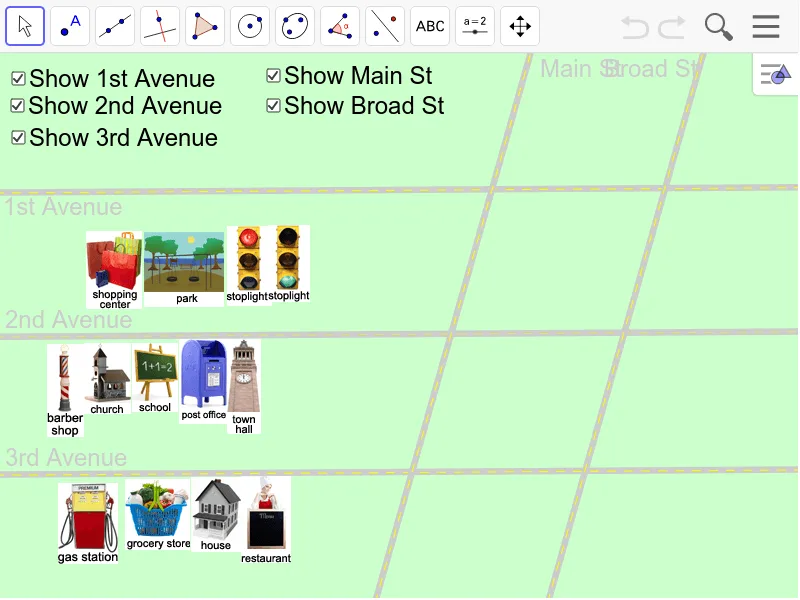
This interactive GeoGebra activity, titled 'Accelerated Geometry Town', demonstrates the angle relationships formed when two parallel lines are cut by a transversal. It focuses on core concepts such as corresponding angles, alternate interior angles, and consecutive interior angles, which are fundamental in plane geometry. The construction uses the Line command to create multiple lines (labeled a, b, c, etc.) and defines numerous points (A through L) as intersections or key locations. Additionally, it incorporates many images (pic1 to pic13) as town-like visual elements, likely to contextualize the problems in a story-driven setting. This activity is suitable for middle school geometry classes to test students' understanding of parallel line angle properties, and can be used as an engaging classroom exercise or homework assignment, enhancing learning through a visually rich and scenario-based approach.
GeoGebra Commands & Parameters
Line(A, B) → aLine(C, a) → bLine(D, a) → cLine(E, b) → dLine(F, b) → eLine(G, e) → fLine(H, I) → gLine(J, g) → hLine(K, g) → iLine(L, h) → j
AI Drawing Prompt Reference
Draw a geometric town scene with two sets of parallel lines intersected by transversals. Start with a horizontal line, then add two lines parallel to it. From the first parallel line, draw a slanted transversal, and from the second parallel line, draw another slanted line. Then add a line parallel to that slanted line. For the second set, begin with a slanted baseline, then draw two lines parallel to it, and finally add another line parallel to one of those. Mark multiple intersection points along all lines, and place several small decorative images around the figure to represent town elements, emphasizing the angle relationships (corresponding, alternate interior, and consecutive interior) formed by the parallel lines and transversals.
The prompt above was compiled from the original drawing commands and is for reference only.