
AA Similarity Theorem Dynamic Demonstration
Loading the math board and drawing, please wait…
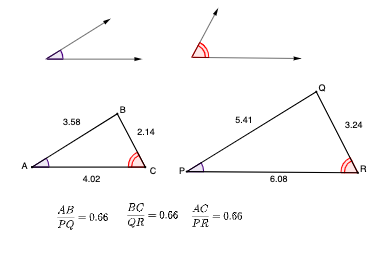
This GeoGebra example dynamically demonstrates the Angle-Angle (AA) similarity criterion for triangles. The core mathematical concept is triangle similarity: if two triangles have two pairs of corresponding angles equal, then the triangles are similar, meaning their corresponding sides are proportional. The construction uses commands such as Vector, Angle, Rotate, Segment, Circle, Intersect, and Line to build two triangles and their corresponding angles. By rotating and measuring angles, users can adjust the angle values and observe that the triangles maintain their shape while changing size, always preserving similarity. Key objects include A_1, B_1, u, C_1, v, D, E, w, F, a, α, β, J, K, J', A, C, f, c, g, I, h, L, i, k, p, M, q, N, j, B, l, m, P, R, n, r, s, R_1, t, forming a complete geometric network. This resource is suitable for middle school geometry classes or high school review sessions, helping students visually grasp the AA similarity condition and develop geometric intuition and logical reasoning skills.
GeoGebra Commands & Parameters
Vector(A_1, B_1) → uVector(A_1, C_1) → vVector(D, E) → wVector(D, F) → aAngle(C_1, A_1, B_1) → αAngle(F, D, E) → βRotate(J, 180° - α - β, K) → J'Segment(A, C) → fCircle(A, Segment[A_1, C_1]) → cCircle(A, Segment[A_1, B_1]) → gIntersect(c, f, 1) → ICircle(I, Segment[C_1, B_1]) → hIntersect(g, h, 1) → LLine(A, L) → iCircle(C, Segment[D, F]) → kCircle(C, Segment[D, E]) → pIntersect(k, f, 1) → MCircle(M, Segment[E, F]) → qIntersect(p, q, 2) → NLine(C, N) → jIntersect(i, j) → BSegment(C, B) → lSegment(B, A) → mSegment(P, R) → nCircle(P, Segment[A_1, C_1]) → rCircle(P, Segment[A_1, B_1]) → sIntersect(r, n, 1) → R_1Circle(R_1, Segment[C_1, B_1]) → tIntersect(s, t, 1) → SLine(P, S) → bCircle(R, Segment[F, D]) → c_1Circle(R, Segment[D, E]) → d_1Intersect(c_1, n, 1) → TCircle(T, Segment[F, E]) → e_1Intersect(d_1, e_1, 2) → ULine(R, U) → f_1Intersect(b, f_1) → QSegment(R, Q) → g_1Segment(Q, P) → h_1Angle(C, A, B) → δAngle(A, B, C) → εAngle(B, C, A) → ζAngle(P, Q, R) → ηAngle(Q, R, P) → θAngle(R, P, Q) → ι