
A6: Reflection Trapezoid - Lauren Green
Loading the math board and drawing, please wait…
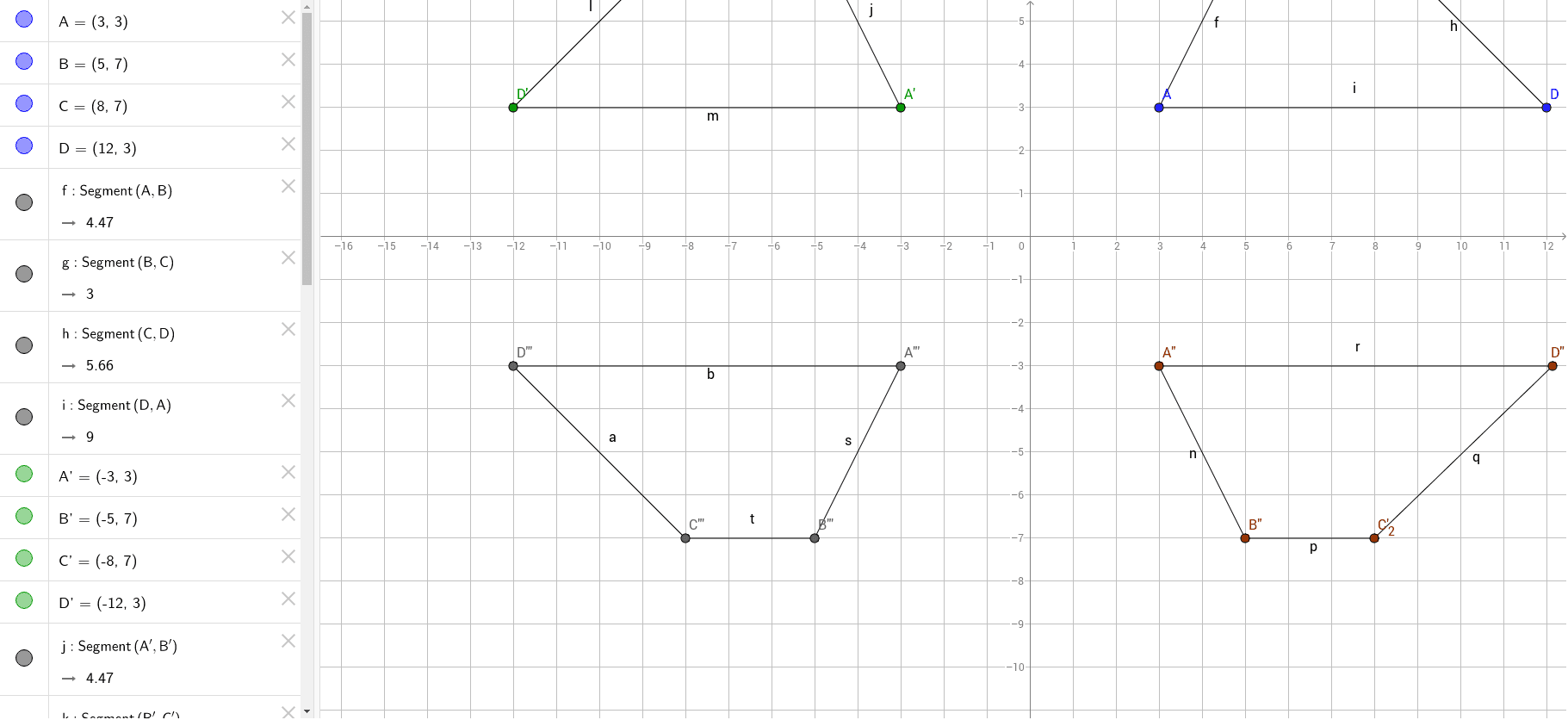
① This example demonstrates the process of repeatedly reflecting a trapezoid across lines, producing multiple mirrored images that illustrate reflection symmetry and similarity transformations. ② Core mathematical concepts include reflection (axial symmetry), similarity transformations, properties of trapezoids, and the composition of multiple reflections. ③ Construction highlights: Using GeoGebra's Segment command, the original trapezoid is defined by vertices A, B, C, D and sides f, g, h, i; the first reflected image is generated with points A', B', C', D' and sides j, k, l, m; a second reflection yields A'', B'', C'', D'' with sides n, p, q, r; a third reflection produces A''', B''', C''', D''' with sides s, t, a, b, forming a chain of reflected copies. ④ Suitable for middle and high school geometry lessons on transformations, symmetry, and similarity, and as an interactive exploration for students learning dynamic geometry software.
GeoGebra Commands & Parameters
Segment(A, B) → fSegment(B, C) → gSegment(C, D) → hSegment(D, A) → iSegment(A', B') → jSegment(B', C') → kSegment(C', D') → lSegment(D', A') → mSegment(A'', B'') → nSegment(B'', C'_2) → pSegment(C'_2, D'') → qSegment(D'', A'') → rSegment(A''', B''') → sSegment(B''', C''') → tSegment(C''', D''') → aSegment(D''', A''') → b
AI Drawing Prompt Reference
Draw a trapezoid and reflect it successively across a line three times, producing three mirrored copies arranged in a chain. The original trapezoid has four vertices and four sides; each reflection creates a new set of vertices and sides, with the copies aligned along the same axis. Show all trapezoids clearly, illustrating reflection symmetry and similarity transformations.
The prompt above was compiled from the original drawing commands and is for reference only.