
A Cube Removed From Another Cube
Loading the math board and drawing, please wait…
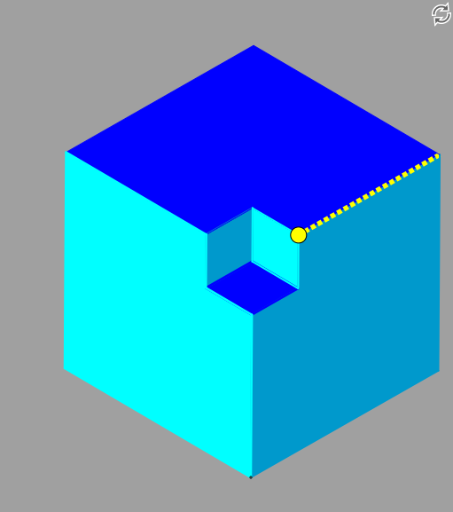
This example demonstrates the process of removing one cube from another. It involves the concept of intersection in solid geometry. Using GeoGebra commands such as Polygon, Midpoint, Segment, Vector, and Point, the intersection of two cubes can be constructed. Suitable for students at the junior high school level and above.
GeoGebra Commands & Parameters
Polygon(A, B, 6) → poly1, a, F, b, c, d, e, f, C, D, EMidpoint(D, A) → GSegment(D, G) → gSegment(B, G) → hSegment(G, F) → iVector(G, D) → uPoint(u) → HSegment(G, H) → jCircle(G, H) → kIntersect(k, i) → I,Intersect(k, h) → J,Segment(E, G) → lSegment(G, A) → mSegment(G, C) → pIntersect(k, l) → K,Intersect(k, m) → L,Intersect(k, p) → M,Segment(K, H) → qSegment(K, I) → rSegment(I, L) → sSegment(L, J) → tSegment(J, M) → a_1Segment(M, H) → b_1Segment(F, I) → c_1Segment(K, G) → d_1Segment(G, L) → e_1Segment(J, B) → f_1Segment(G, M) → g_1Segment(D, H) → h_1Polygon(B, C, D, H, M, J) → poly2, b_2, c_2, d_2, h_2, m_1, j_1Polygon(I, K, G, L) → poly3, i_1, k_1, g_2, l_1Polygon(H, K, I, F, E, D) → poly4, h_3, k_2, i_2, f_2, e_2, d_3Polygon(L, G, M, J) → poly5, l_2, g_3, m_2, j_2Polygon(F, I, L, J, B, A) → poly6, f_3, i_3, l_3, j_3, b_3, a_2Polygon(G, M, H, K) → poly8, g_5, m_4, h_5, k_4Ray(O, N) → n_1