
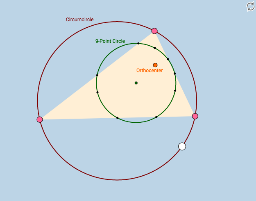
9-Point Circle Property: Midpoint of Line Segment from Orthocenter to Circumcirc
Loading the math board and drawing, please wait…
In collections
CCSS High School: Geometry (Congruence) Volume 2
CCSS High School: Geometry (Congruence) Volume 2
CCSS High School: Geometry (Congruence) Volume 2
CCSS High School: Geometry (Congruence) Volume 2
Triangle Theorems
Triangles: Points of Concurrency
This example demonstrates a key property of the 9-Point Circle: the midpoint of the line segment connecting the orthocenter of a triangle to any point on its circumcircle lies on the 9-Point Circle. Key concepts include the 9-Point Circle, orthocenter, and midpoint. GeoGebra commands used include Line, Segment, Midpoint, Circle, Dilate, Rotate, Polygon, Point, etc. Suitable for high school geometry education.
GeoGebra Commands & Parameters
Line(C, B) → l_1Segment(B, C) → gMidpoint(g) → F_3OrthogonalLine(F_3, l_1) → j_3Line(A, C) → f_1Segment(C, A) → hMidpoint(h) → E_3OrthogonalLine(E_3, f_1) → k_3Intersect(k_3, j_3) → I_2Segment(A, B) → fMidpoint(f) → D_3Min(list1) → aCircle(D_3, (0.15 * a)) → cCircle(E_3, (0.15 * a)) → dCircle(F_3, (0.15 * a)) → eIntersect(c, f, 2) → HIntersect(d, h, 2) → KIntersect(e, g, 2) → MDilate(A, If[0 < b ≤ 1, 1 - b, 0], D_3) → A'Dilate(B, If[2 < b ≤ 3, 3 - b, 0], F_3) → B'Dilate(C, If[4 < b ≤ 5, 5 - b, 0], E_3) → C'Segment(A, A') → lSegment(B, B') → mSegment(C, C') → nRotate(A, If[1 < b ≤ 2, ((b - 1) * π), π], D_3) → A'_1Rotate(A', If[1 < b ≤ 2, ((b - 1) * π), π], D_3) → A''Segment(A'_1, A'') → l'Rotate(B, If[3 < b ≤ 4, ((b - 3) * π), π], F_3) → B'_1Rotate(B', If[3 < b ≤ 4, ((b - 3) * π), π], F_3) → B''Segment(B'_1, B'') → m'Rotate(C, If[5 < b ≤ 6, ((b - 5) * π), π], E_3) → C'_1Rotate(C', If[5 < b ≤ 6, ((b - 5) * π), π], E_3) → C''Segment(C'_1, C'') → n'Polygon(A, B, C) → poly1, c_1, a_1, b_1Line(A, B) → iPoint(i) → C_3Point(i) → GOrthogonalLine(C, i) → jIntersect(i, j) → IRay(A, G) → kRay(B, C_3) → pPoint(k) → JPoint(p) → LCircle(I, (0.15 * a)) → sIntersect(s, i, 2) → NIntersect(s, j, 2) → O_3CircleSector(I, N, O_3) → tAngle(C, B, A) → αAngle(B, A, C) → βAngle(A, C, B) → γPoint(f_1) → PPoint(f_1) → QRay(A, P) → g_1Ray(C, Q) → h_1Point(g_1) → RPoint(h_1) → SOrthogonalLine(B, f_1) → k_1Intersect(f_1, k_1) → TCircle(T, (0.15 * a)) → d_1Intersect(d_1, f_1, 1) → UIntersect(d_1, k_1, 1) → VCircleSector(T, U, V) → e_1OrthogonalLine(A, l_1) → m_1Intersect(l_1, m_1) → WCircle(W, (0.15 * a)) → p_1Intersect(p_1, l_1, 1) → ZIntersect(p_1, m_1, 1) → A_1Point(l_1) → B_1Point(l_1) → D_1CircleSector(W, Z, A_1) → q_1Ray(C, B_1) → n_1Ray(B, D_1) → r_1Point(n_1) → E_1Point(r_1) → F_1Dilate(C, If[6 < b ≤ 7, 7 - b, 0], I) → G_1Segment(C, G_1) → f_2Dilate(B, If[7 < b ≤ 8, 8 - b, 0], T) → B'_2Segment(B, B'_2) → g_2Dilate(A, If[8 < b ≤ 9, 9 - b, 0], W) → A'_2Segment(A, A'_2) → h_2Intersect(k_1, m_1) → ODilate(I, If[12 < b ≤ 13, 13 - b, 0], O) → I'Dilate(A, If[12 < b ≤ 13, 13 - b, 0], O) → A'_3Dilate(T, If[12 < b ≤ 13, 13 - b, 0], O) → T'Segment(I, I') → i_2Segment(A, A'_3) → j_2Segment(T, T') → k_2Dilate(C, If[12 < b ≤ 13, 13 - b, 0], O) → I_1Dilate(W, If[12 < b ≤ 13, 13 - b, 0], O) → W'Dilate(T, If[12 < b ≤ 13, 13 - b, 0], O) → T'_1Segment(W, W') → l_2Segment(C, I_1) → m_2Segment(T, T'_1) → n_2Dilate(I, If[12 < b ≤ 13, 13 - b, 0], O) → I'_1Dilate(B, If[12 < b ≤ 13, 13 - b, 0], O) → B'_3Dilate(W, If[12 < b ≤ 13, 13 - b, 0], O) → W'_1Segment(B, B'_3) → p_2Segment(W, W'_1) → q_2Segment(I, I'_1) → r_2Midpoint(O, C) → FMidpoint(O, A) → DMidpoint(O, B) → EDilate(O, If[14 < b ≤ 15, 15 - b, 0], F) → M_1Dilate(F, If[15 < b ≤ 16, 16 - b, 0], C) → N_1Segment(F, N_1) → t_2Rotate(O, If[16 < b ≤ 17, ((b - 16) * π), π], F) → O_1Rotate(M_1, If[16 < b ≤ 17, ((b - 16) * π), π], F) → P_1Dilate(O, If[17 < b ≤ 18, 18 - b, 0], E) → Q_1Dilate(E, If[18 < b ≤ 19, 19 - b, 0], B) → R_1Segment(E, R_1) → e_2Rotate(O, If[19 < b ≤ 20, ((b - 19) * π), π], E) → S_1Rotate(Q_1, If[19 < b ≤ 20, ((b - 19) * π), π], E) → T_1Dilate(O, If[20 < b ≤ 21, 21 - b, 0], D) → U_1Dilate(D, If[21 < b ≤ 22, 22 - b, 0], A) → V_1Segment(D, V_1) → h_3Rotate(O, If[22 < b ≤ 23, ((b - 22) * π), π], D) → W_1Rotate(U_1, If[22 < b ≤ 23, ((b - 22) * π), π], D) → Z_1Intersect(e, l_1) → A_2, B_2Intersect(e, j_3) → C_2, D_2CircleSector(F_3, A_2, C_2) → c_3Circle(E_3, (0.15 * a)) → d_3Intersect(d_3, k_3) → E_2, F_2Intersect(d_3, f_1) → G_2, H_2CircleSector(E_3, G_2, E_2) → e_3Midpoint(O, I_2) → J_2Dilate(O, If[28 < b ≤ 29, 29 - b, 0], J_2) → K_2Dilate(J_2, If[29 < b ≤ 30, 30 - b, 0], I_2) → L_2Rotate(O, If[30 < b ≤ 31, ((b - 30) * π), π], J_2) → M_2Rotate(K_2, If[30 < b ≤ 31, ((b - 30) * π), π], J_2) → N_2Dilate(J_2, If[31 < b ≤ 32, 32 - b, 0], D_3) → O_2Rotate(J_2, If[32 < b ≤ 34, ((b - 32) * π), (2 * π)], J_2) → P_2Rotate(O_2, If[32 < b ≤ 34, ((b - 32) * π), (2 * π)], J_2) → Q_2Segment(P_2, Q_2) → s_3CircleArc(J_2, D_3, Q_2) → t_3Circle(J_2, D_3) → c_4Point(j) → R_2Point(j) → S_2Ray(C, R_2) → j_4Ray(I, S_2) → k_4Point(j_4) → T_2Point(k_4) → U_2Angle(B, T, C) → δAngle(C, I, A) → εAngle(A, W, B) → ζAngle(I_2, E_3, C) → ηAngle(I_2, D_3, A) → θAngle(I_2, F_3, B) → ιLine(I_2, D_3) → s_2Line(A, W) → a_2Line(C, I) → b_2Line(B, T) → c_2Dilate(I_2, If[0 < v ≤ 1, 1 - v, 0], J_2) → C_1Segment(I_2, C_1) → d_2Dilate(J_2, If[1 < v ≤ 2, 2 - v, 0], O) → H_1Segment(J_2, H_1) → f_3Rotate(I_2, If[2 < v ≤ 3, ((v - 2) * π), π], J_2) → K_1Rotate(C_1, If[2 < v ≤ 3, ((v - 2) * π), π], J_2) → V_2Segment(K_1, V_2) → g_3Dilate(J_2, If[3 < v ≤ 4, 4 - v, 0], D_3) → W_2Segment(J_2, W_2) → i_3Rotate(J_2, If[4 < v ≤ 6, ((v - 4) * π), (2 * π)], J_2) → Z_2Rotate(W_2, If[4 < v ≤ 6, ((v - 4) * π), (2 * π)], J_2) → A_3CircleArc(J_2, D_3, A_3) → p_3Dilate(J_2, If[8 < v ≤ 9, 9 - v, 0], I_2) → G_3Vector(J_2, G_3) → wTranslate(Z_2, w) → H_3Translate(A_3, w) → J_3Segment(H_3, J_3) → q_3Rotate(H_3, If[9 < v ≤ 10, ((v - 9) * π), π], I_2) → K_3Rotate(J_3, If[9 < v ≤ 10, ((v - 9) * π), π], I_2) → L_3Dilate(J_2, If[11 < v ≤ 12, 12 - v, 0], I_2) → D_4Vector(J_2, D_4) → u_1Translate(Z_2, u_1) → G_4Translate(A_3, u_1) → H_4Segment(G_4, H_4) → l_4Angle(D, J_2, D_3) → μRotate(G_4, If[12 < v ≤ 13, ((-(v - 12)) * μ), (-μ)], I_2) → P_3Rotate(H_4, If[12 < v ≤ 13, ((-(v - 12)) * μ), (-μ)], I_2) → Q_3Dilate(J_2, If[14 < v ≤ 15, 15 - v, 0], I_2) → Z_3Vector(J_2, Z_3) → v_1Translate(Z_2, v_1) → A_4Translate(A_3, v_1) → C_4Segment(A_4, C_4) → p_4Angle(D_3, J_2, E) → κRotate(A_4, If[15 < v ≤ 16, ((v - 15) * κ), κ], I_2) → E_4Rotate(C_4, If[15 < v ≤ 16, ((v - 15) * κ), κ], I_2) → F_4Circle(I_2, C) → d_4Rotate(B, If[17 < v ≤ 19, ((v - 17) * π), (2 * π)], I_2) → B'_4CircleArc(I_2, B, B'_4) → e_4Line(B, C) → qLine(A, C) → rLine(B, A) → i_1Point(d_4) → K_4
AI Drawing Prompt Reference
Draw a triangle ABC. Construct line f1 from A to C and line segment h from C to A, with midpoint E3. Construct line f from B to C and line segment h, with midpoint F3. Construct a perpendicular line j3 from E3 to f1 and a perpendicular line k3 from F3 to l1, and let their intersection I2 be a point on the 9-point circle. Construct line segment f from A to B, with midpoint D3. Draw a circle c centered at D3 with radius 0.15 times the length of AB. Repeat the process to draw circles d and e centered at E3 and F3, respectively, with the same radius. Let the intersections of c with f, d with h, and e with g be points H, K, and M, respectively, on the 9-point circle.
The prompt above was compiled from the original drawing commands and is for reference only.