
7 Applications of Forces
Loading the math board and drawing, please wait…
In collections
Pearson Maths A level Statistics and Mechanics 2
Pearson Maths A level Statistics and Mechanics 2
Pearson Maths A level Statistics and Mechanics 2
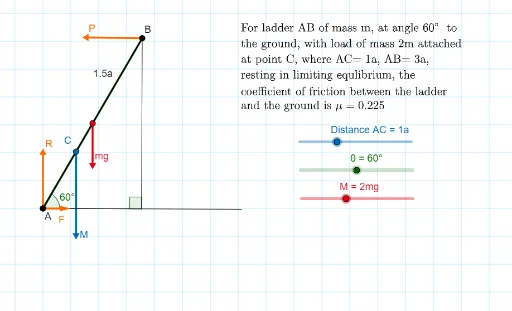
This example demonstrates the geometric phenomena related to seven applications of forces. It involves core mathematical concepts such as incircle, multiplication, variance, polygons, and intersections. The construction utilizes GeoGebra commands/objects like Point, Segment, Rotate, Sequence, Angle, Line, OrthogonalLine, Length, Intersect, Vector, and Midpoint. Suitable for high school mathematics students and teachers for teaching demonstrations and geometric construction practice.
GeoGebra Commands & Parameters
Point(s_1) → DSegment(D, A_1) → hPoint(h) → URotate(A_1, θ, D) → B_1Segment(D, B_1) → sPoint(s) → BSegment(U, C) → aSequence(Segment[(-100, i), (100, i)], i, -50, 50, 1) → list2Sequence(Segment[(i, -100), (i, 100)], i, -50, 50, 1) → list4Angle(A_1, D, B_1) → θ_1Line(D, A_1) → fLine(D, B_1) → gOrthogonalLine(R_1, s) → jOrthogonalLine(G, s) → mPoint(m) → EPoint(m) → FLine(L, s) → iLength(a) → a_{1}Point(i) → NOrthogonalLine(B, h) → lIntersect(l, h) → OAngle(B, O, A) → αPoint(s) → C_2Point(h) → HVector(H, R) → uPoint(Circle[B, 2]) → PSegment(B, P) → kSegment(H, R) → nSegment(B, P) → pMidpoint(A, B) → ISegment(I, J) → qSegment(C, S) → tIntersect(θ_1, f, 1) → TSegment(I, B) → bSegment(U, I) → cSegment(I, B) → dLength(b) → b_{1}Length(c) → c_{1}Length(d) → d_{1}Segment(U, B) → eSegment(U, O) → f_1Segment(O, B) → g_1Point(h) → VVector(A, V) → v