
3D Vector Rotation and Isosceles Triangle Symmetry Exploration
Loading the math board and drawing, please wait…
In collections
Geometry of Angles (Student Created)
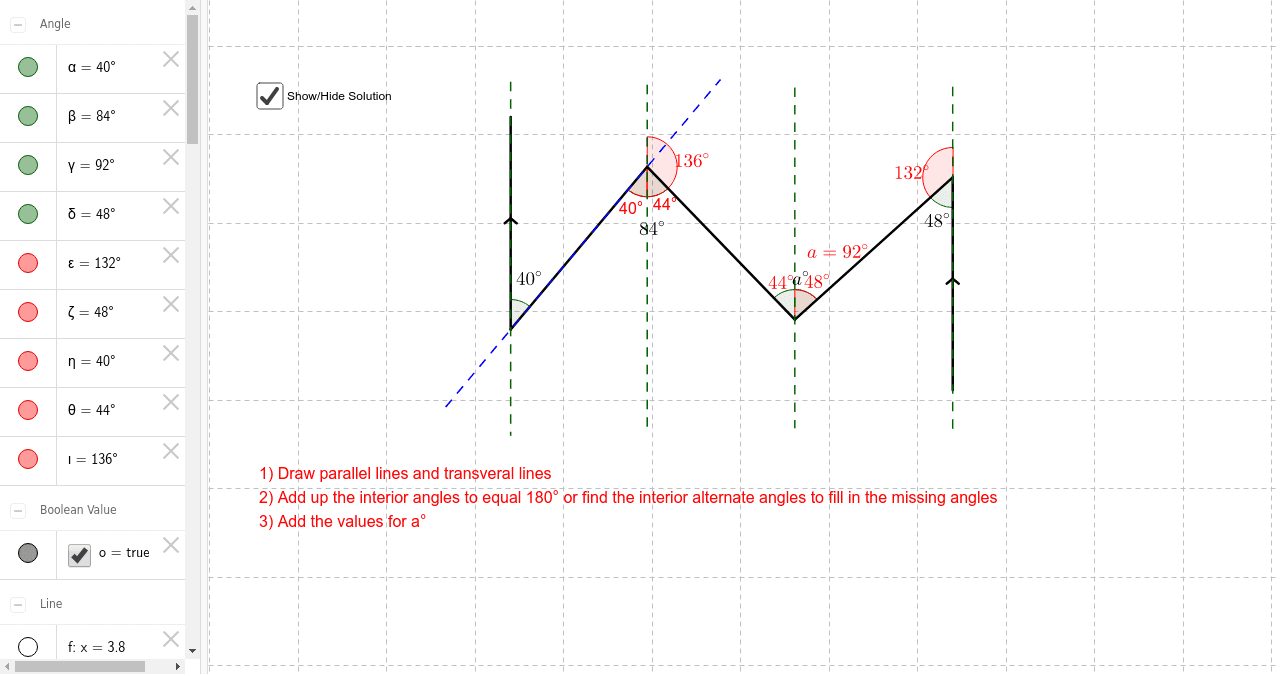
This example demonstrates the construction of a series of isosceles triangles in 3D space through rotation operations, and analyzes their geometric relationships using symmetry. Core mathematical concepts include 3D vectors, rotation, angles, isosceles triangle properties, and symmetry. Construction highlights: using GeoGebra's Rotate command on points B and A to generate A', B', A'', B'', etc., marking angles α, β, γ, δ with the Angle command; connecting segments b, c, d, a, e via Segment; finding intersection points C, D, E, F, H, I, J, K, L, M, N with Intersect; constructing auxiliary lines with Line; marking key points with Point; and adding text labels text1 to text7. Suitable for high school or early college students learning 3D vectors and geometric transformations, as well as exploring rotational symmetry and isosceles triangle properties.
GeoGebra Commands & Parameters
Rotate(A, -40*°, B) → A'Angle(A', B, A) → αRotate(B, 84*°, A') → B'Angle(B, A', B') → βRotate(A', -92*°, B') → A''Angle(A'', B', A') → γRotate(B', 48*°, A'') → B''Angle(B', A'', B'') → δSegment(B, A') → bSegment(A', B') → cSegment(A'', B') → dSegment(B, A) → aSegment(B'', A'') → eIntersect(c, d) → CIntersect(d, e) → DLine(C, e) → fPoint(f) → EPoint(f) → FSegment(E, F) → gLine(D, g) → hPoint(h) → HPoint(h) → ISegment(H, I) → iIntersect(b, c) → GLine(G, g) → jPoint(j) → JPoint(j) → KSegment(K, J) → kIntersect(b, a) → LLine(L, k) → lPoint(l) → MPoint(l) → NSegment(M, N) → mLine(L, b) → nPoint(n) → OPoint(n) → PSegment(P, O) → pAngle(H, D, C) → εAngle(D, C, E) → ζAngle(L, G, J) → ηAngle(J, G, C) → θAngle(C, G, K) → ι