
3D Pythagoras Theorem Construction
Loading the math board and drawing, please wait…
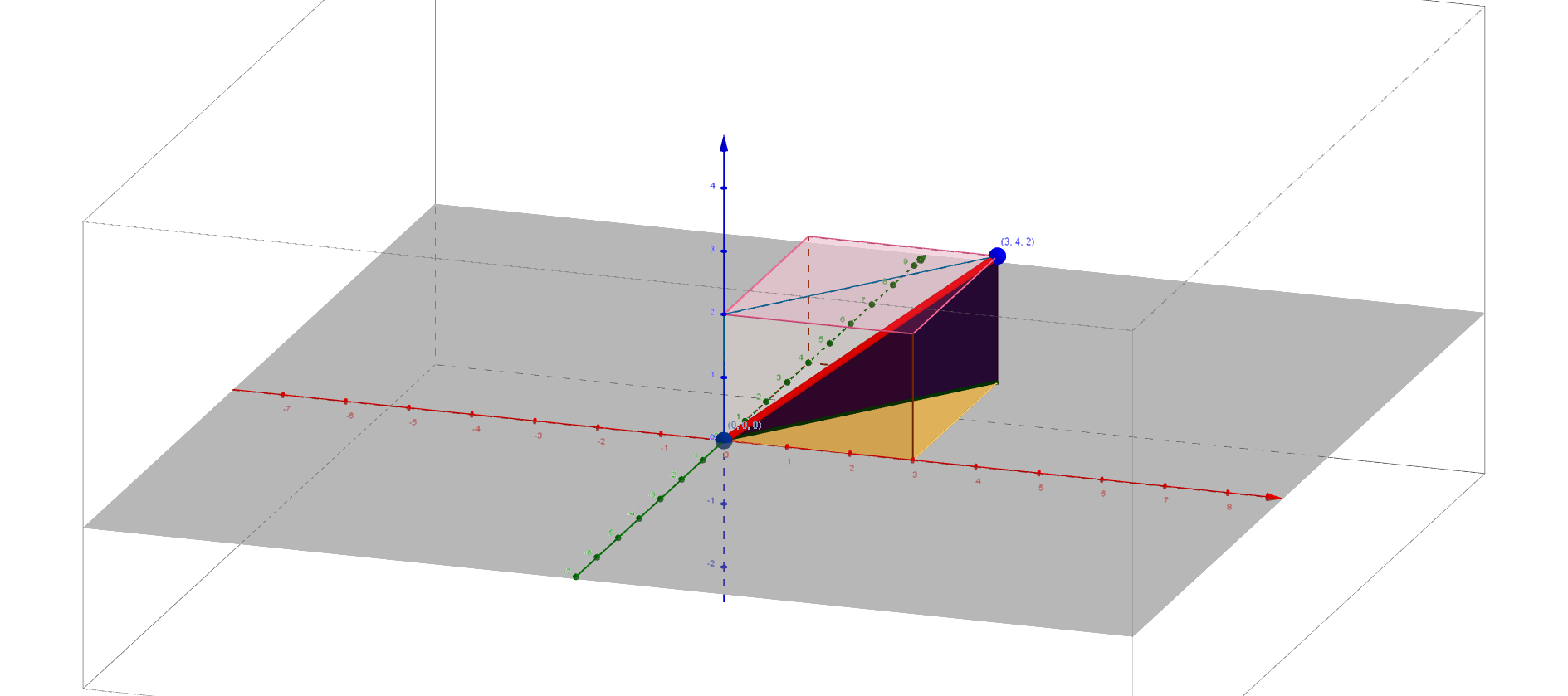
This example demonstrates how to solve line segment length problems using the 3D Pythagorean theorem. It involves core mathematical concepts such as right triangles and cubes in three-dimensional space. Using GeoGebra commands like Polygon, Segment, and Intersect, students can visually understand the geometric relationships in 3D space. Suitable for middle school and above students to learn 3D geometry and apply the Pythagorean theorem.
GeoGebra Commands & Parameters
Polygon(A, E, F, B) → poly1, a, e, f, bPolygon(C, G, H, D) → poly3, c_1, g_1, h, dPolygon(H, D, A, E) → poly4, h_1, d_1, a_1, e_1Polygon(E, F, G, H) → poly5, e_2, f_2, g_2, h_2Polygon(A, E, G, C) → poly6, a_2, e_3, g_3, c_2Segment(A, G) → iPolygon(A, G, C) → poly7, c_3, a_3, g_4Intersect(yAxis, zAxis) → LPolygon(A, C, B) → poly8, b_2, a_4, c_4
AI Drawing Prompt Reference
Draw a cube in 3D space with four vertices A, B, C, D and their corresponding points E, F, G, H on the coordinate axes. Use the polygon command to draw four bases and four sides, then connect points A and G to form a line segment. Finally, draw a triangle containing points A, C, and B.
The prompt above was compiled from the original drawing commands and is for reference only.