
1-step Equations with Fractions
Loading the math board and drawing, please wait…
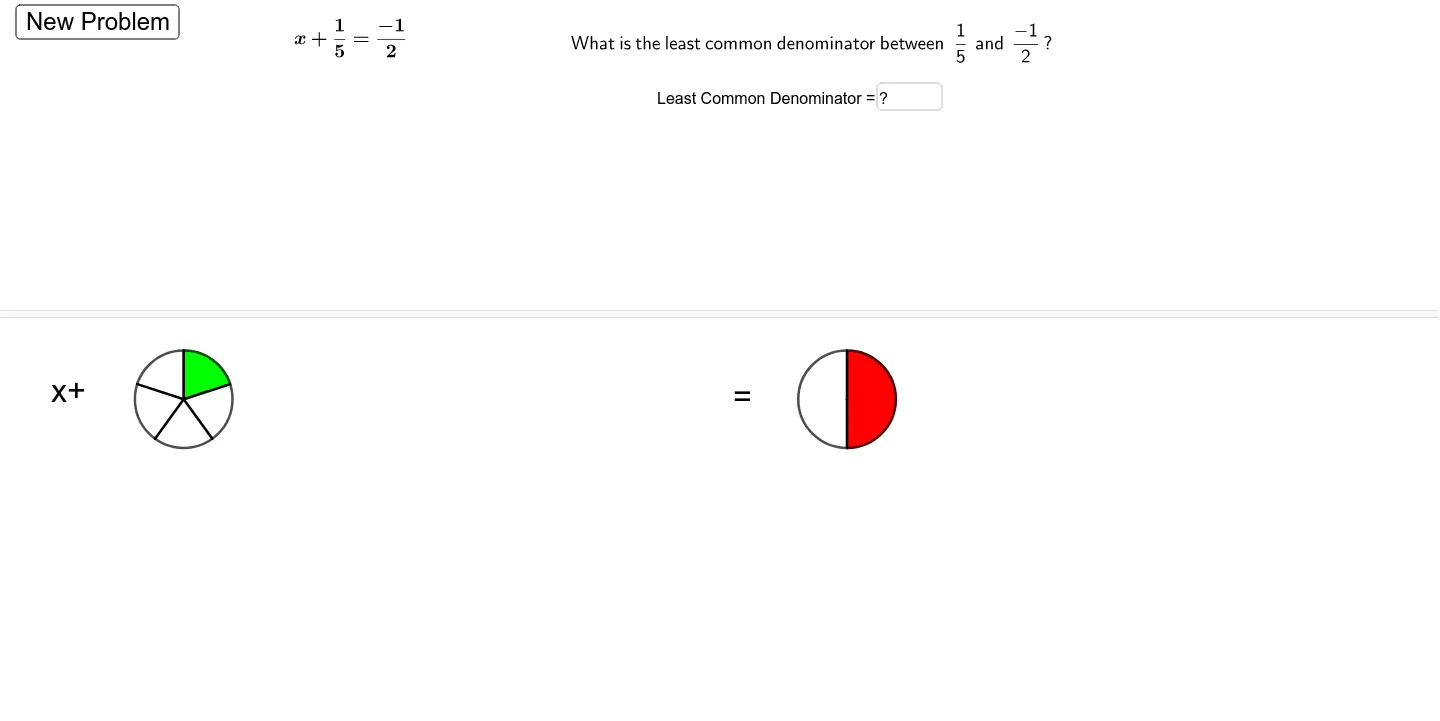
This example demonstrates solving one-step equations with fractions using GeoGebra. Key math concepts include equations and fractions. Commands used include RandomElement, Denominator, LCM, Solve, etc. Suitable for middle school math education to help students understand equation solving.
GeoGebra Commands & Parameters
RandomElement(L_1) → eRandomElement(L_1) → dDenominator(f) → uRandomElement(L_1) → bRandomElement(L_1) → aDenominator(c) → oLCM(o, u) → gSolve(h) → L_2Circle(A, 2.5) → kCircle(E, 2.5) → sCircle(D, 2.5) → rCircle(B, 2.5) → pCircle(C, 2.5) → qCircle(F, 2.5) → tCircle(I, 2.5) → e_1Circle(J, 2.5) → f_1Circle(H, 2.5) → d_1Circle(G, 2.5) → c_1OrthogonalLine(A, xAxis) → iOrthogonalLine(E, xAxis) → jOrthogonalLine(D, xAxis) → lOrthogonalLine(B, xAxis) → mOrthogonalLine(C, xAxis) → nOrthogonalLine(F, xAxis) → g_1OrthogonalLine(I, xAxis) → h_1OrthogonalLine(J, xAxis) → i_1OrthogonalLine(H, xAxis) → j_1OrthogonalLine(G, xAxis) → k_1Intersect(k, i, 2) → KIntersect(s, j, 2) → LIntersect(r, l, 2) → MIntersect(p, m, 2) → NIntersect(q, n, 2) → OIntersect(t, g_1, 2) → PIntersect(e_1, h_1, 2) → QIntersect(f_1, i_1, 2) → RIntersect(d_1, j_1, 2) → SIntersect(c_1, k_1, 2) → TSequence(Rotate[K, (-((360° * i / g))), A], i, 1, g) → L_3Sequence(Rotate[K, (-((360° * i / o))), A], i, 1, o) → L_4Sequence(Rotate[L, (-((360° * i / g))), E], i, 1, g) → L_5Sequence(Rotate[L, (-((360° * i / o))), E], i, 1, o) → L_6Sequence(Rotate[M, (-((360° * i / g))), D], i, 1, g) → L_7Sequence(Rotate[M, (-((360° * i / o))), D], i, 1, o) → L_8Sequence(Rotate[N, (-((360° * i / g))), B], i, 1, g) → L_9Sequence(Rotate[N, (-((360° * i / o))), B], i, 1, o) → L_{10}Sequence(Rotate[O, (-((360° * i / g))), C], i, 1, g) → L_{11}Sequence(Rotate[O, (-((360° * i / o))), C], i, 1, o) → L_{12}Sequence(Rotate[P, (-((360° * i / g))), F], i, 1, g) → L_{13}Sequence(Rotate[P, (-((360° * i / u))), F], i, 1, u) → L_{14}Sequence(Rotate[Q, (-((360° * i / g))), I], i, 1, g) → L_{15}Sequence(Rotate[Q, (-((360° * i / u))), I], i, 1, u) → L_{16}Sequence(Rotate[R, (-((360° * i / g))), J], i, 1, g) → L_{17}Sequence(Rotate[R, (-((360° * i / u))), J], i, 1, u) → L_{18}Sequence(Rotate[S, (-((360° * i / g))), H], i, 1, g) → L_{19}Sequence(Rotate[S, (-((360° * i / u))), H], i, 1, u) → L_{20}Sequence(Rotate[T, (-((360° * i / g))), G], i, 1, g) → L_{21}Sequence(Rotate[T, (-((360° * i / u))), G], i, 1, u) → L_{22}Sequence(Segment[A, Element[L_3, i]], i, 1, g) → L_{23}Sequence(Segment[A, Element[L_4, i]], i, 1, o) → L_{24}Sequence(Segment[E, Element[L_5, i]], i, 1, g) → L_{25}Sequence(Segment[E, Element[L_6, i]], i, 1, o) → L_{26}Sequence(Segment[D, Element[L_7, i]], i, 1, g) → L_{27}Sequence(Segment[D, Element[L_8, i]], i, 1, o) → L_{28}Sequence(Segment[B, Element[L_9, i]], i, 1, g) → L_{29}Sequence(Segment[B, Element[L_{10}, i]], i, 1, o) → L_{30}Sequence(Segment[C, Element[L_{11}, i]], i, 1, g) → L_{31}Sequence(Segment[C, Element[L_{12}, i]], i, 1, o) → L_{32}Sequence(Segment[F, Element[L_{13}, i]], i, 1, g) → L_{33}Sequence(Segment[I, Element[L_{15}, i]], i, 1, g) → L_{35}Sequence(Segment[I, Element[L_{16}, i]], i, 1, u) → L_{36}Sequence(Segment[F, Element[L_{14}, i]], i, 1, u) → L_{34}Sequence(Segment[J, Element[L_{17}, i]], i, 1, g) → L_{37}Sequence(Segment[J, Element[L_{18}, i]], i, 1, u) → L_{38}Sequence(Segment[H, Element[L_{19}, i]], i, 1, g) → L_{39}Sequence(Segment[H, Element[L_{20}, i]], i, 1, u) → L_{40}Sequence(Segment[G, Element[L_{21}, i]], i, 1, g) → L_{41}Sequence(Segment[G, Element[L_{22}, i]], i, 1, u) → L_{42}Numerator(c) → vNumerator(f) → wSegment(U, V) → l_1OrthogonalLine(V, l_1) → m_1Circle(V, 5) → p_1Intersect(p_1, m_1, 1) → WIntersect(p_1, m_1, 2) → ZSegment(W, Z) → n_1Div(abs(a), abs(b)) → s_1Circle(A, K) → c_2Circle(E, L) → d_2Circle(D, M) → e_2Circle(B, N) → f_2Circle(C, O) → g_2Circle(F, P) → h_2Circle(I, Q) → k_2Circle(J, R) → p_2Circle(H, S) → q_2Circle(G, T) → r_2Div(abs(d), abs(e)) → u_1If(c < 0, (-s_1), s_1) → v_1Numerator(t_1) → w_1Sector(k, Element[L_4, abs(w_1)], K) → s_2Sector(s, Element[L_6, abs(w_1)], L) → t_2Sector(r, Element[L_8, abs(w_1)], M) → c_3Sector(p, Element[L_{10}, abs(w_1)], N) → d_3Sector(q, Element[L_{12}, abs(w_1)], O) → e_3Div(abs(d), abs(e)) → a_2If(f < 0, (-a_2), a_2) → b_2Numerator(i_2) → j_2Sector(t, Element[L_{14}, abs(j_2)], P) → f_3Sector(e_1, Element[L_{16}, abs(j_2)], Q) → g_3Sector(f_1, Element[L_{18}, abs(j_2)], R) → h_3Sector(d_1, Element[L_{20}, abs(j_2)], S) → k_3Sector(c_1, Element[L_{22}, abs(j_2)], T) → p_3Vector(A, A_1) → u_2Translate(L_{23}, u_2) → L_{43}Translate(L_{24}, u_2) → L_{44}Translate(L_{25}, u_2) → L_{45}Translate(L_{26}, u_2) → L_{46}Translate(L_{27}, u_2) → L_{47}Translate(L_{28}, u_2) → L_{48}Translate(L_{29}, u_2) → L_{49}Translate(L_{30}, u_2) → L_{50}Translate(L_{31}, u_2) → L_{51}Translate(L_{32}, u_2) → L_{52}Translate(s, u_2) → s'Translate(r, u_2) → r'Translate(q, u_2) → q'Translate(p, u_2) → p'Translate(k, u_2) → k'Translate(c_2, u_2) → c_4Translate(d_2, u_2) → d_4Translate(e_2, u_2) → e_4Translate(f_2, u_2) → f_4Translate(g_2, u_2) → g_4Translate(s_2, u_2) → s_4Translate(t_2, u_2) → t_4Translate(c_3, u_2) → c_5Translate(d_3, u_2) → d_5Translate(e_3, u_2) → e_5Vector(A, F) → v_2Translate(L_{43}, v_2) → L_{53}Translate(L_{44}, v_2) → L_{54}Translate(L_{45}, v_2) → L_{55}Translate(L_{46}, v_2) → L_{56}Translate(L_{47}, v_2) → L_{57}Translate(L_{48}, v_2) → L_{58}Translate(L_{49}, v_2) → L_{59}Translate(L_{50}, v_2) → L_{60}Translate(L_{51}, v_2) → L_{61}Translate(L_{52}, v_2) → L_{62}Translate(c_4, v_2) → q_3Translate(d_4, v_2) → r_3Translate(e_4, v_2) → s_3Translate(f_4, v_2) → t_3Translate(g_4, v_2) → h_4Translate(k', v_2) → k''Translate(p', v_2) → p''Translate(q', v_2) → q''Translate(r', v_2) → r''Translate(s', v_2) → s''Translate(t_4, v_2) → k_4Translate(s_4, v_2) → p_4Translate(c_5, v_2) → q_4Translate(d_5, v_2) → r_4Translate(e_5, v_2) → f_5Textfield(A1) → InputBox1Textfield(A2) → InputBox2Textfield(A3) → InputBox3
AI Drawing Prompt Reference
Draw a figure with five circles, each with a radius of 2.5 and centers at points A, E, D, B, and C. Then draw five vertical lines through A, E, D, B, and C, respectively. Rotate the first line 360 degrees/g around A, the second line 360 degrees/o around E, and so on for the other lines. Finally, find the intersections of all circles and lines, and use these points to draw a series of rotated shapes.
The prompt above was compiled from the original drawing commands and is for reference only.