
验证函数 f(x)=±√(x+3) 与 g(x)=x²-3 互为反函数
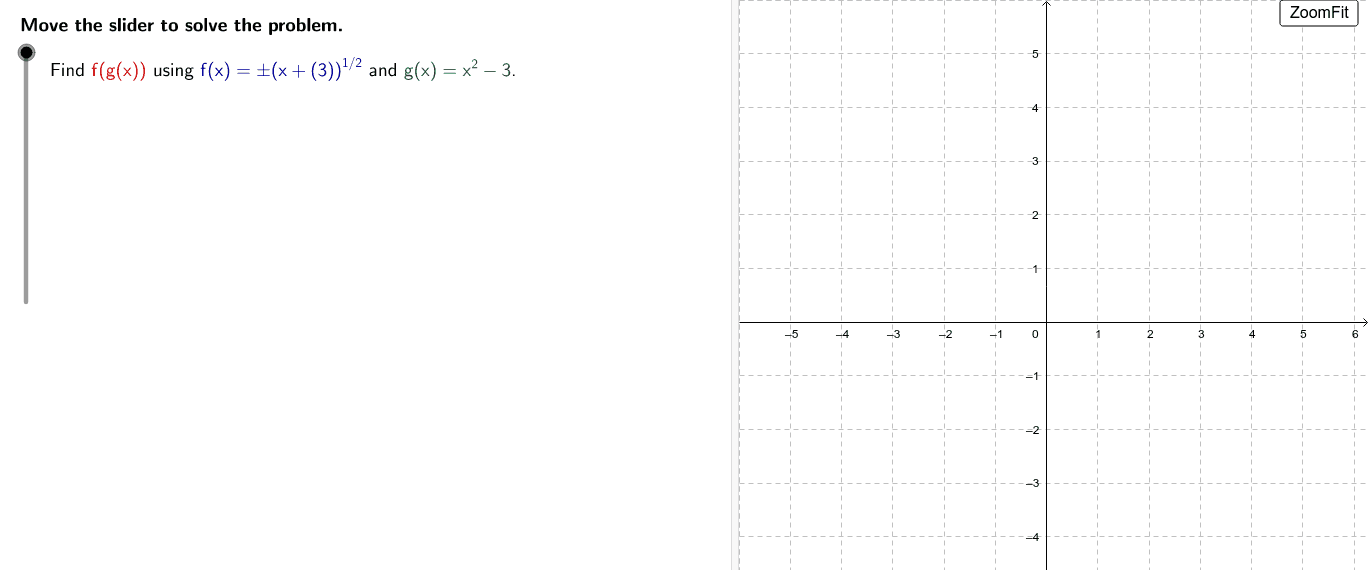
几何画板及绘图内容加载中,请稍等……
① 该范例演示如何通过复合函数 f(g(x)) 与 g(f(x)) 验证两个函数互为反函数的图形与代数关系。② 涉及核心数学概念:函数复合、反函数定义、定义域与值域的对应、平方根函数的正负分支。③ 作图要点:使用了 LaTeX、Corner、If、Simplify、Max 等命令,配合 stepMax、stepper、steps、counter、text0、Original、Randomize、ZoomFit、button1、A、B、txmin、txmax、tymin、tymax、Problem、a、b、c、f、evenodd、f2、g、d、text4、text6、text8、text9、text10、text21、text23、text24、list1、maxzeros、range、xmax、xmin、ymax、ymin、text3 等对象实现动态展示与步骤控制。④ 适合高中数学“函数与导数”章节或大学预科课程,作为反函数验证的教学演示与自学素材。
GeoGebra 命令及参数
LaTeX(steps) → counterLaTeX("\text{Move the slider to solve the problem.}") → text0Corner(1) → ACorner(3) → BLaTeX("\text{}") → ProblemIf(IsInteger[c / 2], LaTeX["\pm"], "") → evenoddSimplify(Polynomial[x^(c) - b] / a) → gLaTeX((((((((("\textcolor{#000099}{f(x)=" * evenodd) * "(") * Simplify[(a * x)]) * "+(") * b) * "))^{1/") * c) * "}}")) → text4LaTeX((((((((("\textcolor{#CC0000}{f(g(x))=" * evenodd) * "((") * Simplify[(a * g(x))]) * ")+(") * b) * "))^{1/") * c) * "}}")) → text6LaTeX((((((("\textcolor{#CC0000}{f(g(x))=" * evenodd) * "\left(x^") * c) * "\right)^{1/") * c) * "}}")) → text8LaTeX("\text{Simplify the powers.}") → text9LaTeX("\textcolor{#CC0000}{f(g(x))=x}") → text10LaTeX("\textcolor{#CC0000}{g(f(x))=x}") → text21LaTeX("\text{State a conclusion about whether }\textcolor{#006633}{g(x)}\text{ is the inverse}\cr\text{of }\textcolor{#000099}{f(x)}\text{ based on the results for }\textcolor{#CC0000}{f(g(x))}\text{ and }\textcolor{#CC0000}{g(f(x))}.") → text23LaTeX("\text{We have determined that }\textcolor{#CC0000}{f(g(x)) = x}\text{ and }\cr\textcolor{#CC0000}{g(f(x)) = x}\text{. By substitution, }\textcolor{#CC0000}{f(g(x)) = g(f(x))};\cr\text{therefore, }\textcolor{#006633}{g(x)}\text{ is the inverse of }\textcolor{#000099}{f(x)}.") → text24Max(Zip[abs(x(a)), a, list1]) → maxzerosLaTeX("\text{Original function }\textcolor{#000099}{f(x)}") → text3LaTeX((("\text{Substitute }\textcolor{#006633}{" * g) * "}\text{ for }\textcolor{#000099}{x}\text{ and name the }\cr\text{new function }\textcolor{#CC0000}{f(g(x))}.")) → text5LaTeX((("\text{The notation }\textcolor{#CC0000}{f(g(x))}\text{ means that the input for }\textcolor{#000099}{f(x)}\text{ is equal to the output of }\textcolor{#006633}{g(x)}\text{.}\cr\text{In other words, to find }\textcolor{#CC0000}{f(g(x))}\text{, replace }\textcolor{#000099}{x}\text{ in the value of the function }\textcolor{#000099}{f(x)}\cr\text{with the value of the function }\textcolor{#006633}{g(x)}\text{. Therefore, replace }\textcolor{#000099}{x}\text{ with }\textcolor{#006633}{" * g) * "}\text{ and then}\cr\text{solve the resulting composition of functions.}")) → text2LaTeX((((((((((("\text{Find }\textcolor{#CC0000}{f(g(x))}\text{ using }\textcolor{#000099}{f(x)=" * evenodd) * "(") * Simplify[(a * x)]) * "+(") * b) * "))^{1/") * c) * "}}\text{ and }\textcolor{#006633}{g(x) = ") * g) * "}.")) → text1LaTeX("\text{Original function }\textcolor{#006633}{g(x)}") → text14LaTeX("\text{Use the buttons below to return to the original problem or}\cr\text{randomly generate a similar practice problem.}") → RandomizationTextLaTeX("\text{Simplify.}") → text20LaTeX((((((((((("\text{Find }\textcolor{#CC0000}{g(f(x))}\text{ using }\textcolor{#000099}{f(x)=" * evenodd) * "(") * Simplify[(a * x)]) * "+(") * b) * "))^{1/") * c) * "}}\text{ and }\textcolor{#006633}{g(x) = ") * g) * "}.")) → text12LaTeX((((((((("\text{The notation }\textcolor{#CC0000}{g(f(x))}\text{ means that the input for }\textcolor{#006633}{g(x)}\text{ is equal to the output of }\textcolor{#000099}{f(x)}\text{.}\cr\text{In other words, to find }\textcolor{#CC0000}{g(f(x))}\text{, replace }\textcolor{#006633}{x}\text{ in the value of the function }\textcolor{#006633}{g(x)}\cr\text{with the value of the function }\textcolor{#000099}{f(x)}\text{. Therefore, replace }\textcolor{#006633}{x}\text{ with }\textcolor{#000099}{" * evenodd) * "(") * Simplify[(a * x)]) * "+(") * b) * "))^{1/") * c) * "}}\cr\text{and then solve the resulting composition of }\text{functions.}")) → text13LaTeX((("\textcolor{#006633}{g(x)=" * g) * "}")) → text15LaTeX((((((((((((((("\textcolor{#CC0000}{g(f(x))=\frac{\left(" * evenodd) * "((") * Simplify[(a * x)]) * ")+(") * b) * "))^{1/") * c) * "}\right)^{") * c) * "}-(") * b) * ")}{") * a) * "}}")) → text17LaTeX((((((((("\text{Substitute }\textcolor{#000099}{" * evenodd) * "(") * Simplify[(a * x)]) * "+(") * b) * "))^{1/") * c) * "}}\text{ for }\textcolor{#006633}{x}\text{ and }\cr\text{name the new function }\textcolor{#CC0000}{g(f(x))}.")) → text16LaTeX((((((((("\textcolor{#CC0000}{g(f(x))=\frac{\left((" * Simplify[(a * x)]) * ")+(") * b) * ")\right)-") * b) * "}{") * a) * "}}")) → text19LaTeX("\text{Simplify the powers.}") → text18LaTeX((((((((((("\text{}\textcolor{#CC0000}{g(f(x))=x}\text{ when }\textcolor{#000099}{f(x)= " * evenodd) * "(") * Simplify[(a * x)]) * "+(") * b) * "))^{1/") * c) * "}}\text{ and }\textcolor{#006633}{g(x)=") * g) * "}.")) → text22LaTeX((((((((((("\text{}\textcolor{#CC0000}{f(g(x))=x}\text{ when }\textcolor{#000099}{f(x)= " * evenodd) * "(") * Simplify[(a * x)]) * "+(") * b) * "))^{1/") * c) * "}}\text{ and }\textcolor{#006633}{g(x)=") * g) * "}.")) → text11LaTeX("\text{Simplify.}") → text7
AI 绘图提示语参考
绘制函数 f(x) = ±√(x+3) 和 g(x) = x²-3 的图形,并验证它们是否互为反函数。首先绘制 f(x) 的正负两个分支,然后绘制 g(x)。接着计算 f(g(x)) 和 g(f(x)),简化表达式,观察结果是否等于 x,以验证它们是否互为反函数。
以上提示语为根据原始绘图命令整理而来,仅供参考。