
海军战斗中的向量游戏
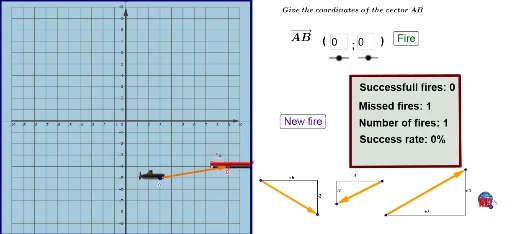
几何画板及绘图内容加载中,请稍等……
这个范例通过模拟海军战斗中的向量运动,展示了向量的基本概念和操作。它涉及向量的加法、减法以及向量的逻辑运算。通过使用GeoGebra命令如Vector、plusk、If等,用户可以直观地理解向量的几何意义和运算规则。适合初中及以上学生学习向量的基础知识。
GeoGebra 命令及参数
Random(-6, 6) → aVector((0, 0), (0, 0.07)) → zVector((0, 0), (0.055, 0)) → wVector((0, 0), (1, 0)) → cVector((0, 0), (0, 1)) → d_1wybuch(C, Vector[(4 * w)], Vector[(2 * z)]) → poly1plusk(C) → liste5If(total ≟ 0, 0, round((100 * reussi / total))) → tauxTextfield(m) → TextechampTextfield(n) → ChampTexte1Vector(A, B) → eElement(liste2, 4) → PPSequence(Segment[(Element[liste2, i], -10), (Element[liste2, i], 10)], i, 1, Length[liste2]) → liste3Sequence(Segment[(-10, Element[liste2, i]), (10, Element[liste2, i])], i, 1, Length[liste2]) → liste4Vector((-10, 0), (10, 0)) → uVector((0, -10), (0, 10)) → vPolygon(AA, BB, 4) → poly2, aa, bb, g, h, E, FPolygon(J, G, H, I) → poly3, j_1, g_1, h_1, i_1Polygon(K, L, M, N) → poly4, k, l, m_1, n_1Vector(O, P) → qLine(O, xAxis) → rLine(P, yAxis) → sIntersect(r, s) → QVector(R, S) → tLine(R, xAxis) → a_1Line(S, bb) → b_1Intersect(b_1, a_1) → TSegment(O, Q) → c_1Segment(P, Q) → e_1Segment(T, R) → f_1Segment(T, S) → k_1Vector(U, V) → u_1Line(U, xAxis) → l_1Line(V, bb) → p_1Intersect(p_1, l_1) → WSegment(U, W) → q_1Segment(W, V) → r_1Midpoint(c_1) → ZMidpoint(f_1) → A_1Midpoint(k_1) → B_1Midpoint(q_1) → C_1Midpoint(r_1) → D_1Midpoint(e_1) → E_1Segment(E - (0, 1.4), F - (0, 1.4)) → s_1