
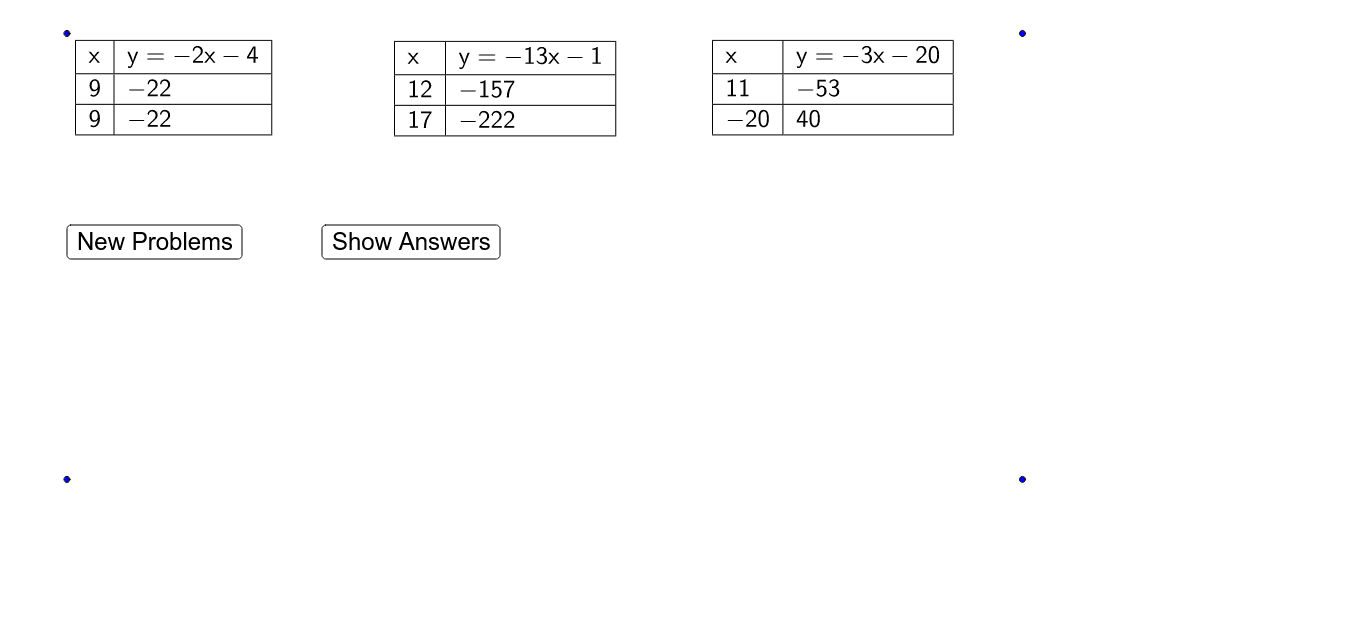
用方程完成表格
几何画板及绘图内容加载中,请稍等……
①本范例演示如何利用方程填充数据表格;②涉及的核心数学概念包括方程、线性方程、计算;③构造摘要中用到了RemoveUndefined, Element, Random, Text, If, FractionText, TableText等GeoGebra命令和对象;④适合初中及以上学生用于理解方程应用和数据处理。
GeoGebra 命令及参数
RemoveUndefined(Sequence[(-21 + i)^(2) / (-21 + i), i, 1, 41]) → numersXElement(numersX, Random[1, 20]) → numerX1Element(numersX, Random[1, 20]) → numerX2Element(numersX, Random[1, 20]) → numerX3Element(numersX, Random[1, 20]) → numerX4Element(numersX, Random[1, 20]) → numerX5Element(numersX, Random[1, 20]) → numerX6Random(-20, 20) → X1ARandom(-20, 20) → X2ARandom(-20, 20) → X3ARandom(-20, 20) → X4ARandom(-20, 20) → X5ARandom(-20, 20) → X6ARandom(-20, 20) → X1BRandom(-20, 20) → X2BRandom(-20, 20) → X3BRandom(-20, 20) → X4BRandom(-20, 20) → X5BRandom(-20, -1) → b1Random(-20, 20) → X6BRandom(-20, -1) → b2Random(-20, -1) → b3Random(-20, -1) → b4Random(-20, -1) → b5Random(-20, -1) → b6Text(abs(numerX2)) → forTextNumber2Text(abs(numerX3)) → forTextNumber3Text(abs(numerX4)) → forTextNumber4Text(abs(numerX5)) → forTextNumber5Text(abs(numerX6)) → forTextNumber6If(numerX1 < 0, " - ", " ") → signX1If(numerX2 < 0, " - ", " ") → signX2If(numerX3 < 0, " - ", " ") → signX3If(numerX4 < 0, " - ", " ") → signX4If(numerX5 < 0, " - ", " ") → signX5If(numerX6 < 0, " - ", " ") → signX6Text(abs(numerX1)) → forTextNumber1Text(denomX1) → forTextDenomX1Text(denomX2) → forTextDenomX2Text(denomX3) → forTextDenomX3Text(denomX4) → forTextDenomX4Text(denomX5) → forTextDenomX5Text(denomX6) → forTextDenomX6If(b1 < 0, " - ", " + ") → signB1If(b2 < 0, " - ", " + ") → signB2If(b3 < 0, " - ", " + ") → signB3If(b4 < 0, " - ", " + ") → signB4If(b5 < 0, " - ", " + ") → signB5If(b6 < 0, " - ", " + ") → signB6Text(X1A) → forTextX1AText(X2A) → forTextX2AText(X3A) → forTextX3AText(X4A) → forTextX4AText(X5A) → forTextX5AText(X6A) → forTextX6AText(X1B) → forTextX1BText(X2B) → forTextX2BText(X3B) → forTextX3BText(X4B) → forTextX4BText(X5B) → forTextX5BText(X6B) → forTextX6BFractionText(y1B) → forTexty1BFractionText(abs(b1)) → forTextb1FractionText(abs(b2)) → forTextb2FractionText(abs(b3)) → forTextb3FractionText(abs(b4)) → forTextb4FractionText(abs(b5)) → forTextb5FractionText(abs(b6)) → forTextb6FractionText(outSide1) → forTextOutSide1FractionText(outSide2) → forTextOutSide2FractionText(outSide3) → forTextOutSide3FractionText(outSide4) → forTextOutSide4FractionText(outSide6) → forTextOutSide6FractionText(outSide5) → forTextOutSide5FractionText(y1A) → forTexty1AFractionText(y2A) → forTexty2AFractionText(y2B) → forTexty2BFractionText(y3A) → forTexty3AFractionText(y3B) → forTexty3BFractionText(y4A) → forTexty4AFractionText(y4B) → forTexty4BFractionText(y5A) → forTexty5AFractionText(y5B) → forTexty5BFractionText(y6A) → forTexty6AFractionText(y6B) → forTexty6BIf(showAnswers ≟ true, forTexty1A, " ") → B2If(showAnswers ≟ true, forTextX1B, " ") → A3If(showAnswers ≟ true, forTexty2A, " ") → E2If(showAnswers ≟ true, forTexty3A, " ") → H2If(showAnswers ≟ true, forTexty4A, " ") → K2If(showAnswers ≟ true, forTexty5A, " ") → N2If(showAnswers ≟ true, forTexty6A, " ") → Q2If(showAnswers ≟ true, forTextX2B, " ") → D3If(showAnswers ≟ true, forTextX3B, " ") → G3If(showAnswers ≟ true, forTextX4B, " ") → J3If(showAnswers ≟ true, forTextX5B, " ") → M3If(showAnswers ≟ true, forTextX6B, " ") → P3TableText({{A1, B1}, {A2, B2}, {A3, B3}}, "|_") → Table1TableText({{G1, H1}, {G2, H2}, {G3, H3}}, "|_") → Table3TableText({{J1, K1}, {J2, K2}, {J3, K3}}, "|_") → Table4TableText({{M1, N1}, {M2, N2}, {M3, N3}}, "|_") → Table5TableText({{P1, Q1}, {P2, Q2}, {P3, Q3}}, "|_") → Table6TableText({{D1, E1}, {D2, E2}, {D3, E3}}, "|_") → Table2