
交通矩阵与流量网络
几何画板及绘图内容加载中,请稍等……
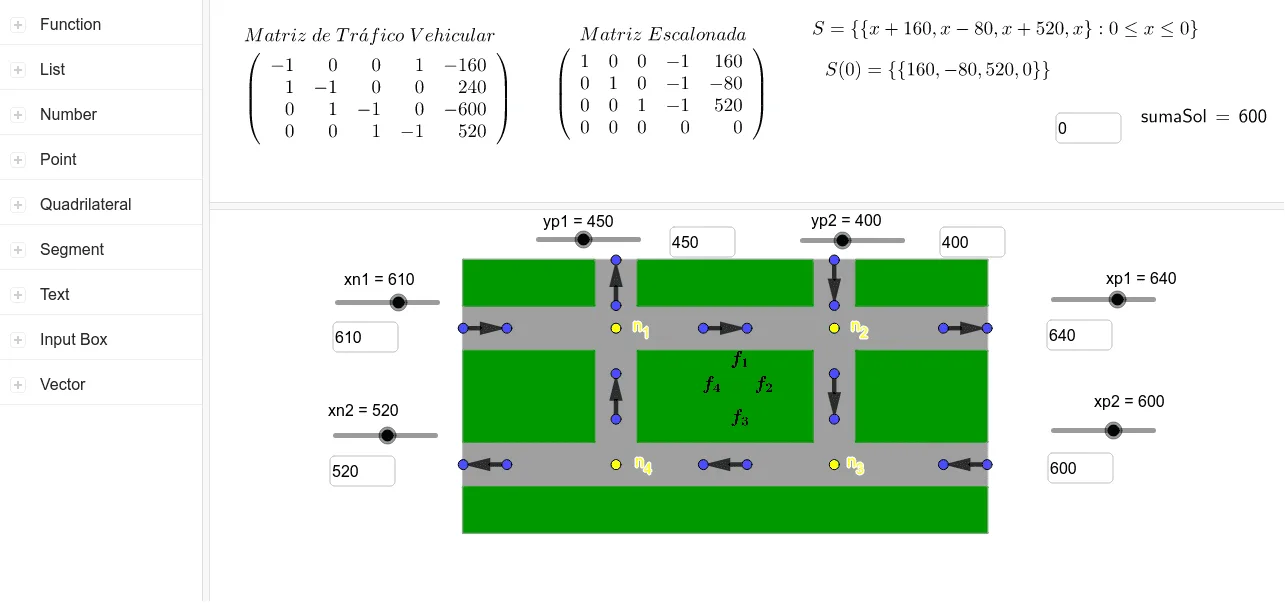
①本范例演示了交通矩阵与流量网络在二维空间中的可视化与计算;②涉及的核心数学概念包括矩阵运算、线性方程、向量与函数;③作图要点提炼自构造摘要,使用了GeoGebra命令如ReducedRowEchelonForm(行简化)、Simplify(化简)、Slope(斜率)、Vector(向量)等,以及对象如xn2, xp2, yp1等;④适合高中及以上数学学习者,用于理解线性代数在交通流分析中的应用。
GeoGebra 命令及参数
ReducedRowEchelonForm(m4) → m5Simplify(Element[m5, 1, 5] - (x * Element[m5, 1, 4])) → f1Simplify(Element[m5, 2, 5] - (x * Element[m5, 2, 4])) → f2Simplify(Element[m5, 3, 5] - (x * Element[m5, 3, 4])) → f3Slope(f1) → mf1Slope(f2) → mf2Slope(f3) → mf3RemoveUndefined(Sequence[If[Element[mL, i] > 0 ∧ Element[bL, i] < 0, Element[Solutions[Element[fL, i]], 1]], i, 1, Length[bL]]) → LminRemoveUndefined(Sequence[If[Element[mL, i] < 0 ∧ Element[bL, i] > 0, Element[Solutions[Element[fL, i]], 1]], i, 1, Length[bL]]) → LmaxIf(Length[Lmin] ≟ 0, 0, Max[Lmin]) → xminIntersect(xAxis, yAxis) → APoint(yAxis) → BPoint(xAxis) → DPoint(yAxis) → EPoint(yAxis) → HPolygon(E, F, G, H) → c2, e, f_1, g, hPoint(yAxis) → IPoint(yAxis) → LPolygon(I, J, K, L) → c3, i, j, k, lPolygon(M, N, O, P) → c4, m, n, o, pPolygon(Q, R, S, T) → c5, q, r, s, tPolygon(U, V, W, Z) → c6, u, v, w, z_1Point(xAxis) → A_1Point(xAxis) → B_1Polygon(E_1, F_1, G_1, H_1) → c8, e_1, g_1, h_1, i_1Polygon(I_1, J_1, K_1, L_1) → c9, j_1, k_1, l_1, m_1Polygon(A, B_1, L_1, L) → c10, a_2, n_5, p_1, l_2Textfield(yp1) → CasillaDeEntrada1Textfield(yp2) → CasillaDeEntrada2Textfield(xn1) → CasillaDeEntrada3Textfield(xn2) → CasillaDeEntrada4Textfield(xp1) → CasillaDeEntrada7Textfield(xp2) → CasillaDeEntrada8Vector(S_1, T_1) → q_1Vector(U_1, V_1) → r_1Sum(l3) → sumaSolLaTeX(sumaSol, true, true) → texto7Textfield(s_n) → CasillaDeEntrada9Vector(P_1, O_1) → v_1Vector(N_1, M_1) → u_1If(Length[Lmax] ≟ 0, If[xmin > 0, 1 / 0, 0], Min[Lmax]) → xmaxVector(G_2, H_2) → t_1Vector(I_2, J_2) → u_2Vector(K_2, L_2) → v_2Vector(F_2, E_2) → w_2Vector(D_2, C_2) → b_2Vector(B_2, A_2) → c_2