
9的乘法表
几何画板及绘图内容加载中,请稍等……
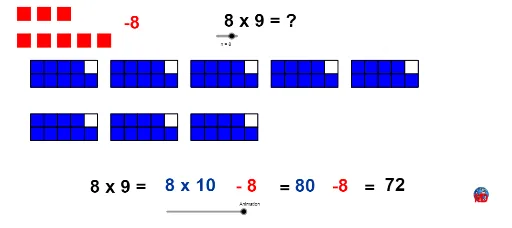
这个范例演示了9的乘法表,通过十位数来展示。核心数学概念包括乘法和数列。使用了Polygon, Sequence, Take, Translate等GeoGebra命令。适合小学高年级或初中学生学习乘法和数列。
GeoGebra 命令及参数
Polygon(A, A + (0.5, 0), A + (0.5, 0.5), A + (0, 0.5)) → q1, a, f, g, hSequence(Sequence[Translate[q1, Vector[(i * Vector[A, A + (0.5, 0)]) + (j * Vector[A, A + (0, 0.5)])]], i, 0, 4], j, 0, 1) → l3Sequence(Translate[l3, Vector[((i - 1) * Vector[A, A + (3, 0)])]], i, 1, If[n ≥ 5, 5, n]) → l3'Polygon(B, B + (0.5, 0), B + (0.5, 0.5), B + (0, 0.5)) → q2, b, i, j, kSequence(Sequence[Translate[q2, Vector[(i * Vector[A, A + (0.5, 0)]) + (j * Vector[A, A + (0, 0.5)])]], i, 0, 4], j, 0, 1) → l1Sequence(Translate[l1, Vector[((i - 1) * Vector[A, A + (3, 0)])]], i, 1, If[n ≤ 5, 0, n - 5]) → l2Take(Join[l3], 1, 9) → l4Take(Join[l1], 1, 9) → l6Sequence(Translate[l6, Vector[((i - 1) * Vector[A, A + (3, 0)])]], i, 1, If[n ≤ 5, 0, n - 5]) → l7Sequence(Translate[l4, Vector[((i - 1) * Vector[A, A + (3, 0)])]], i, 2, If[n ≥ 5, 5, n]) → l5Sequence(Translate[l3, Vector[((i - 1) * Vector[A, A + (3, 0)])]], i, 2, If[n ≥ 5, 5, n]) → l8Sequence(Translate[l1, Vector[((i - 1) * Vector[A, A + (3, 0)])]], i, 1, If[n ≤ 5, 0, n - 5]) → l9Polygon(P - (0.5, 0), P, 4) → poly1, l, m, p, q, H, ITranslate(poly1, Vector[(If[0 < Animation < 3, 0, If[3 < Animation < 10, (Animation - 3) / 7, 1]] * Vector[P, E + (0.5, 0)])]) → poly1'Polygon(J, J + (0.5, 0), 4) → poly2, r, s, t, c, K, LTranslate(poly2, Vector[(If[0 < Animation < 3, 0, If[3 < Animation < 10, (Animation - 3) / 7, 1]] * Vector[J, G])]) → poly2'Polygon(Q - (0.5, 0), Q, 4) → poly3, d, e, f_1, g_1, M, NTranslate(poly3, Vector[(If[0 < Animation < 3, 0, If[3 < Animation < 10, (Animation - 3) / 7, 1]] * Vector[Q, D])]) → poly3'Polygon(R - (0.5, 0), R, 4) → poly4, h_1, i_1, j_1, k_1, T, UTranslate(poly4, Vector[(If[0 < Animation < 3, 0, If[3 < Animation < 10, (Animation - 3) / 7, 1]] * Vector[R, O + (0.5, 0)])]) → poly4'Polygon(S - (0.5, 0), S, 4) → poly5, l_1, m_1, n_1, p_1, W, ZTranslate(poly5, Vector[(If[0 < Animation < 3, 0, If[3 < Animation < 10, (Animation - 3) / 7, 1]] * Vector[S, V + (0.5, 0)])]) → poly5'Polygon(I_1 - (0.5, 0), I_1, 4) → poly6, q_1, r_1, s_1, t_1, A_1, B_1Translate(poly6, Vector[(If[0 < Animation < 3, 0, If[3 < Animation < 10, (Animation - 3) / 7, 1]] * Vector[I_1, D_1])]) → poly6'Polygon(J_1 - (0.5, 0), J_1, 4) → poly7, a_1, b_1, c_1, d_1, C_1, N_1Translate(poly7, Vector[(If[0 < Animation < 3, 0, If[3 < Animation < 10, (Animation - 3) / 7, 1]] * Vector[J_1, E_1])]) → poly7'Polygon(K_1 - (0.5, 0), K_1, 4) → poly8, e_1, f_2, g_2, h_2, O_1, P_1Translate(poly8, Vector[(If[0 < Animation < 3, 0, If[3 < Animation < 10, (Animation - 3) / 7, 1]] * Vector[K_1, F_1])]) → poly8'Polygon(L_1 - (0.5, 0), L_1, 4) → poly9, i_2, j_2, k_2, l_2, Q_1, R_1Translate(poly9, Vector[(If[0 < Animation < 3, 0, If[3 < Animation < 10, (Animation - 3) / 7, 1]] * Vector[L_1, G_1])]) → poly9'Polygon(M_1 - (0.5, 0), M_1, 4) → poly10, m_2, n_2, p_2, q_2, S_1, T_1Translate(poly10, Vector[(If[0 < Animation < 3, 0, If[3 < Animation < 10, (Animation - 3) / 7, 1]] * Vector[M_1, H_1])]) → poly10'