
立体投影
几何画板及绘图内容加载中,请稍等……
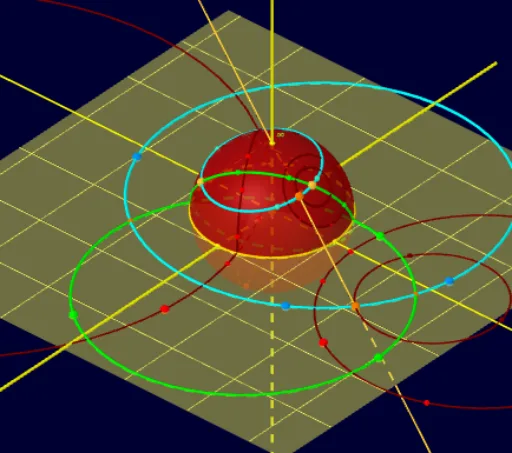
这个范例演示了立体投影的概念。它涉及立体几何中的关键数学概念,如球面、平面和投影线。通过使用GeoGebra命令如Circle、Line、Sphere和Intersect,用户可以直观地理解立体投影的原理。适合高中或大学的立体几何课程。
GeoGebra 命令及参数
Intersect(xAxis, yAxis) → ACircle(A, B) → cPoint(c) → CPoint(c) → DLine(C, D) → fPoint(c) → ELine(E, A) → gPoint(zAxis) → FSphere(A, F) → aOrthogonalLine(F, xOyPlane) → hCircle(G, H, I) → dCircle(J, K, L) → eIntersect(e, d) → M, N, ,Point(e) → OLine(O, F) → iIntersect(i, a, 1) → PLine(J, F) → jLine(K, F) → kLine(L, F) → lIntersect(l, a) → T, UIntersect(k, a) → V, WIntersect(j, a) → Z, A_1Plane(V, Z, T) → bIntersectPath(b, a) → pLine(H, F) → mLine(G, F) → nLine(I, F) → qIntersect(n, a) → Q, RIntersect(q, a) → S, B_1Intersect(m, a) → C_1, D_1Plane(S, Q, C_1) → oIntersectPath(o, a) → rLine(N, F) → tIntersect(r, p, 2) → E_1Line(F, M) → f_1Intersect(r, p, 1) → F_1IntersectPath(o, b) → g_1Mirror(G_1, d) → H_1Mirror(H_1, e) → I_1Mirror(G_1, e) → J_1Circle(I_1, J_1, G_1) → c_1Mirror(K_1, d) → L_1Mirror(L_1, e) → M_1Mirror(K_1, e) → N_1Circle(K_1, L_1, M_1) → d_1Line(L_1, F) → h_1Line(M_1, F) → i_1Line(N_1, F) → j_1Line(H_1, F) → k_1Line(I_1, F) → l_1Line(J_1, F) → m_1Intersect(h_1, a, 1) → O_1Intersect(k_1, a, 1) → P_1Intersect(l_1, a, 1) → Q_1Intersect(m_1, a, 1) → R_1Plane(R_1, Q_1, P_1) → w_1IntersectPath(w_1, a) → e_1Intersect(i_1, a, 1) → S_1Intersect(j_1, a, 1) → T_1Plane(O_1, S_1, C_1) → a_1Plane(T_1, S_1, O_1) → b_1IntersectPath(b_1, a) → p_1Intersect(c_1, d_1) → U_1, V_1, ,Intersect(e_1, p_1) → W_1, Z_1, ,Line(W_1, Z_1) → n_1IntersectPath(b, o) → q_1LaTeX(V_1, true, true) → Text1Circle(O, V_1, U_1) → s_1Tangent(O, e) → f_2,Mirror(O, d) → O'LineBisector(O, O') → g_2Intersect(f_2, g_2) → B_2Circle(B_2, O) → c_2Mirror(O', e) → O''Line(F, O'') → h_2Line(F, O') → i_2Intersect(i_2, a, 2) → C_2Intersect(h_2, a, 2) → D_2Plane(P, D_2, C_2) → o_1IntersectPath(o_1, a) → r_1IntersectPath(b_1, o_1) → j_2IntersectPath(o_1, b_1) → k_2IntersectPath(b_1, o_1) → l_2IntersectPath(o_1, b_1) → m_2IntersectPath(o_1, b_1) → n_2IntersectPath(o_1, b_1) → p_2IntersectPath(o_1, a_1) → q_2Plane(Q_1, R_1, Q) → u_1IntersectPath(o_1, u_1) → r_2Line(F, K_1) → s_2Intersect(s_2, p_1, 1) → A_2Plane(T_1, A_2, O_1) → v_1IntersectPath(o_1, v_1) → t_2