
通过三个数据点求解二次方程
几何画板及绘图内容加载中,请稍等……
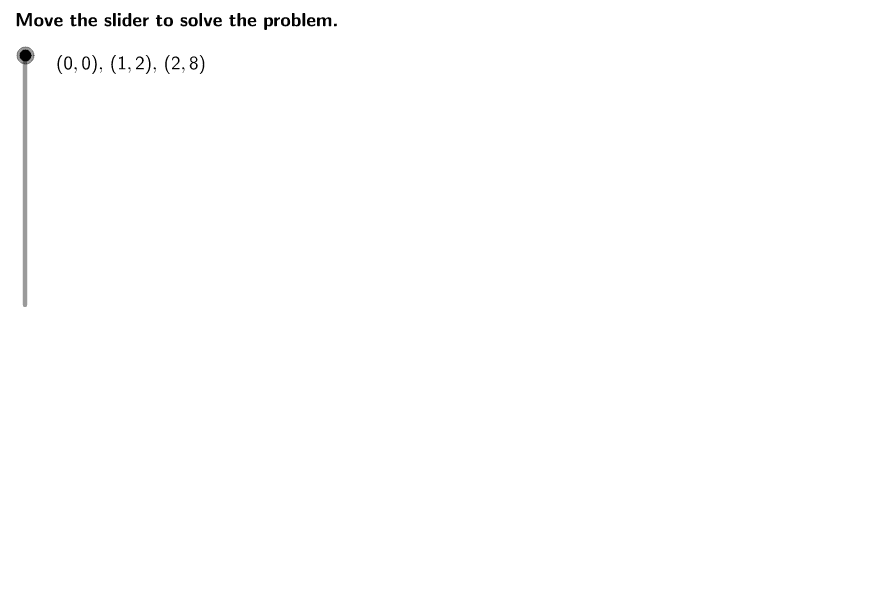
①本范例演示如何通过三个数据点(0,0), (1,2), (2,8)求解一个二次方程;②涉及的核心数学概念包括二次函数、方程组求解、解析几何;③作图要点提炼自构造摘要,使用了LaTeX, If, TableText等GeoGebra命令/对象进行条件判断和文本显示;④适合高中阶段学习二次函数和方程组的学生使用。
GeoGebra 命令及参数
LaTeX(steps) → counterLaTeX("\text{Use the buttons below to return to the original problem or}\cr\text{randomly generate a similar practice problem.}") → RandomizationTextLaTeX("\text{Use the given data points to write three equations using the standard form of a}\cr\text{quadratic equation.}") → text1LaTeX(((((A * "\text{, }") * B) * "\text{, }") * C)) → ProblemLaTeX("\text{Substitute the }\textcolor{#000099}{x}\text{- and }\textcolor{#000099}{y}\text{-values from each of the three data points into }\cr\textcolor{#000099}{y=ax^2 +bx+c}\text{ and simplify.}") → text2If(x(A) ≟ 0, LaTeX[""], If[x(A) ≟ 1, LaTeX["-b"], If[x(A) ≟ -1, LaTeX["+b"], LaTeX[(Simplify[(-x(A))] * "b")]]]) → cbIf(x(A) ≟ 0, LaTeX[""], If[x(A) ≟ 1, LaTeX["-a"], If[x(A) ≟ -1, LaTeX["-a"], LaTeX[(Simplify[(-x(A)^(2))] * "a")]]]) → caIf(y(A) ≟ 0, LaTeX[""], If[y(A) ≟ 1, LaTeX["1"], If[y(A) ≟ -1, LaTeX["-1"], LaTeX[y(A)]]]) → cyIf(x(A) + y(A) ≟ 0, LaTeX["0"], LaTeX[""]) → cfixLaTeX("\text{Substitute }\textcolor{#000099}{c}\text{ and }\textcolor{#000099}{b}\text{ from the previous steps into the equation using the third}\cr\text{point and solve for }\textcolor{#000099}{a}.") → text7LaTeX("\text{Substitute the value of }\textcolor{#000099}{a}\text{ into the equation for }\textcolor{#000099}{b}\text{ to find the value for }\textcolor{#000099}{b}.") → text10LaTeX((("\textcolor{#000099}{b=" * b) * "}")) → text11LaTeX("\text{Substitute the values for }\textcolor{#000099}{a}\text{ and }\textcolor{#000099}{b}\text{ into the formula for }\textcolor{#000099}{c}\text{ to find the value for }\textcolor{#000099}{c}.") → text12LaTeX((("\textcolor{#000099}{c=" * c) * "}")) → text13LaTeX("\text{Use the values determined for }\textcolor{#000099}{a}\text{, }\textcolor{#000099}{b}\text{, and }\textcolor{#000099}{c}\text{ to write the quadratic equation that is}\cr\text{true for the three data points.}") → text14LaTeX((((((("\text{Substitute }\textcolor{#000099}{a = " * a) * "}\text{, }\textcolor{#000099}{b = ") * b) * "}\text{, and }\textcolor{#000099}{c = ") * c) * "}\text{ into the standard form of a quadratic}\cr\text{equation and simplify.}")) → text15LaTeX("\text{Check the resulting equation by substituting the x- and y-values from each of the}\cr\text{three data points to see if a true statement results. All three data points should}\cr\text{produce true statements.}") → text17LaTeX((("\text{All three data points produce true statements for }\textcolor{#000099}{y = " * f) * "}.")) → text19TableText({{LaTeX[("\text{For }" * A)], LaTeX[("\text{For }" * B)], LaTeX[("\text{For }" * C)]}, {LaTeX[(("\textcolor{#000099}{y=" * f) * "}")], LaTeX[(("\textcolor{#000099}{y=" * f) * "}")], LaTeX[(("\textcolor{#000099}{y=" * f) * "}")]}, {LaTeX[(((("\textcolor{#000099}{" * y(A)) * "=") * f(x(A))) * "}")], LaTeX[(((("\textcolor{#000099}{" * y(B)) * "=") * f(x(B))) * "}")], LaTeX[(((("\textcolor{#000099}{" * y(C)) * "=") * f(x(C))) * "}")]}}) → text18LaTeX((("\text{Substitute }\textcolor{#000099}{" * x4) * "}\text{ for }\textcolor{#000099}{x}\text{ in the equation and solve for }\textcolor{#000099}{y}.")) → text22LaTeX((((("\textcolor{#000099}{y=" * f) * "}\cr\textcolor{#000099}{y=") * f(x4)) * "}")) → text23LaTeX((((("\text{The fourth point is }\textcolor{#000099}{(" * x4) * ",") * f(x4)) * ")}.")) → text24TableText({{LaTeX[("\text{For }" * A)], LaTeX[("\text{For }" * B)], LaTeX[("\text{For }" * C)]}, {LaTeX["\textcolor{#000099}{y=ax^2+bx+c}"], LaTeX["\textcolor{#000099}{y=ax^2+bx+c}"], LaTeX["\textcolor{#000099}{y=ax^2+bx+c}"]}, {LaTeX[(((((("\textcolor{#000099}{" * y(A)) * "=a(") * x(A)) * ")^2+b(") * x(A)) * ")+c}")], LaTeX[(((((("\textcolor{#000099}{" * y(B)) * "=a(") * x(B)) * ")^2+b(") * x(B)) * ")+c}")], LaTeX[(((((("\textcolor{#000099}{" * y(C)) * "=a(") * x(C)) * ")^2+b(") * x(C)) * ")+c}")]}, {LaTeX[(((((("\textcolor{#000099}{c=" * y(A)) * "-a(") * x(A)) * ")^2-b(") * x(A)) * ")}")], LaTeX[""], LaTeX[""]}}) → text3LaTeX("\text{Move the slider to solve the problem.}") → text0LaTeX("\text{If we designate the three given points from left to right as }\textcolor{#000099}{(x_1,y_1)}\text{, }\textcolor{#000099}{(x_2,y_2)}\text{, }\cr\text{and }\textcolor{#000099}{(x_3,y_3)}\text{, then the general formula for }\textcolor{#000099}{b}\text{ is }\cr\textcolor{#000099}{b=\frac{y_2-y_1-a[(x_2)^2-(x_1)^2]}{x_2-x_1}}.") → text5LaTeX((((((((((((((((((("\text{Substituting in the given values gives }\textcolor{#000099}{b=\frac{(" * y(B)) * ")-(") * y(A)) * ")-a[(") * x(B)) * ")^2-(") * x(A)) * ")^2]}{(") * x(B)) * ")-(") * x(A)) * ")}=\frac{") * y2my1) * "-a(") * x2mx1sq) * ")}{") * x2mx1) * "}}.")) → text6LaTeX("\text{The general formula for }\textcolor{#000099}{a}\text{ is }\textcolor{#000099}{a=\frac{(y_3-y_1)(x_2-x_1)-(y_2-y_1)(x_3-x_1)}{[(x_3)^2-(x_1)^2](x_2-x_1)-(x_3-x_1)[(x_2)^2-(x_1)^2]}}.") → text8TableText({{LaTeX["\textcolor{#000099}{y=ax^2+bx+c}"], LaTeX["\text{Standard form of a quadratic equation}"]}, {LaTeX[(((((("\textcolor{#000099}{y=(" * a) * ")x^2+(") * b) * ")x+(") * c) * ")}")], LaTeX[(((((("\text{Substitute }\textcolor{#000099}{" * a) * "}\text{ for }\textcolor{#000099}{a}\text{, }\textcolor{#000099}{") * b) * "}\text{ for }\textcolor{#000099}{b}\text{, and }\textcolor{#000099}{") * c) * "}\text{ for }\textcolor{#000099}{c}.")]}, {LaTeX[(("\textcolor{#000099}{y=" * f) * "}")], LaTeX["\text{Simplify.}"]}}) → text16LaTeX((("\text{Use the resulting quadratic equation model for the three given points to predict}\cr\text{the location of a fourth point for which }\textcolor{#000099}{x = " * x4) * "}.")) → text20LaTeX("\text{Substitute the value for }\textcolor{#000099}{c}\text{ found from the first point into the equation from the second}\cr\text{point and solve for }\textcolor{#000099}{b}.") → text4LaTeX((((((((((((((((((((((((((((((((((("\text{Substitute values using the given points. }\cr\textcolor{#000099}{a=\frac{[" * y(C)) * "-(") * y(A)) * ")][") * x(B)) * "-(") * x(A)) * ")]-[") * y(B)) * "-(") * y(A)) * ")][") * x(C)) * "-(") * x(A)) * ")]}{[(") * x(C)) * ")^2-(") * x(A)) * ")^2][") * x(B)) * "-(") * x(A)) * ")]-[") * x(C)) * "-(") * x(A)) * ")][(") * x(B)) * ")^2-(") * x(A)) * ")^2]}=") * a) * "}")) → text9LaTeX((("\text{Since }\textcolor{#000099}{y = " * f) * "}\text{ is true for all three given points, it will be true for all other}\cr\text{points on the graph. Therefore, the equation can be used to predict other points.}")) → text21
AI 绘图提示语参考
画一个包含三个数据点 (0,0), (1,2), (2,8) 的图形,并展示如何通过这些点求解一个二次方程。首先标出这三个点,然后绘制一条通过它们的二次曲线。接着,在旁边用数学公式和步骤展示如何通过代入这些点的坐标到二次方程的标准形式 y=ax^2+bx+c 中,解出系数 a、b、c 的值。最后,将求得的系数代入方程,验证曲线确实通过所有三个点,并展示如何用该方程预测第四个点的位置。
以上提示语为根据原始绘图命令整理而来,仅供参考。