
二元一次方程的解
几何画板及绘图内容加载中,请稍等……
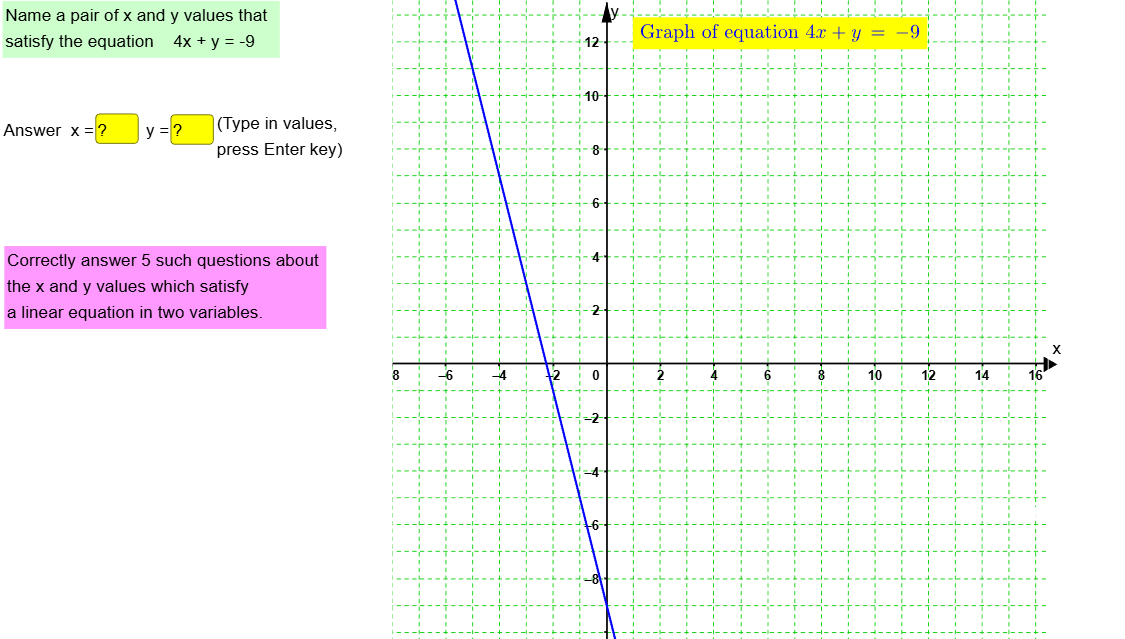
本范例演示如何找到满足给定二元一次方程的x和y值。核心数学概念包括二元一次方程及其解。使用了GeoGebra命令如TextToUnicode、IndexOf、If等进行数值处理和方程求解。适合初中及以上学生学习。
GeoGebra 命令及参数
TextToUnicode(usertxtanswery) → listdigitsyIndexOf(46, listdigitsy) → yindexofdecimalpointIndexOf(47, listdigitsy) → yindexofdivisorIf(Element[listdigitsy, 1] ≟ 45, 2, 1) → ystartindexIf(Defined[IndexOf[32, listdigitsy]], IndexOf[32, listdigitsy], ystartindex - 1) → yindexofspaceIf(Defined[yindexofdivisor], Sum[(If[Element[listdigitsy, 1] ≟ 45, -1, 1] * Sequence[((Element[listdigitsy, i] - 48) * 10^(yindexofspace - 1 - i)), i, ystartindex, yindexofspace - 1])], If[Defined[yindexofdecimalpoint], (If[Element[listdigitsy, 1] ≟ 45, -1, 1] * Sum[Sequence[((Element[listdigitsy, i] - 48) * 10^(yindexofdecimalpoint - 1 - i)), i, ystartindex, yindexofdecimalpoint - 1]]), 0]) → ywholepartLength(listdigitsy) → ylengthlistdigitsSum(Sequence[((Element[listdigitsy, i] - 48) * 10^(ylengthlistdigits - i)), i, ydenomstartindex, ylengthlistdigits]) → ydenomIf(Defined[yindexofdivisor], ynumer / ydenom, If[Defined[yindexofdecimalpoint], (If[Element[listdigitsy, 1] ≟ 45, -1, 1] * Sum[Sequence[((Element[listdigitsy, i] - 48) * 10^(ylengthlistdigits - i)), i, yindexofdecimalpoint + 1, ylengthlistdigits]] / 10^(ylengthlistdigits - yindexofdecimalpoint)), 0]) → ydecimalpartTextToUnicode(usertxtanswerx) → listdigitsxIndexOf(46, listdigitsx) → xindexofdecimalpointIf(Element[listdigitsx, 1] ≟ 45, 2, 1) → xstartindexIf(Defined[IndexOf[32, listdigitsx]], IndexOf[32, listdigitsx], xstartindex - 1) → xindexofspaceLength(listdigitsx) → xlengthlistdigitsIndexOf(47, listdigitsx) → xindexofdivisorSum(Sequence[((Element[listdigitsx, i] - 48) * 10^(xlengthlistdigits - i)), i, xdenomstartindex, xlengthlistdigits]) → xdenomIf(Defined[xindexofdivisor], xnumer / xdenom, If[Defined[xindexofdecimalpoint], (If[Element[listdigitsx, 1] ≟ 45, -1, 1] * Sum[Sequence[((Element[listdigitsx, i] - 48) * 10^(xlengthlistdigits - i)), i, xindexofdecimalpoint + 1, xlengthlistdigits]] / 10^(xlengthlistdigits - xindexofdecimalpoint)), 0]) → xdecimalpartIf(Defined[xindexofdivisor], Sum[(If[Element[listdigitsx, 1] ≟ 45, -1, 1] * Sequence[((Element[listdigitsx, i] - 48) * 10^(xindexofspace - 1 - i)), i, xstartindex, xindexofspace - 1])], If[Defined[xindexofdecimalpoint], (If[Element[listdigitsx, 1] ≟ 45, -1, 1] * Sum[Sequence[((Element[listdigitsx, i] - 48) * 10^(xindexofdecimalpoint - 1 - i)), i, xstartindex, xindexofdecimalpoint - 1]]), 0]) → xwholepartRandomElement({-1, 1, 2, -2, -3, 3, 4, -4, -1, 1, -2, 2, 5, -5, -1, 1}) → a_1RandomElement({0, -1, 1, 2, -2, -3, 3, 0, -1, 1, -2, 2, 4, -4, 0, -1, 1, -2, 2, 5, -5, 0, -1, 1, -2, 2}) → n_3RandomElement({-1, 0, 1, 2, -2, 0, -3, 3}) → x_gRandomElement({-1, 1, 2, -2, -3, 3, 4, -4, -1, 1, -2, 2, 5, -5, -1, 1}) → b_1If(Defined[xindexofdivisor], xdecimalpart + xwholepart, If[Defined[xindexofdecimalpoint], xdecimalpart + xwholepart, Sum[(If[Element[listdigitsx, 1] ≟ 45, -1, 1] * Sequence[((Element[listdigitsx, i] - 48) * 10^(xlengthlistdigits - i)), i, xstartindex, xlengthlistdigits])]]) → xuseranswerIf(Defined[yindexofdivisor], ydecimalpart + ywholepart, If[Defined[yindexofdecimalpoint], ydecimalpart + ywholepart, Sum[(If[Element[listdigitsy, 1] ≟ 45, -1, 1] * Sequence[((Element[listdigitsy, i] - 48) * 10^(ylengthlistdigits - i)), i, ystartindex, ylengthlistdigits])]]) → yuseranswerSimplify(If[-8 ≤ x ≤ 16, ((-(x(e_n) / y(e_n))) * x) - z(e_n) / y(e_n)]) → fSequence(abs(f(0) - (a_1 / b_1 * i) - round(f(0) - (a_1 / b_1 * i), 0)), i, 0, abs(b_1 - 1)) → listsearch1stinteger, {0}Sort(Sequence[xInty + (b_1 * i), i, -2, 2, 1]) → listxnoRandomElement({1, 2, 3, 4}) → shiftpostyJoin({{x}, listxno}) → listxRandomElement(Remove[{1, 2, 3, 4}, {shiftposty}]) → shiftpostxRemove(listx, {Element[listx, shiftpostx + 1]}) → listprexJoin({{y}, (m * listx) + d}) → listyRemove(listy, {Element[listy, shiftposty + 1]}) → listpreyInsert("p", listprey, shiftposty + 1) → listypostElement(listy, shiftposty + 1) → answerpElement(listx, shiftposty + 1) → x_pGCD({a_1, b_1, c_1}) → c_gInsert("q", listprex, shiftpostx + 1) → listxpostTableText({listxpost, listypost}, "c_|h") → txtTableValuesElement(listy, shiftpostx + 1) → y_qTextfield(usertxtanswerx) → InputBox1Textfield(usertxtanswery) → InputBox2Element(listx, shiftpostx + 1) → answerqMin(Min[listyno] - ((Max[listyno] - Min[listyno]) * 0.1), -2) → yMinMax(Max[listyno] + ((Max[listyno] - Min[listyno]) * 0.1), 2) → yMaxMin(Min[listxno] - ((Max[listxno] - Min[listxno]) * 0.2), -2) → xMinMax(Max[listxno] + ((Max[listxno] - Min[listxno]) * 0.2), 2) → xMaxPoint(e_n) → EPolygon((x(P_{xaxisarrow}), y(Corner[2])), Corner[2], (x(Corner[2]), y(Corner[4]) + 4), (x(P_{xaxisarrow}), y(Corner[4]) + 4)) → Whiteboxright, g, j, k, lPolygon(Corner[1], (-8, y(Corner[1])), (-8, y(Corner[4]) + 4), Corner[4] + 4) → Whiteboxleft, c, e, h, iVector(P_{feedbackanchor1}, P_{useranswer}) → pIf(abs(yuseranswer - f(xuseranswer)) < 0.0001, true, false) → answersbothcorrectCoordPointertoAxes7(E) → u, v, text3, text4, text5, text6, text7, A, BDefined(xindexofspace) → isMixedNumberIf(abs(yuseranswer - f(xuseranswer)) < 0.001, true, false) → yanswerapproxtrueforxSequence(Translate[badge, Vector[(0, 0), ((2 * j), 0)]], j, 1, score) → listbadgepicsIndexOf(Min[listynoabs], listynoabs) → listynominindexIf(Defined[Element[listyno, listynominindex + 1]], listynominindex + 1, listynominindex - 1) → listynochosenindexPathParameter(E) → a
AI 绘图提示语参考
绘制一个坐标系,显示多条直线及其交点。随机生成一组线性方程的系数,计算并标出满足方程的 x 和 y 值。在坐标系中标出这些交点,并用表格列出对应的 x 和 y 值。调整坐标轴范围以清晰显示所有交点,确保图形适合中学生理解线性方程的解。
以上提示语为根据原始绘图命令整理而来,仅供参考。