
有理数集合
几何画板及绘图内容加载中,请稍等……
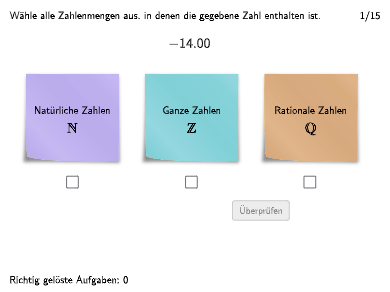
本范例演示有理数集合的概念,涉及有理数的比较与排序,以及在数轴上的表示。使用了Join, Sequence, Zip等GeoGebra命令。适合初中7-8年级学生学习。
GeoGebra 命令及参数
Join({Sequence[Q0 + (m * (absnotes, 0)), m, 0, 2], {(0, -5), (0, -5), (0, -5)}}) → listPointsNotesSequence(Random[1, 1], m, 1, 110) → listCorrect1, {1, 1, 1, 1, 1, 1, 1, 1, 1, 1, 1, 1, 1, 1, 1, 1, 1, 1, 1, 1, 1, 1, 1, 1, 1, 1, 1, 1, 1, 1, 1, 1, 1, 1, 1, 1, 1, 1, 1, 1, 1, 1, 1, 1, 1, 1, 1, 1, 1, 1, 1, 1, 1, 1, 1, 1, 1, 1, 1, 1, 1, 1, 1, 1, 1, 1, 1, 1, 1, 1, 1, 1, 1, 1, 1, 1, 1, 1, 1, 1, 1, 1, 1, 1, 1, 1, 1, 1, 1, 1, 1, 1, 1, 1, 1, 1, 1, 1, 1, 1, 1, 1, 1, 1, 1, 1, 1, 1, 1, 1}Zip(RandomElement[{2, 2} \ {m}], m, listCorrect1) → listCorrect2Flatten(Join[{{7, 15, 8}, Shuffle[(1…15) \ {7, 15, 8}], Sequence[Shuffle[1…15], i, 1, 9]}]) → listExnumsIf(listsolhelp ≟ {0, 0, 1}, RandomElement[{{1, 3, 2}, {2, 3, 1}, {3, 2, 1}, {3, 1, 2}}], If[listsolhelp ≟ {0, 1, 1}, RandomElement[{{2, 1, 3}, {2, 3, 1}, {3, 1, 2}, {3, 2, 1}}], {1, 2, 3}]) → listChangedPositionsIf(shuffle, IndexOf[1, listChangedPositions], listCorrect1(Mod[questionCount, 100] + 1)) → posC1If(shuffle, IndexOf[2, listChangedPositions], listCorrect2(Mod[questionCount, 100] + 1)) → posC2RemoveUndefined({If[selected1, 1], If[selected2, 2], If[selected3, 3]}) → listselectedZip(RandomElement[{3, 3} \ {m, n}], m, listCorrect1, n, listCorrect2) → listCorrect3If(shuffle, IndexOf[3, listChangedPositions], listCorrect3(Mod[questionCount, 100] + 1)) → posC3RemoveUndefined({If[listsolhelp(1) ≟ 1, posC1], If[listsolhelp(2) ≟ 1, posC2], If[listsolhelp(3) ≟ 1, posC3]}) → listsolSequence(Random[1, 4], m, 1, 110) → listNote1, {4, 4, 1, 1, 3, 2, 3, 2, 4, 4, 1, 4, 3, 1, 3, 1, 3, 2, 4, 2, 1, 2, 2, 3, 4, 3, 2, 4, 2, 1, 2, 1, 1, 4, 3, 2, 2, 2, 4, 1, 4, 2, 4, 1, 2, 1, 4, 4, 4, 4, 1, 4, 1, 2, 2, 1, 1, 3, 4, 3, 1, 3, 1, 4, 1, 2, 3, 4, 2, 3, 3, 2, 3, 3, 4, 3, 4, 4, 1, 3, 2, 2, 4, 2, 3, 1, 3, 1, 2, 3, 2, 4, 4, 2, 2, 1, 4, 1, 2, 1, 4, 3, 3, 2, 4, 1, 2, 3, 3, 3}Zip(RandomElement[{5} \ {m}], m, listNote1) → listNote2Zip(RandomElement[{1, 2, 3, 4} \ {m, n}], m, listNote1, n, listNote2) → listNote3Zip(RandomElement[{1, 2, 3, 4} \ {m, n, j}], m, listNote1, n, listNote2, j, listNote3) → listNote4Sequence(P0 + (m * (abstext, 0)), m, 0, 2) → listPointsTextZip(RandomElement[{1, 2, 3} \ {m, n}], m, listCorrect1, n, listCorrect2) → listWrong3Textfield(input1) → InputBox1Textfield(input2) → InputBox2Polygon(PtopLeftCornerFeedback, PtopRightCornerFeedback, PbottomRightCornerFeedback, PbottomLeftCornerFeedback) → rectangleCorrect, rectangleCorrectS3, rectangleCorrectS4, rectangleCorrectS2, rectangleCorrectS1Shuffle(Sequence[Random[0, 10], i, 1, 100]) → randomNosForX, {1, 1, 7, 5, 4, 4, 8, 5, 10, 3, 0, 1, 9, 9, 4, 3, 7, 8, 5, 6, 5, 5, 3, 1, 5, 4, 3, 8, 2, 7, 7, 6, 7, 7, 3, 9, 1, 0, 0, 9, 0, 6, 6, 7, 8, 5, 6, 8, 5, 7, 2, 0, 8, 0, 7, 5, 10, 3, 0, 5, 6, 0, 7, 4, 5, 6, 4, 0, 2, 9, 0, 3, 0, 6, 10, 6, 3, 1, 10, 10, 10, 4, 8, 7, 3, 1, 4, 9, 9, 4, 6, 0, 1, 7, 5, 6, 5, 6, 3, 2}Shuffle(Sequence[Random[0, 10], i, 1, 100]) → randomNosForY, {2, 0, 7, 10, 2, 10, 9, 8, 6, 0, 7, 0, 10, 2, 10, 4, 2, 8, 5, 5, 1, 7, 8, 9, 10, 2, 1, 0, 9, 7, 2, 8, 9, 3, 7, 2, 8, 1, 0, 3, 1, 0, 1, 2, 0, 3, 9, 0, 3, 4, 2, 1, 3, 0, 0, 10, 5, 2, 7, 5, 3, 2, 0, 2, 6, 8, 1, 3, 2, 7, 0, 2, 6, 3, 8, 5, 7, 6, 10, 3, 9, 7, 7, 8, 2, 6, 5, 9, 3, 5, 3, 0, 8, 9, 1, 9, 9, 6, 10, 0}Append(true, Sequence[If[randomNosForX(i) ≟ randomNosForX(i - 1), false, true], i, 2, 100]) → stayXAppend(true, Sequence[If[randomNosForY(i) ≟ randomNosForY(i - 1), false, true], i, 2, 100]) → stayYRemove(Sequence[If[stayX(i), randomNosForX(i), 0], i, 1, 100], Sequence[0, i, 1, 100]) → randomNosForXwithoutRepeatRemove(Sequence[If[stayY(i), randomNosForY(i), 0], i, 1, 100], Sequence[0, i, 1, 100]) → randomNosForYwithoutRepeatElement(randomNosForXwithoutRepeat, Mod[questionCount, Length[randomNosForXwithoutRepeat]] + 1) → numXwithoutRepeatElement(randomNosForYwithoutRepeat, Mod[questionCount, Length[randomNosForYwithoutRepeat]] + 1) → numYwithoutRepeatNumberSeparationComma(numX) → Text3NumberSeparationComma(numY) → Text4NumberSeparationComma(numZ) → Text5Zip(RandomElement[{6} \ {m, n, j, l}], m, listNote1, n, listNote2, j, listNote3, l, listNote4) → listNote5Zip(RandomElement[{1, 2, 3, 4} \ {m, n, j, l, k}], m, listNote5, listNote1, n, listNote2, j, listNote3, l, listNote4, k) → listNote6Length(listsol) → numSolText(numAHelpText, midPointQuestionNumber, true, true, 0, 0) → Text1Defined(IndexOf[IndexOf[3, listChangedPositions], listselected]) → selectedShuffle3Defined(IndexOf[IndexOf[2, listChangedPositions], listselected]) → selectedShuffle2Defined(IndexOf[IndexOf[1, listChangedPositions], listselected]) → selectedShuffle1
AI 绘图提示语参考
在坐标系中展示有理数集合,用不同颜色标记有理数点,并在数轴上表示它们的位置。随机生成多个有理数点,用线条连接它们,形成数轴上的分布。部分点用特殊符号标注,并随机调整顺序,展示有理数的比较和排序。背景包含随机生成的数字和符号,以及一些辅助文本说明。
以上提示语为根据原始绘图命令整理而来,仅供参考。