
金字塔剖分
几何画板及绘图内容加载中,请稍等……
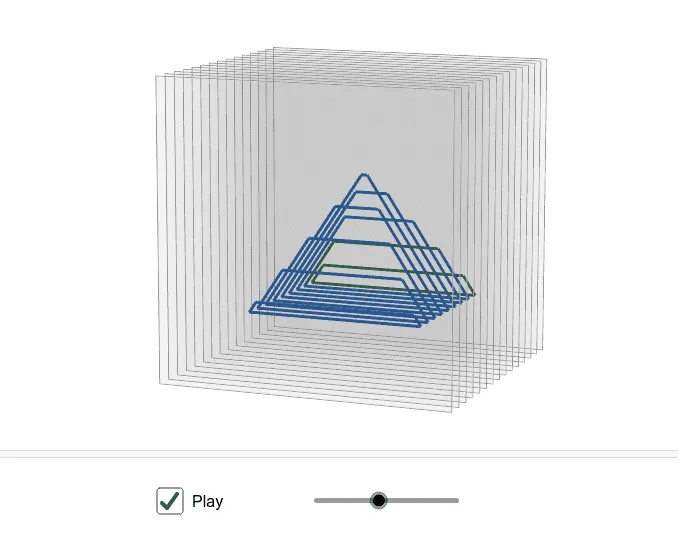
①本范例演示金字塔的几何剖分与艺术化呈现;②涉及的核心数学概念包括立体几何、参数方程、函数图像与几何作图;③作图要点提炼自构造摘要,使用了Polygon(多边形)、Translate(平移)、Plane(平面)、Centroid(质心)、Pyramid(金字塔)、IntersectPath(路径相交)等GeoGebra命令与对象;④适合高中及以上学段,用于学习立体几何构造、参数方程应用及优化问题。
GeoGebra 命令及参数
Polygon(A, B, D, C) → p0, a, b, d, cTranslate(p0, Vector[(0, -1, 0), (0, (2 / n * (1 - 1)) - 1, 0)]) → P1Translate(p0, Vector[(0, -1, 0), (0, (2 / n * (2 - 1)) - 1, 0)]) → P2Translate(p0, Vector[(0, -1, 0), (0, (2 / n * (3 - 1)) - 1, 0)]) → P3Translate(p0, Vector[(0, -1, 0), (0, (2 / n * (4 - 1)) - 1, 0)]) → P4Translate(p0, Vector[(0, -1, 0), (0, (2 / n * (5 - 1)) - 1, 0)]) → P5Translate(p0, Vector[(0, -1, 0), (0, (2 / n * (6 - 1)) - 1, 0)]) → P6Translate(p0, Vector[(0, -1, 0), (0, (2 / n * (7 - 1)) - 1, 0)]) → P7Translate(p0, Vector[(0, -1, 0), (0, (2 / n * (8 - 1)) - 1, 0)]) → P8Translate(p0, Vector[(0, -1, 0), (0, (2 / n * (9 - 1)) - 1, 0)]) → P9Translate(p0, Vector[(0, -1, 0), (0, (2 / n * (10 - 1)) - 1, 0)]) → P10Translate(p0, Vector[(0, -1, 0), (0, (2 / n * (11 - 1)) - 1, 0)]) → P11Translate(p0, Vector[(0, -1, 0), (0, (2 / n * (12 - 1)) - 1, 0)]) → P12Translate(p0, Vector[(0, -1, 0), (0, (2 / n * (13 - 1)) - 1, 0)]) → P13Translate(p0, Vector[(0, -1, 0), (0, (2 / n * (14 - 1)) - 1, 0)]) → P14Translate(p0, Vector[(0, -1, 0), (0, (2 / n * (15 - 1)) - 1, 0)]) → P15Plane(P1) → PO1Plane(P2) → PO2Plane(P3) → PO3Plane(P4) → PO4Plane(P5) → PO5Plane(P6) → PO6Plane(P7) → PO7Plane(P8) → PO8Plane(P9) → PO9Plane(P10) → PO10Plane(P11) → PO11Plane(P12) → PO12Plane(P13) → PO13Plane(P14) → PO14Plane(P15) → PO15Polygon((o, (-o) + t, (-o)), ((-o), (-o) + t, (-o)), ((-o), o + t, (-o)), (o, o + t, (-o))) → base, f, g, h, iCentroid(base) → TPyramid(base, (x(T), y(T), z(T) + 0.9)) → s, face1, face3, face4, face2, edge1, edge2, edge3, edge4IntersectPath(PO1, s) → S1_1, F_2, G_2, H_2, I_2, h_3, i_3, j_3, k_3IntersectPath(PO2, s) → S2_1, B_2, C_2, D_2, E_2, d_2, e_2, f_3, g_3IntersectPath(PO3, s) → S3_1, V_1, W_1, Z_1, A_2, t_2, a_2, b_2, c_2IntersectPath(PO4, s) → S4_1, E, F, T_1, U_1, j, k, r_2, s_2IntersectPath(PO5, s) → S5_1, G, H, I, J, l, m, p, qIntersectPath(PO6, s) → S6_1, K, L, M, N, r, e, f_1, g_1IntersectPath(PO7, s) → S7_1, O, P, Q, R, h_1, i_1, j_1, k_1IntersectPath(PO8, s) → S8_1, S, U, V, W, l_1, m_1, n_1, p_1IntersectPath(PO9, s) → S9_1, Z, A_1, B_1, C_1, q_1, r_1, s_1, t_1IntersectPath(PO10, s) → S10_1, D_1, E_1, F_1, G_1, a_1, b_1, c_1, d_1IntersectPath(PO11, s) → S11_1, H_1, I_1, J_1, K_1, e_1, f_2, g_2, h_2IntersectPath(PO12, s) → S12_1, L_1, M_1, N_1, O_1, i_2, j_2, k_2, l_2IntersectPath(PO13, s) → S13_1, P_1, Q_1, R_1, S_1, m_2, n_2, p_2, q_2IntersectPath(PO14, s) → S14_1, J_2, K_2, L_2, M_2, l_3, m_3, n_3, p_3IntersectPath(PO15, s) → S15_1, N_2, O_2, P_2, Q_2, q_3, r_3, s_3, t_3