
地球轨道可能轨迹
几何画板及绘图内容加载中,请稍等……
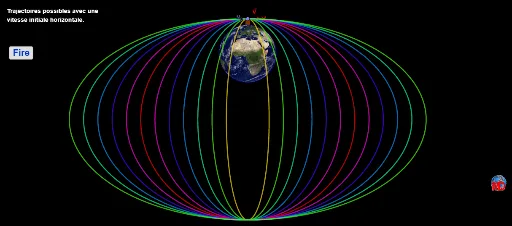
这个范例演示了地球周围发射物体可能的轨道轨迹。涉及的核心数学概念包括椭圆、几何和向量。通过使用GeoGebra命令如Ray、Line、Circle、Intersect等,可以构造出物体的可能轨迹。适合高中及以上学生或相关科研人员使用。
GeoGebra 命令及参数
Ray(F, j) → vertPoint(xAxis) → ALine(F, A) → bCircle(F, A) → TerreIntersect(Terre, vert) → H,Ray(H, j) → possiblePoint(possible) → M_0Distance(F, M_0) → rLine(M_0, xAxis) → horiz_0Point(horiz_0) → BVector(M_0, B) → vLength(v) → lvMidpoint(F', F) → DSegment(D, M_0) → dLine(D, b) → cEllipse(F, F', Distance[M_0, M'_0] / 2) → trajIntersect(Terre, traj) → I, J, ,Intersect(traj, c) → E, GSegment(D, G) → eMirror(BB_1, F) → BB_2Intersect(Terre, Segment[BB_1, B_4]) → B_1,Intersect(Terre, Segment[BB_2, B_3]) → B_2,Polygon(B_1, B_2, B_3, B_4) → tour, b_1, b_2, b_3, b_4Distance(C, J) → aaIf(Distance[C, J] < 0.25, 0, 1) → VitesseCurveCartesian((x(D) + (e * cos((-i) + π / 2)), y(D) + (d * sin((-i) + π / 2))), i, 0, f) → gDistance(A, F) → RSequence(CurveCartesian[(x(D) + (j * cos((-i) + π / 2)), y(D) + (d * sin((-i) + π / 2))), i, 0, f], j, 30, 250, 20) → l1Element(l1, A1) → B1Element(l1, A2) → B2Element(l1, A3) → B3Element(l1, A4) → B4Element(l1, A5) → B5Element(l1, A6) → B6Element(l1, A7) → B7Element(l1, A8) → B8Element(l1, A9) → B9Element(l1, A10) → B10Element(l1, A11) → B11Element(l1, A12) → B12Element(l1, A13) → B13Element(l1, A14) → B14Element(l1, A15) → B15Element(l1, A16) → B16Element(l1, A17) → B17Element(l1, A18) → B18Element(l1, A19) → B19Element(l1, A20) → B20Element(l1, A21) → B21Element(l1, A22) → B22Element(l1, A23) → B23Element(l1, A24) → B24Element(l1, A25) → B25Element(l1, A26) → B26Element(l1, A27) → B27Element(l1, A28) → B28Element(l1, A29) → B29Element(l1, A30) → B30Element(l1, A31) → B31Sequence((x(D) + (j * cos((-f) + π / 2)), y(D) + (d * sin((-f) + π / 2))), j, 30, 250, 20) → l2