
物理问题:可分离微分方程
几何画板及绘图内容加载中,请稍等……
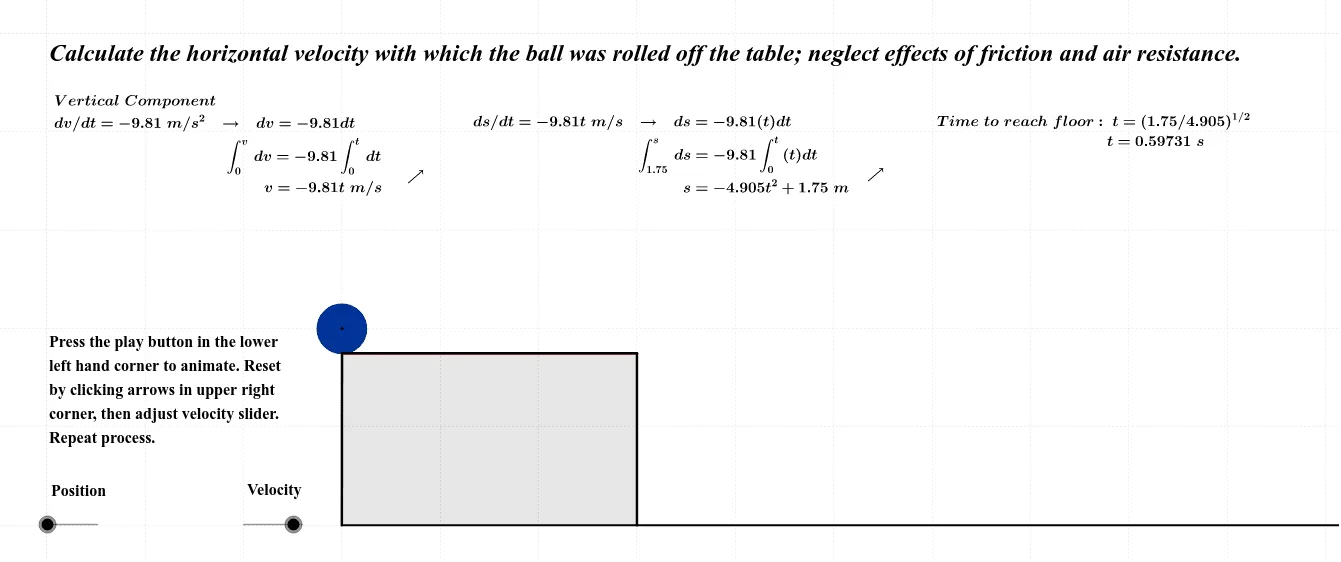
①本范例演示了如何使用 GeoGebra 绘制可分离微分方程的解曲线;②涉及的核心数学概念包括微分方程、分离变量法、函数图像、向量与三维空间;③作图要点提炼自构造摘要,使用了 Intersect(交点)、Point(点)、Segment(线段)、Polygon(多边形)、Circle(圆)、OrthogonalLine(垂线)、Vector(向量)等命令与对象;④适合高中及以上学生学习和理解微分方程在物理问题中的应用,也可用于教学演示。
GeoGebra 命令及参数
Intersect(xAxis, yAxis) → APoint(yAxis) → BSegment((5, 0), (5, 2)) → gSegment((0, 0), (0, 2)) → fSegment(B, D) → a_2Polygon(A, B, D, E) → poly1, a_1, b_2, d, eIntersect(p, c, (11.32455531795991, 1.5032515232604737E-9)) → CIntersect(p, c, (11.32455531795991, 1.5032515232604737E-9)) → FIntersect(i, j) → GIntersect(i, k) → HSegment(H, G) → lIntersect(p, m, (10.916079783099388, 0.250000000000135)) → IIntersect(k, m) → JSegment(J, I) → nIntersect(m, g) → KSegment(K, I) → qIntersect(h, r, (2, 1.75)) → LIntersect(p, r, (7.1713, 1.7642728155)) → MCircle(M, 0.25) → tPoint(Circle[(0, 1.75), 5]) → NSegment(K, I) → b_1Segment(E, O) → d_1Intersect(r, a_2) → QCircle(Q, 0.25) → c_1Circle(Q, 0.26867087944031054) → g_1OrthogonalLine(M, d_1) → h_1Intersect(h_1, d_1) → RSegment(R, M) → i_1OrthogonalLine(C, xAxis) → j_1OrthogonalLine(I, j_1) → k_1OrthogonalLine(I, xAxis) → l_1Intersect(c, l_1) → SSegment(S, I) → m_1Segment((5, 2), (a, 2)) → n_1Intersect(r, n_1) → TCircle(T, 0.25) → q_1Circle(T, 0.23573262929063565) → r_1Vector((5, 2), (a, 2)) → u_1Vector((a, 2), (a, 0.25)) → v_1Vector((5, 2), (a, 0.25)) → w_1Point(u_3) → USegment(U, T) → u_2Segment(U, M) → w_2Segment(T, M) → vSegment((2, 1.75), N) → s_1Segment(P, V) → bPolygon(P, N, E, V) → poly2, p_1, n_2, e_1, v_2OrthogonalLine(M, f_1) → c_2Intersect(f_1, c_2) → WCircle(W, 0.25) → d_2Circle(W, 0.23702296356931926) → e_2Point(Circle[(2, 0), 12]) → ZSegment((2, 0), Z) → f_2Segment(D, M) → wSegment(D, T) → t_1Segment(D, T) → g_2OrthogonalLine(M, d_1) → h_2Intersect(h_2, d_1) → A_1Segment(A_1, M) → i_2Point(Circle[(5, 2), i_2]) → B_1Segment((5, 2), B_1) → u