
Oscar的平行四边形、菱形、矩形、正方形、筝形、梯形
几何画板及绘图内容加载中,请稍等……
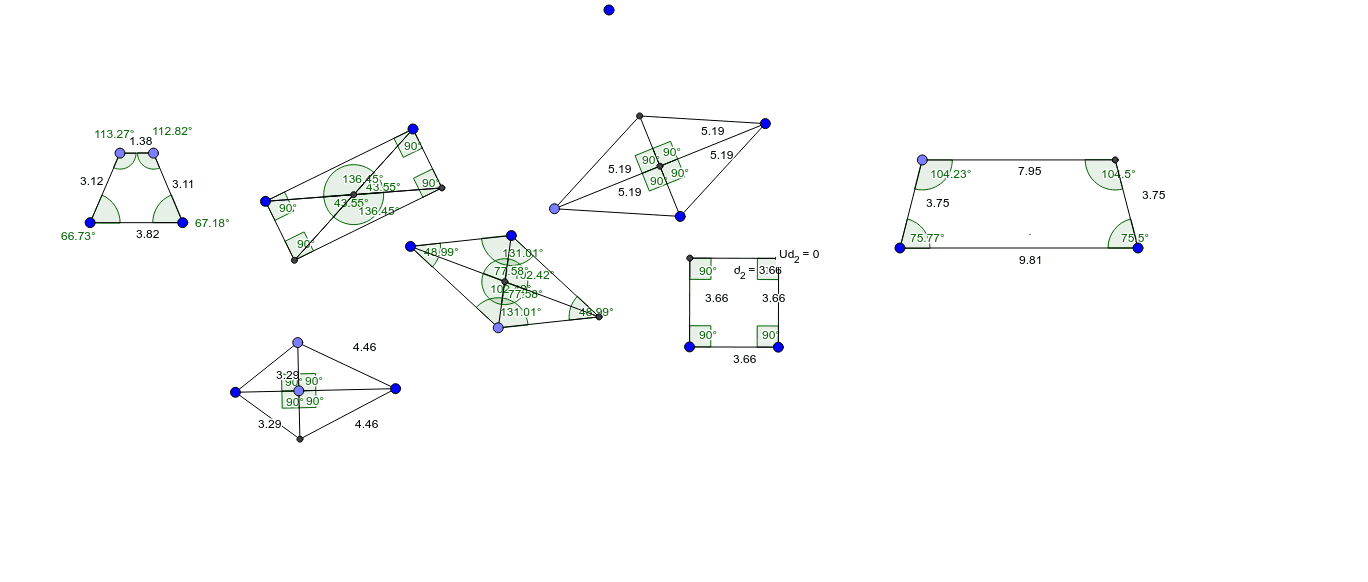
这个范例展示了Oscar的平行四边形、菱形、矩形、正方形、筝形和梯形。它涉及的核心数学概念包括几何作图、角度、距离和构造。通过使用GeoGebra命令如Line、Point、Segment、Intersect、Angle、Circle等,可以构建这些图形。适合初中和高中学生学习几何作图和相关概念。
GeoGebra 命令及参数
Line(A, B) → aLine(C, a) → bPoint(b) → DSegment(A, D) → cLine(B, c) → dIntersect(d, b) → ESegment(B, E) → eSegment(A, B) → fSegment(E, D) → gAngle(A, B, E) → αAngle(B, E, D) → βAngle(E, D, A) → γAngle(D, A, B) → δSegment(B, D) → hSegment(A, E) → iIntersect(i, h) → FAngle(A, F, D) → εAngle(D, F, E) → ζAngle(E, F, B) → ηAngle(B, F, A) → θCircle(G, H) → kPoint(k) → ICircle(I, G) → pCircle(H, G) → qIntersect(p, q, 2) → JSegment(I, J) → jSegment(J, H) → lSegment(H, G) → mSegment(G, I) → nSegment(J, G) → rSegment(I, H) → sIntersect(r, s) → KSegment(I, K) → tSegment(K, H) → a_1Segment(J, K) → b_1Segment(K, G) → c_1Angle(H, K, J) → ιAngle(G, K, H) → κAngle(I, K, G) → λAngle(J, K, I) → μSegment(L, M) → d_1Line(N, d_1) → e_1OrthogonalLine(L, e_1) → f_1Intersect(f_1, e_1) → OOrthogonalLine(M, e_1) → g_1Intersect(e_1, g_1) → PSegment(L, O) → h_1Segment(O, P) → i_1Segment(P, M) → j_1Angle(O, L, M) → νAngle(L, M, P) → ξAngle(M, P, O) → οAngle(P, O, L) → ρSegment(M, O) → k_1Segment(L, P) → l_1Intersect(l_1, k_1) → QSegment(M, Q) → m_1Segment(Q, L) → n_1Segment(Q, O) → p_1Segment(Q, P) → q_1Angle(L, Q, O) → σAngle(O, Q, P) → τAngle(P, Q, M) → υAngle(M, Q, L) → ϕSegment(R, S) → r_1OrthogonalLine(R, r_1) → s_1OrthogonalLine(S, r_1) → t_1Circle(R, S) → c_2Intersect(c_2, s_1, 2) → TOrthogonalLine(T, s_1) → a_2Intersect(t_1, a_2) → USegment(R, T) → b_2Segment(T, U) → d_2Segment(U, S) → e_2Angle(R, T, U) → χAngle(T, U, S) → ψAngle(U, S, R) → ωAngle(S, R, T) → α_1Segment(V, W) → f_2Point(f_2) → ZOrthogonalLine(Z, f_2) → g_2Point(g_2) → A_1Circle(Z, A_1) → h_2Intersect(h_2, g_2, 2) → B_1Point(h_2) → C_1Segment(V, A_1) → i_2Segment(V, B_1) → j_2Segment(B_1, W) → k_2Segment(W, A_1) → l_2Segment(D_1, E_1) → m_2Point(m_2) → F_1OrthogonalLine(F_1, m_2) → n_2Point(n_2) → G_1Circle(F_1, G_1) → p_2Intersect(p_2, n_2, 2) → H_1Segment(D_1, G_1) → q_2Segment(D_1, H_1) → r_2Segment(H_1, E_1) → s_2Segment(E_1, G_1) → t_2Segment(I_1, J_1) → a_3OrthogonalLine(I_1, a_3) → b_3OrthogonalLine(J_1, a_3) → c_3Point(b_3) → K_1OrthogonalLine(K_1, b_3) → d_3Intersect(c_3, d_3) → L_1Segment(K_1, L_1) → e_3Point(e_3) → M_1Segment(I_1, M_1) → f_3Circle(J_1, f) → g_3Intersect(g_3, e_3, 1) → N_1Segment(J_1, N_1) → h_3Segment(M_1, N_1) → i_3Segment(O_1, P_1) → j_3OrthogonalLine(O_1, j_3) → k_3OrthogonalLine(P_1, j_3) → l_3Point(k_3) → Q_1OrthogonalLine(Q_1, k_3) → m_3Intersect(l_3, m_3) → R_1Segment(Q_1, R_1) → n_3Point(n_3) → S_1Segment(O_1, S_1) → p_3Circle(P_1, 3.08) → q_3Circle(P_1, 3.124410319967215) → r_3Point(r_3) → T_1Circle(P_1, 6.95) → s_3Circle(P_1, 6.919440774045372) → t_3Point(s_3) → U_1Circle(P_1, 6.962364924165079) → c_4Point(Circle[V_1, 9]) → W_1Segment(V_1, W_1) → a_4Line(Z_1, a_4) → b_4Point(b_4) → A_2Segment(V_1, A_2) → d_4Circle(W_1, 6.83) → e_4Intersect(e_4, b_4, 1) → B_2Segment(W_1, B_2) → f_4Segment(A_2, B_2) → g_4Segment(C_2, D_2) → h_4OrthogonalLine(C_2, h_4) → i_4OrthogonalLine(D_2, h_4) → j_4Point(i_4) → E_2OrthogonalLine(E_2, i_4) → k_4Intersect(j_4, k_4) → F_2Segment(E_2, F_2) → l_4Point(l_4) → G_2Point(l_4) → H_2Point(l_4) → J_2Segment(G_2, J_2) → m_4Segment(C_2, G_2) → n_4Segment(D_2, J_2) → p_4Segment(D_1, E_1) → q_4Segment(G_1, H_1) → r_4Segment(D_1, F_1) → s_4Segment(F_1, E_1) → t_4Segment(G_1, F_1) → a_5Segment(F_1, H_1) → b_5Angle(G_1, F_1, E_1) → β_1Angle(E_1, F_1, G_1) → γ_1Angle(H_1, F_1, E_1) → δ_1Angle(D_1, F_1, H_1) → ε_1Angle(G_1, F_1, D_1) → ζ_1Distance(q_2, t_2) → oDistance(U, d_2) → distanceUd2Segment(K_2, L_2) → c_5OrthogonalLine(M_2, c_5) → d_5OrthogonalLine(K_2, c_5) → e_5OrthogonalLine(L_2, c_5) → f_5Point(e_5) → N_2OrthogonalLine(O_2, e_5) → g_5OrthogonalLine(N_2, e_5) → h_5Intersect(f_5, h_5) → P_2Segment(N_2, P_2) → i_5Point(i_5) → Q_2Point(i_5) → R_2Point(i_5) → S_2Segment(Q_2, K_2) → j_5Segment(Q_2, R_2) → k_5Segment(R_2, L_2) → l_5Angle(K_2, Q_2, R_2) → η_1Angle(Q_2, R_2, L_2) → θ_1Angle(R_2, L_2, K_2) → ι_1Angle(L_2, K_2, Q_2) → κ_1Segment(T_2, U_2) → m_5OrthogonalLine(T_2, m_5) → n_5OrthogonalLine(U_2, m_5) → p_5Point(n_5) → V_2OrthogonalLine(V_2, p_5) → q_5Intersect(p_5, q_5) → W_2Segment(R_2, Z_2) → r_5Point(r_5) → A_3Segment(A_3, B_3) → s_5Segment(V_2, W_2) → t_5Point(t_5) → D_3Segment(D_3, T_2) → a_6Circle(U_2, 3.07) → c_6Intersect(c_6, t_5, 1) → E_3Segment(E_3, U_2) → b_6Segment(D_3, E_3) → d_6Circle(U_2, 3.07) → e_6Segment(E_3, U_2) → f_6Segment(F_3, G_3) → g_6OrthogonalLine(F_3, g_6) → h_6OrthogonalLine(G_3, g_6) → i_6Point(h_6) → H_3OrthogonalLine(H_3, h_6) → j_6Intersect(i_6, j_6) → I_3Segment(H_3, I_3) → k_6Point(k_6) → J_3Segment(F_3, J_3) → l_6Circle(G_3, 3.76) → p_6Intersect(p_6, k_6, 1) → K_3Segment(G_3, K_3) → m_6Segment(J_3, K_3) → n_6Angle(F_3, J_3, K_3) → λ_1Angle(J_3, K_3, G_3) → μ_1Angle(K_3, G_3, F_3) → ν_1Angle(G_3, F_3, J_3) → ξ_1Point(Circle[L_3, 9]) → M_3Segment(L_3, M_3) → q_6Line(N_3, q_6) → r_6Point(r_6) → O_3Segment(L_3, O_3) → s_6Circle(M_3, 6.83) → t_6Intersect(t_6, r_6, 1) → P_3Segment(M_3, P_3) → a_7Segment(O_3, P_3) → b_7Segment(Q_3, R_3) → c_7OrthogonalLine(Q_3, c_7) → d_7OrthogonalLine(R_3, c_7) → e_7Point(d_7) → S_3OrthogonalLine(S_3, d_7) → f_7Intersect(e_7, f_7) → T_3Segment(S_3, T_3) → g_7Point(g_7) → U_3Segment(Q_3, U_3) → h_7Circle(R_3, 3.75) → k_7Intersect(k_7, g_7, 1) → V_3Segment(R_3, V_3) → i_7Segment(U_3, V_3) → j_7Angle(Q_3, U_3, V_3) → ο_1Angle(U_3, V_3, R_3) → ρ_1Angle(V_3, R_3, Q_3) → σ_1Angle(R_3, Q_3, U_3) → τ_1
AI 绘图提示语参考
绘制一个平行四边形,然后在其基础上构造一个菱形、矩形、正方形、筝形和梯形。首先画出两条相交的直线AB和BC,接着过点B作直线AB的平行线,交直线BC于点D,连接AD和BD,得到平行四边形ABCD。接着以点D为圆心,DA为半径画圆,交直线AB于点E,连接BE,得到菱形ABED。再以点E为圆心,EA为半径画圆,交直线BD于点F,连接EF,得到矩形ABEF。然后以点F为圆心,FA为半径画圆,交直线BE于点G,连接FG,得到正方形ABFG。接着以点G为圆心,GA为半径画圆,交直线EF于点H,连接GH,得到筝形ABGH。最后以点H为圆心,HA为半径画圆,交直线FG于点I,连接HI,得到梯形ABHI。
以上提示语为根据原始绘图命令整理而来,仅供参考。