
NS2-02-CYU1 合并同类项互动练习
几何画板及绘图内容加载中,请稍等……
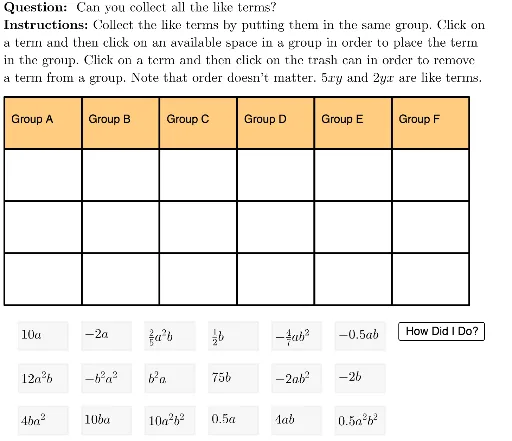
该范例是一个用于代数基础教学的互动练习,通过拖拽或点击匹配的方式,让学生将代数表达式中的同类项进行合并。核心数学概念是合并同类项,即把具有相同变量和指数的项相加或相减,简化多项式表达式。作图要点:利用GeoGebra的Sequence、Flatten、Shuffle等命令生成随机排列的项卡片,并通过Zip、Element、Text等命令创建文本标签和交互按钮;对象包括多个term变量、表格布局(colWidth、rowHeight等)以及用于反馈的cmark、xmark、TryAnother、HowDidIDo等控件。适合初中或高中代数入门阶段,用于课堂练习或自主复习,帮助学生巩固合并同类项的规则。
GeoGebra 命令及参数
Sequence(Polygon[{tableAnchor + ((5 * colWidth), 0 - (rowHeight * i)), tableAnchor + ((6 * colWidth), 0 - (rowHeight * i)), tableAnchor + ((6 * colWidth), 0 - (rowHeight * i) - rowHeight), tableAnchor + ((5 * colWidth), ((-rowHeight) * i) - rowHeight)}], i, 0, lastRow - 1) → tableCol6Sequence(Polygon[{tableAnchor + ((3 * colWidth), 0 - (rowHeight * i)), tableAnchor + ((4 * colWidth), 0 - (rowHeight * i)), tableAnchor + ((4 * colWidth), 0 - (rowHeight * i) - rowHeight), tableAnchor + ((3 * colWidth), ((-rowHeight) * i) - rowHeight)}], i, 0, lastRow - 1) → tableCol4Sequence(Polygon[{tableAnchor + ((2 * colWidth), 0 - (rowHeight * i)), tableAnchor + ((3 * colWidth), 0 - (rowHeight * i)), tableAnchor + ((3 * colWidth), 0 - (rowHeight * i) - rowHeight), tableAnchor + ((2 * colWidth), ((-rowHeight) * i) - rowHeight)}], i, 0, lastRow - 1) → tableCol3Sequence(Polygon[{tableAnchor + (colWidth, 0 - (rowHeight * i)), tableAnchor + ((2 * colWidth), 0 - (rowHeight * i)), tableAnchor + ((2 * colWidth), 0 - (rowHeight * i) - rowHeight), tableAnchor + (colWidth, ((-rowHeight) * i) - rowHeight)}], i, 0, lastRow - 1) → tableCol2Sequence(Polygon[{tableAnchor + (0, 0 - (rowHeight * i)), tableAnchor + (colWidth, 0 - (rowHeight * i)), tableAnchor + (colWidth, 0 - (rowHeight * i) - rowHeight), tableAnchor + (0, ((-rowHeight) * i) - rowHeight)}], i, 0, lastRow - 1) → tableCol1Sequence(Polygon[{tableAnchor + ((4 * colWidth), 0 - (rowHeight * i)), tableAnchor + ((5 * colWidth), 0 - (rowHeight * i)), tableAnchor + ((5 * colWidth), 0 - (rowHeight * i) - rowHeight), tableAnchor + ((4 * colWidth), ((-rowHeight) * i) - rowHeight)}], i, 0, lastRow - 1) → tableCol5Flatten(Sequence[Sequence[(i, j), i, -8, -8 + (5 * (tileWidth + 1)), tileWidth + 1], j, 1, 1 - (2 * (tileHeight + 1)), (-tileHeight) - 1]) → fixedFrameAnchorsShuffle(fixedFrameAnchors) → shuffledFrameAnchorsLaTeX(UnicodeToLetter[10003]) → cmarkLaTeX(UnicodeToLetter[10007]) → xmarkLaTeX((((("\text{" * QUESTION) * "\\") * INSTRUCTIONS) * "}")) → TEXTZip(Polygon[A, A + (tileWidth, 0), A + (tileWidth, (-tileHeight)), A + (0, (-tileHeight))], A, shuffledFrameAnchors) → framesElement(frames, 1) → frame1Element(frames, 2) → frame2Element(frames, 3) → frame3Element(frames, 4) → frame4Element(frames, 5) → frame5Element(frames, 6) → frame6Element(frames, 7) → frame7Element(frames, 8) → frame8Element(frames, 9) → frame9Flatten(Zip[Sequence[Element[A, i], i, 2, 4], A, {tableCol1, tableCol2, tableCol3, tableCol4, tableCol5, tableCol6}]) → cellsElement(cells, 1) → cell1Element(frames, activeTile) → highlightedTileElement(cells, 2) → cell2Element(cells, 3) → cell3Element(cells, 4) → cell4Element(cells, 5) → cell5Element(cells, 7) → cell7Element(cells, 8) → cell8Element(cells, 9) → cell9Element(cells, activeCell) → highlightedCellElement(tableCol1, 1) → col1HeaderCellElement(tableCol2, 1) → col2HeaderCellElement(tableCol3, 1) → col3HeaderCellElement(tableCol4, 1) → col4HeaderCellElement(cells, 6) → cell6Zip(Mod[A, 6] ≟ Mod[B, 6] ∧ Mod[B, 6] ≟ Mod[C, 6] ∧ A ≠ 0 ∧ B ≠ 0 ∧ C ≠ 0, A, Sequence[itemsInCells(i), i, 1, 16, 3], B, Sequence[itemsInCells(j), j, 2, 17, 3], C, Sequence[itemsInCells(k), k, 3, 18, 3]) → cellsCorrectText("", tableAnchor + (0, (-rowHeight) - rowHeight / 3), true, true) → rowHeader1Text("", tableAnchor + (0, ((-rowHeight) * 2) - rowHeight / 3), true, true) → rowHeader2Text("", tableAnchor + (0, ((-rowHeight) * 3) - rowHeight / 3), true, true) → rowHeader3Element(cells, 10) → cell10Element(cells, 11) → cell11Element(cells, 12) → cell12Element(cells, 13) → cell13Element(cells, 14) → cell14Element(cells, 15) → cell15Element(cells, 16) → cell16Element(cells, 17) → cell17Element(cells, 18) → cell18Element(tableCol5, 1) → col5HeaderCellElement(tableCol6, 1) → col6HeaderCellText("Group A", tableAnchor + (0.5, ((-rowHeight)) / 2)) → col1HeaderText("Group B", tableAnchor + (0.5 + colWidth, ((-rowHeight)) / 2)) → col2HeaderText("Group C", tableAnchor + (0.5 + (2 * colWidth), ((-rowHeight)) / 2)) → col3HeaderText("Group D", tableAnchor + (0.5 + (3 * colWidth), ((-rowHeight)) / 2)) → col4HeaderText("Group E", tableAnchor + (0.5 + (4 * colWidth), ((-rowHeight)) / 2)) → col5HeaderLaTeX("\text{You collected all the like terms.}") → feedbackElement(frames, 10) → frame10Element(frames, 11) → frame11Element(frames, 12) → frame12Element(frames, 13) → frame13Element(frames, 14) → frame14Element(frames, 15) → frame15Element(frames, 16) → frame16Element(frames, 17) → frame17Element(frames, 18) → frame18Text("Group F", tableAnchor + (0.5 + (5 * colWidth), ((-rowHeight)) / 2)) → col6HeaderZip(Text[If[A, cmark, ""], Vertex[B, 2] + symbolOffset], A, cellsCorrect, B, {col1HeaderCell, col2HeaderCell, col3HeaderCell, col4HeaderCell, col5HeaderCell, col6HeaderCell}) → cmarkListZip(Text[If[¬A, xmark, ""], Vertex[B, 2] + symbolOffset], A, cellsCorrect, B, {col1HeaderCell, col2HeaderCell, col3HeaderCell, col4HeaderCell, col5HeaderCell, col6HeaderCell}) → xmarkList
AI 绘图提示语参考
绘制一个用于代数同类项合并练习的交互式表格界面。表格由六列多行组成,每列顶部有标题单元格,下方是若干空白单元格。在表格上方显示问题文本和操作说明。在表格右侧或下方,随机排列九个方形卡片,每个卡片内包含一个代数项(如含变量的项)。卡片位置随机打乱,用户需将卡片拖放到表格的对应单元格中,以完成同类项分组。表格中某些单元格可高亮显示,表示当前选中或待放置位置。界面包含用于检查答案、重新出题和初始化练习的按钮,以及正确和错误标记符号。整体布局整齐,适合教学练习。
以上提示语为根据原始绘图命令整理而来,仅供参考。