
LCM与HCF的几何作图示例
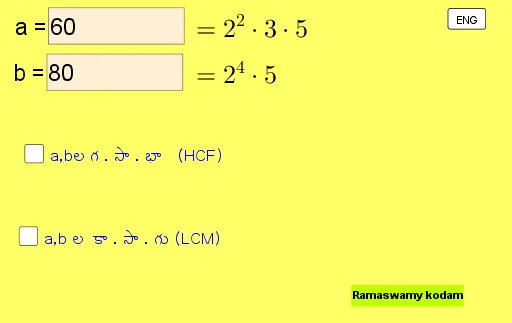
几何画板及绘图内容加载中,请稍等……
本范例演示如何通过几何图形直观展示两个数的最小公倍数(LCM)与最大公约数(HCF)。核心数学概念包括数论中的LCM和HCF,以及几何作图方法。作图要点涉及使用GeoGebra命令如Unique、Factors、Sort、Zip、KeepIf等来处理数字列表,并结合输入框和文本框进行交互。适合初中或高中数学教学,用于理解数论与几何的结合。
GeoGebra 命令及参数
Unique(PrimeFactors[b]) → listBFactors(b) → M2Unique(PrimeFactors[a]) → listASort(Union[listA, listB]) → listPrimeZip(If[Defined[IndexOf[k, listB]], Element[M2, IndexOf[k, listB], 2], 0], k, listPrime) → listB2Factors(a) → M1Zip(If[Defined[IndexOf[k, listA]], Element[M1, IndexOf[k, listA], 2], 0], k, listPrime) → listA2Zip({k, Min[m, n]}, k, listPrime, m, listA2, n, listB2) → listHCFKeepIf(Element[k, 2] ≠ 0, k, listHCF) → listHCF'Zip(((Element[p, 1] * If[Element[p, 2] ≠ 1, (("^{" * Element[p, 2]) * "}")]) * If[{p} ≠ Last[M1], UnicodeToLetter[8901], ""]), p, M1) → listTextATextfield(a) → inputBox1LaTeX("=" + (Sum[listTextA])) → textAZip(((Element[p, 1] * If[Element[p, 2] ≠ 1, (("^{" * Element[p, 2]) * "}")]) * If[{p} ≠ Last[M2], UnicodeToLetter[8901], ""]), p, M2) → listTextBLaTeX("=" + (Sum[listTextB])) → textBTextfield(b) → inputBox2Zip(((Element[p, 1] * If[Element[p, 2] ≠ 1, (("^{" * Element[p, 2]) * "}")]) * If[{p} ≠ Last[listHCF'], UnicodeToLetter[8901], ""]), p, listHCF') → listTextHCFZip({k, Max[m, n]}, k, listPrime, m, listA2, n, listB2) → listLCMZip(((Element[p, 1] * If[Element[p, 2] ≠ 1, (("^{" * Element[p, 2]) * "}")]) * If[{p} ≠ Last[listLCM], UnicodeToLetter[8901], ""]), p, listLCM) → listTextLCMLaTeX("\text{HCF= }" + (If[listHCF' ≟ {}, "1", Sum[listTextHCF]])) → textHCFLaTeX("\text{LCM= }" + (Sum[listTextLCM])) → textLCM
AI 绘图提示语参考
绘制两个数a和b的最小公倍数(LCM)和最大公约数(HCF)的几何表示。首先输入两个数a和b,然后根据这两个数的质因数分解,构造出它们的HCF和LCM的几何图形。HCF用文本表示,LCM也用文本表示。确保显示HCF和LCM的计算结果。
以上提示语为根据原始绘图命令整理而来,仅供参考。