
等腰三角形示例与反例:几何作图与性质分析
几何画板及绘图内容加载中,请稍等……
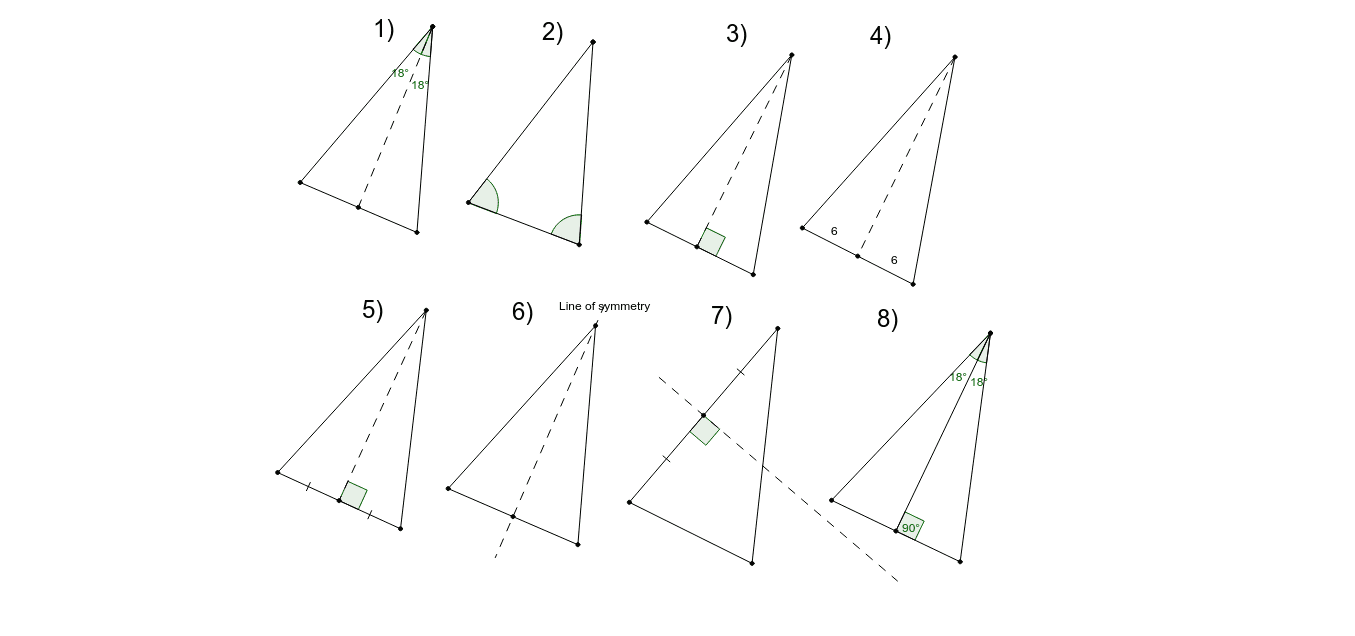
本范例通过GeoGebra演示等腰三角形的构造与性质。核心数学概念包括三角形分类、角平分线、等腰三角形性质等。作图要点涉及使用Rotate、Angle、Segment、Point等命令,以及Midpoint、Circle等工具。适合初中生学习几何作图,或用于教学演示。
GeoGebra 命令及参数
Rotate(A, 36*°, B) → A'Angle(A, B, A') → αSegment(C, D) → aRotate(C, α, D) → C'Rotate(D, α, D) → D'Segment(C', D') → a'Point(a') → ERay(D, E) → bPoint(b) → FSegment(C, F) → cAngularBisector(C, D, F) → dIntersect(d, c) → GSegment(D, G) → eSegment(D, F) → fAngle(C, D, G) → βAngle(G, D, F) → γSegment(H, I) → gSegment(H, J) → hMirror(H, g) → H'Mirror(J, g) → J'Segment(H', J') → h'Segment(J, J') → iAngle(J', J, H) → δAngle(H, J', J) → εSegment(K, L) → jSegment(L, M) → kSegment(M, K) → lOrthogonalLine(L, l) → mIntersect(m, l) → NSegment(L, N) → nAngle(M, N, L) → ζPoint(Circle[O, 2.5]) → PSegment(O, P) → pMidpoint(O, P) → QSegment(O, R) → qSegment(R, P) → rSegment(R, Q) → sSegment(S, T) → tMidpoint(S, T) → UOrthogonalLine(U, t) → a_1Point(a_1) → VSegment(S, V) → b_1Segment(V, T) → c_1Segment(V, U) → d_1Segment(W, Z) → e_1Midpoint(e_1) → A_1OrthogonalLine(A_1, e_1) → f_1Point(f_1) → B_1Segment(W, B_1) → g_1Segment(B_1, Z) → h_1Point(f_1) → C_1Point(f_1) → D_1Segment(C_1, D_1) → i_1Segment(E_1, F_1) → j_1Circle(G_1, 0.3) → k_1Midpoint(S, U) → H_1Point(k_1) → J_1Segment(G_1, J_1) → l_1Circle(H_1, l_1) → p_1OrthogonalLine(H_1, t) → m_1Intersect(p_1, m_1, 2) → K_1Intersect(p_1, m_1, 1) → L_1Segment(S, U) → q_1Segment(U, T) → r_1Midpoint(F_1, E_1) → I_1OrthogonalLine(I_1, j_1) → n_1Segment(F_1, I_1) → s_1Segment(I_1, E_1) → t_1Segment(E_1, M_1) → a_2Segment(M_1, F_1) → b_2Point(n_1) → N_1Point(n_1) → O_1Segment(N_1, O_1) → c_2Angle(F_1, I_1, O_1) → ηRotate(A_2, 36*°, B_2) → A'_1Angle(A_2, B_2, A'_1) → α_1Segment(C_2, D_2) → a_3Rotate(C_2, α_1, D_2) → C'_1Rotate(D_2, α_1, D_2) → D'_1Segment(C'_1, D'_1) → a'_1Point(a'_1) → E_2Ray(D_2, E_2) → b_3Point(b_3) → F_2Segment(C_2, F_2) → c_3AngularBisector(C_2, D_2, F_2) → d_2Intersect(d_2, c_3) → G_2Segment(D_2, G_2) → e_2Segment(D_2, F_2) → f_2Angle(C_2, D_2, G_2) → β_1Angle(G_2, D_2, F_2) → γ_1OrthogonalLine(C_2, e_2) → g_2Intersect(g_2, f_2) → P_1Segment(D_2, P_1) → h_2Midpoint(C_2, P_1) → Q_1Segment(C_2, P_1) → i_2Segment(Q_1, D_2) → j_2Angle(P_1, Q_1, D_2) → θAngle(T, U, V) → ι