
不等式演示
几何画板及绘图内容加载中,请稍等……
所属专题
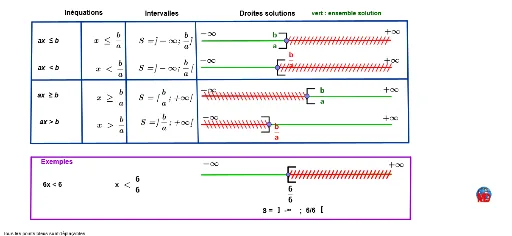
Everything you want to know about inequalities without ever
Everything you Want to Know about Inequalities (D Mentrard)
①本范例演示了不等式在几何图形中的表现与求解过程;②涉及的核心数学概念包括不等式、解析几何、几何作图;③作图要点:使用了Segment、Point、Sequence、If、Circle、OrthogonalLine、Intersect、Line等GeoGebra命令与对象;④适合高中及以上数学学习者,用于理解不等式与几何图形的关联及解题技巧。
GeoGebra 命令及参数
Segment(U_1, V_1) → p_2Point(p_2) → W_1Segment(W_1, U_1) → t_2Segment(A, B) → aPoint(a) → CSegment(D, E) → bSegment(F, G) → cSegment(H, I) → dPoint(b) → JPoint(c) → KPoint(d) → LSegment(C, B) → eSequence(C + (i, 0), i, 0, e, n) → liste1Segment(J, E) → fSequence(J + (i, 0), i, 0, f, n) → liste2Segment(F, K) → gSequence(K - (i, 0), i, 0, g, n) → liste3Segment(L, H) → hSequence(L - (i, 0), i, 0, h, n) → liste4Sequence(C + (i, n), i, n, e, n) → liste5Sequence(C + (i, (-n)), i, 0, e, n) → liste6Sequence(Segment[Element[liste6, i], Element[liste5, i]], i, 0, e / n) → liste7Sequence(J + (i, n), i, n, f, n) → liste9Sequence(J + (i, (-n)), i, 0, f, n) → liste8Sequence(Segment[Element[liste8, i], Element[liste9, i]], i, 0, f / n) → liste10Sequence(K - (i, n), i, 0, g, n) → liste11Sequence(K - (i, (-n)), i, n, g, n) → liste12Sequence(Segment[Element[liste12, i], Element[liste11, i]], i, 0, g / n) → liste13Sequence(L - (i, (-n)), i, n, h, n) → liste14Sequence(L - (i, n), i, 0, h, n) → liste15Sequence(Segment[Element[liste14, i], Element[liste15, i]], i, 0, h / n) → liste16Segment(A, C) → iSegment(D, J) → jSegment(K, G) → kSegment(L, I) → lIf(sign ≟ 1, "≤", If[sign ≟ 2, "<", If[sign ≟ 3, "≥", ">"]]) → signinIf(sign ≟ 1, "]", If[sign ≟ 2, "[", If[sign ≟ 3, "[", "["]]) → croch2If(sign ≟ 1, "]", If[sign ≟ 2, "]", If[sign ≟ 3, "[", "]"]]) → croch1If(sign ≟ 1, "-∞", If[sign ≟ 2, " -∞", If[sign ≟ 3, "" + bb + " /" + aa, "" + bb + " /" + aa]]) → nomb1If(sign ≟ 1, " " + bb + " /" + aa, If[sign ≟ 2, " " + bb + "/" + aa, If[sign ≟ 3, "+∞", "+∞"]]) → nomb2Circle(C, (2 * n)) → pCircle(J, (2 * n)) → qCircle(K, (2 * n)) → rCircle(L, (2 * n)) → sOrthogonalLine(C, a) → tOrthogonalLine(J, b) → a_1OrthogonalLine(K, c) → b_1OrthogonalLine(L, d) → c_1Intersect(p, t) → M, NIntersect(q, a_1) → O, PIntersect(r, b_1) → Q, RIntersect(s, c_1) → S, TSegment(N, M) → d_1Segment(P, O) → e_1Segment(R, Q) → f_1Segment(T, S) → g_1Intersect(p, i) → U,Intersect(q, f) → V,Intersect(r, k) → W,Intersect(s, h) → Z,OrthogonalLine(U, a) → h_1OrthogonalLine(V, f) → i_1OrthogonalLine(W, k) → j_1OrthogonalLine(Z, h) → k_1Line(N, i) → l_1Line(M, i) → m_1Line(P, b) → n_1Line(O, b) → p_1Line(R, g) → q_1Line(Q, g) → r_1Line(T, l) → s_1Line(S, d) → t_1Intersect(l_1, h_1) → A_1Intersect(m_1, h_1) → B_1Intersect(n_1, i_1) → C_1Intersect(p_1, i_1) → D_1Intersect(j_1, q_1) → E_1Intersect(r_1, j_1) → F_1Intersect(s_1, k_1) → G_1Intersect(k_1, t_1) → H_1Segment(A_1, N) → a_2Segment(B_1, M) → b_2Segment(P, C_1) → c_2Segment(O, D_1) → d_2Segment(R, E_1) → e_2Segment(Q, F_1) → f_2Segment(T, G_1) → g_2Segment(S, H_1) → h_2Line(I_1, J_1) → i_2Line(K_1, L_1) → j_2Line(M_1, N_1) → k_2Point(i_2) → O_1Point(k_2) → P_1Line(O_1, P_1) → l_2Point(i_2) → Q_1Point(k_2) → R_1Line(Q_1, R_1) → m_2Point(i_2) → S_1Point(k_2) → T_1Line(S_1, T_1) → n_2Segment(U_1, W_1) → q_2Segment(W_1, V_1) → r_2If(sign ≟ 1, "]", If[sign ≟ 2, "[", If[sign ≟ 3, "[", "]"]]) → croch2droiteSequence(W_1 + (i, 0), i, 0, r_2, n) → liste17Sequence(W_1 + (i, n), i, n, r_2, n) → liste18Sequence(W_1 + (i, (-n)), i, 0, r_2, n) → liste19Sequence(Segment[Element[liste19, i], Element[liste18, i]], i, 0, r_2 / n) → liste20Sequence(W_1 - (i, n), i, 0, t_2, n) → liste22Sequence(W_1 - (i, 0), i, 0, q_2, n) → liste21Sequence(W_1 - (i, (-n)), i, n, t_2, n) → liste23Segment(W_1, V_1) → s_2Sequence(Segment[Element[liste22, i], Element[liste23, i]], i, 0, t_2 / n) → liste24Segment(O_1, P_1) → a_3Segment(Q_1, R_1) → b_3Segment(J_1, N_1) → c_3Segment(I_1, M_1) → d_3Intersect(j_2, d_3) → Z_1Intersect(c_3, j_2) → A_2Segment(I_1, J_1) → e_3Segment(Z_1, A_2) → f_3Segment(M_1, N_1) → g_3Segment(S_1, T_1) → h_3Circle(W_1, (2 * n)) → k_3OrthogonalLine(W_1, p_2) → i_3Intersect(k_3, i_3) → B_2, C_2Intersect(p_2, r_2) → D_2Intersect(k_3, r_2) → E_2,OrthogonalLine(E_2, r_2) → j_3Line(C_2, r_2) → l_3Line(B_2, p_2) → m_3Intersect(l_3, j_3) → F_2Intersect(j_3, m_3) → G_2Segment(F_2, C_2) → n_3Segment(G_2, B_2) → p_3Intersect(k_3, q_2) → H_2,OrthogonalLine(H_2, q_2) → q_3Intersect(l_3, q_3) → I_2Intersect(m_3, q_3) → J_2Segment(C_2, I_2) → r_3Segment(B_2, J_2) → s_3Segment(C_2, B_2) → t_3Segment(K_2, L_2) → a_4Segment(L_2, M_2) → b_4Segment(N_2, M_2) → c_4Segment(N_2, K_2) → d_4