
用图像法解二次方程(二)(自我评估)
几何画板及绘图内容加载中,请稍等……
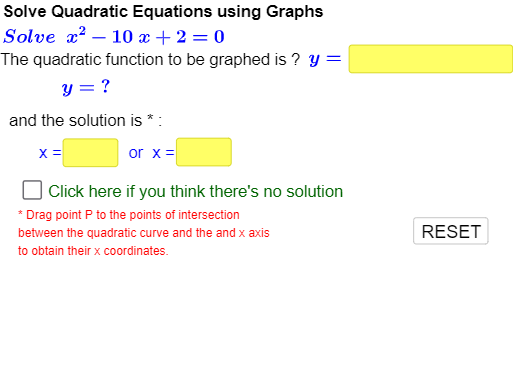
本范例演示了如何通过图像法解包含两边均为代数表达式的二次方程。首先需要额外步骤将方程整理为标准形式,然后通过绘制函数图像找到交点,从而确定方程的根。涉及的核心数学概念包括二次函数、函数图像、交点求解。作图要点:使用了GeoGebra的Sequence、Union、Simplify、Root、Textfield、Roots、Extremum、If、Point、Intersect等命令和对象,通过滑块动态展示方程解的变化。适合高中阶段学生用于理解函数图像与方程解的关系,提升自我评估能力。
GeoGebra 命令及参数
Sequence(i, i, 1, 20, 1) → list4Sequence(i, i, -20, -1, 1) → list1Union(list1, list4) → list5Sequence(i, i, -7, 9, 1) → list2Sequence(i, i, -13, 13, 1) → list3Simplify((a * x^(2)) + (b * x) + c) → fRoot(f) → A, BTextfield(inputa) → InputBox1Textfield(inputb) → InputBox2Textfield(inputc) → InputBox3Textfield(inputx1) → InputBox4Textfield(inputx2) → InputBox5Roots(f, -30, 30) → C, D,Extremum(f, -30, 30) → EIf(usera ≟ a, true, false) → correctaIf(userb ≟ b, true, false) → correctbIf(userc ≟ c, true, false) → correctcIf(abs(x(C) - Min[userx1, userx2]) < 0.055, true, false) → correctxminIf(abs(x(D) - Max[userx1, userx2]) < 0.055, true, false) → correctxmaxIf(b^(2) < (4 * ac), nosolncorrect, correctxmax ∧ correctxmin) → correctrootsPoint(f) → PSimplify((-c)) → c_2Simplify((a * x^(2)) + (b * x)) → f_2Simplify((a * x^(2))) → f_3Simplify(((-b) * x) - c) → bc_3Textfield(inputf) → InputBox6If(f_{userinput} ≟ f, true, false) → correctfunctionIf(correctfunction ∧ correctroots ∧ checkedroots ∨ checkrootcounter > 1, true, false) → showbutton1If(correctfunction ∧ correctroots ∨ checkrootcounter > 1, true, false) → nIf(correctfunction ∧ correctroots ∨ checkrootcounter > 1, true, false) → oIf(correctfunction ∧ correctroots ∨ checkrootcounter > 1, true, false) → pIf(correctfunction ∧ correctroots ∨ checkrootcounter > 1, true, false) → qIf(correctfunction ∧ correctroots ∨ checkrootcounter > 1, true, false) → rIf(correctfunction ∧ correctroots ∨ checkrootcounter > 1, true, false) → sIf(correctfunction ∧ correctroots ∨ checkrootcounter > 1, true, false) → tIf(correctfunction ∧ correctroots ∨ checkrootcounter > 1, true, false) → uIf(correctfunction ∧ correctroots ∨ checkrootcounter > 1, true, false) → vIf(correctfunction ∧ correctroots ∨ checkrootcounter > 1, true, false) → wIf(y(E) < 0, y(E) + Min[(-abs((0.25 * y(E)))), -5], Min[-5, (-abs((0.25 * y(E))))]) → yMinView2If(y(E) > 0, y(E) + Max[(0.25 * y(E)), 5], Max[abs((0.25 * y(E))), 5]) → yMaxView2Intersect(f, xAxis) → F, GIf(If[discriminant < 0, x(E) + 5, If[discriminant ≟ 0, x(E) + 5, x(G) + (0.5 * abs(x(G) - x(F)))]] < 0, 1, If[discriminant < 0, x(E) + 5, If[discriminant ≟ 0, x(E) + 5, x(G) + (0.5 * abs(x(G) - x(F)))]]) → xMaxView2If(If[discriminant < 0, x(E) - 5, If[discriminant ≟ 0, x(E) - 5, x(F) - (0.5 * abs(x(G) - x(F)))]] > 0, -1, If[discriminant < 0, x(E) - 5, If[discriminant ≟ 0, x(E) - 5, x(F) - (0.5 * abs(x(G) - x(F)))]]) → xMinView2