
几何作图范例:三角形与中心点
几何画板及绘图内容加载中,请稍等……
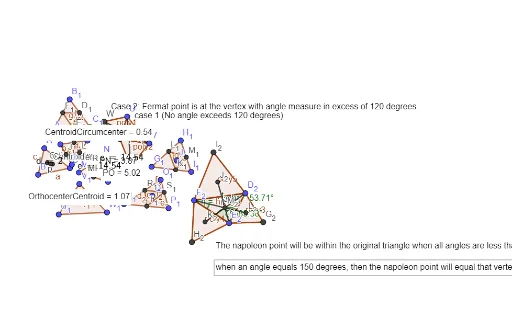
①本范例演示了如何通过 GeoGebra 命令绘制三角形并找出其垂心、外心和重心;②涉及的核心数学概念包括三角形、角度、相似三角形、等边三角形、最小公倍数与最大公约数;③作图要点提炼自构造摘要,使用了 Polygon、OrthogonalLine、Intersect、Midpoint、Segment、Distance、LaTeX、Line、Angle、Rotate、Centroid、InteriorAngles、Text 等命令和对象;④适合高中阶段学生学习和理解几何作图技巧及三角形中心点的性质。
GeoGebra 命令及参数
Polygon(A, B, C) → t1, c, a, bOrthogonalLine(A, a) → fOrthogonalLine(C, c) → gOrthogonalLine(B, b) → hIntersect(f, h) → OrthocenterMidpoint(c) → DMidpoint(b) → EMidpoint(a) → FOrthogonalLine(F, a) → iOrthogonalLine(E, b) → jOrthogonalLine(D, c) → kIntersect(j, i) → CircumcenterSegment(A, F) → lSegment(B, E) → mSegment(C, D) → nIntersect(l, n) → CentroidSegment(Orthocenter, Circumcenter) → pDistance(Orthocenter, Centroid) → distanceOrthocenterCentroidDistance(Centroid, Circumcenter) → distanceCentroidCircumcenterLaTeX(d, true, true) → text1Polygon(G, H, I) → t2, i_1, g_1, h_1Midpoint(h_1) → JMidpoint(i_1) → KMidpoint(g_1) → LPolygon(J, K, L) → t3, l_1, j_1, k_1Polygon(M, N, O) → t4, o, m_1, n_1Distance(M, P) → distanceMPDistance(P, N) → distancePNDistance(P, O) → distancePOLaTeX(e, true, true) → text2LaTeX(e, true, true) → text3Midpoint(n_1) → QMidpoint(o) → RMidpoint(m_1) → SPolygon(T, U, V) → t5, v, t, uPolygon(T, U, 3) → poly1, q, r, s, WPolygon(V, T, 3) → poly2, f_1, p_1, q_1, ZSegment(Z, U) → r_1Segment(W, V) → s_1LaTeX(text5, true, true) → text6Polygon(A_1, B_1, C_1) → t6, c_1, a_1, b_1OrthogonalLine(B_1, b_1) → t_1OrthogonalLine(C_1, c_1) → d_1OrthogonalLine(A_1, a_1) → e_1Intersect(a_1, e_1) → D_1Intersect(t_1, b_1) → E_1Intersect(c_1, d_1) → F_1Polygon(F_1, D_1, E_1) → t7, f_2, g_2, h_2Polygon(G_1, H_1, I_1) → t8, i_2, j_2, k_2OrthogonalLine(J_1, k_2) → l_2OrthogonalLine(J_1, j_2) → m_2OrthogonalLine(J_1, i_2) → n_2Intersect(l_2, k_2) → K_1Intersect(n_2, i_2) → L_1Intersect(m_2, j_2) → M_1Polygon(L_1, M_1, K_1) → t9, p_2, q_2, r_2Polygon(N_1, O_1, P_1) → t10, s_2, t_2, o_1Line(N_1, Q_1) → a_2Line(P_1, Q_1) → b_2Line(O_1, Q_1) → c_2Intersect(b_2, s_2) → R_1Intersect(a_2, t_2) → S_1Intersect(c_2, o_1) → T_1Polygon(R_1, T_1, S_1) → t11, d_2, e_2, f_3Polygon(U_1, V_1, W_1) → t12, w_1, u_1, v_1Angle(U_1, V_1, W_1) → αRotate(U_1, (1 / 3 * α), V_1) → A_2Rotate(W_1, (-((1 / 3 * α))), V_1) → Z_1Angle(W_1, U_1, V_1) → βRotate(W_1, (1 / 3 * β), U_1) → B_{2}Rotate(V_1, (-1 / 3 * β), U_1) → C_2Angle(V_1, W_1, U_1) → γPolygon(D_2, E_2, F_2) → t13, g_3, h_3, i_3Polygon(D_2, E_2, 3) → poly3, j_3, k_3, l_3, G_2Polygon(E_2, F_2, 3) → poly4, m_3, n_3, p_3, H_2Polygon(F_2, D_2, 3) → poly5, q_3, r_3, s_3, I_2Centroid(F_2, D_2, I_2) → J_2Centroid(H_2, E_2, F_2) → K_2Centroid(E_2, D_2, G_2) → L_2Segment(L_2, F_2) → t_3Segment(E_2, J_2) → b_3Segment(K_2, D_2) → a_3Intersect(b_3, a_3) → M_2InteriorAngles(t13) → ε, ζ, ηText("The napoleon point will be within the original triangle when all angles are less than 150 degrees.") → text7Text("when an angle equals 150 degrees, then the napoleon point will equal that vertex.") → text8