
勾股定理的几何证明
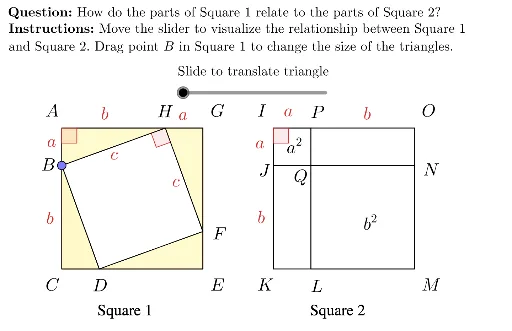
几何画板及绘图内容加载中,请稍等……
①本范例演示了勾股定理的几何证明方法,通过构建特定图形展示直角三角形三边关系;②涉及的核心数学概念包括直角三角形、勾股定理、几何作图、面积计算;③作图要点——从下方『构造摘要』提炼用到了Point(点)、Polygon(多边形)、Translate(平移)、Angle(角度)、LaTeX(公式)等GeoGebra命令/对象;④适合高中数学教学或数学爱好者用于深入理解勾股定理的几何内涵。
GeoGebra 命令及参数
Point(Segment[A, B]) → EPolygon(A, B, 4) → square1, f, g, h, i, C, DTranslate(E, Vector[((2 * f) + spacer - Segment[B, E], 0)]) → E'Translate(D, Vector[E' - D]) → D'Translate(square1, (f + spacer, 0)) → square2Polygon(A, F, E) → t1, e, a, f_1Polygon(F, D, G) → t2, g_1, f_2, dPolygon(G, H, C) → t3, c, g_2, h_1Polygon(E, B, H) → t4, h_2, e_1, bTranslate(A, Vector[((2 * f) + spacer - Segment[B, E], 0)]) → A'Translate(F, Vector[((2 * f) + spacer - Segment[B, E], 0)]) → F'Polygon(A', F', E') → t1', e', a', f'Translate(G, Vector[F' - G]) → G'Translate(H, Vector[F' - G]) → H'Translate(C, Vector[F' - G]) → C'Polygon(G', H', C') → t3', c', g', h'Translate(E, (f + spacer, 0)) → E'_1Translate(B, (f + spacer, 0)) → B'Translate(H, (f + spacer, 0)) → H'_1Polygon(E'_1, B', H'_1) → t4', h'_1, e'_1, b'Translate(G, Vector[E' - D]) → G'_1Translate(F, Vector[D' - D]) → F'_1Polygon(F'_1, D', G'_1) → t2', g'_1, f'_1, d'Translate(A, Vector[(n * Vector[((2 * f) + spacer - Segment[B, E], 0)])]) → A'_1Translate(F, Vector[(n * Vector[((2 * f) + spacer - Segment[B, E], 0)])]) → F'_2Translate(E, Vector[(n * Vector[((2 * f) + spacer - Segment[B, E], 0)])]) → E'_2Polygon(A'_1, F'_2, E'_2) → t1'', e'_2, a'_1, f'_2Translate(F, Vector[(n * Vector[G, G'_1])]) → F'_3Translate(D, Vector[(n * Vector[G, G'_1])]) → D'_1Translate(G, Vector[(n * Vector[G, G'_1])]) → G'_2Polygon(F'_3, D'_1, G'_2) → t2'', g'_2, f'_3, d'_1Translate(G, Vector[(n * Vector[G, F'])]) → G'_3Translate(H, Vector[(n * Vector[G, F'])]) → H'_2Translate(C, Vector[(n * Vector[G, F'])]) → C'_1Polygon(G'_3, H'_2, C'_1) → t3'', c'_1, g'_3, h'_2Translate(E, Vector[(n * Vector[B, B'])]) → E'_3Translate(B, Vector[(n * Vector[B, B'])]) → B'_1Translate(H, Vector[(n * Vector[B, B'])]) → H'_3Polygon(E'_3, B'_1, H'_3) → t4'', h'_3, e'_3, b'_1Polygon(E', A', 4) → aSquared, j, k, l, m, I, JPolygon(D', G'_1, 4) → bSquared, p, q, r, s, K, LPoint(i) → MPoint(h) → NPolygon(E, F, G, H) → q1, t, i_1, j_1, k_1Angle(B, A, D) → αAngle(B', I, G') → βAngle(E, F, G) → γLaTeX("\text{\textbf{Question: }How do the parts of Square 1 relate to the parts of Square 2?}") → instruction1LaTeX("\text{\textbf{Instructions: }Move the slider to visualize the relationship between Square 1\\and Square 2. Drag point \(B\) in Square 1 to change the size of the triangles.}") → instruction2
AI 绘图提示语参考
画一个直角三角形,在其三条边上分别构建正方形,通过平移和旋转将这些正方形重新排列,展示两条直角边构成的正方形面积之和等于斜边正方形的面积,并标出相关连接线与辅助图形,以直观验证勾股定理。
以上提示语为根据原始绘图命令整理而来,仅供参考。