
分数加法估算练习
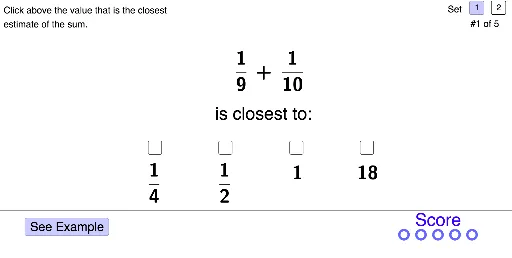
几何画板及绘图内容加载中,请稍等……
本范例演示如何估算分数加法的结果是否大于或小于给定数值,并提供反馈和示例估算策略。涉及的核心数学概念包括分数加法、不等式判断和数学估算。构造要点使用了GeoGebra命令如If、Polygon、FractionText、Ellipse、Vector、Segment、Sequence等,用于创建问题界面、显示结果和提供交互反馈。适合初中及以上数学教学,用于培养学生的估算能力和分数运算理解。
GeoGebra 命令及参数
If(set ≟ 1, Element[sumBenchmarkSet1, problem], Element[sumBenchmarkSet2, problem]) → sumBenchmarkValueIf(set ≟ 1, {0.25, 1, 0.5, 0.5, 8}, {0.25, 0.1111111111111111, 1, 0.5, 0.5}) → SR1If(set ≟ 1, {0.5, 2, 1, 1, 0.5}, {0.5, 0.25, 2, 1, 6}) → SR2If(set ≟ 1, {1, 19, 2, 8, 0.5}, {1, 0.5, 15, 2, 0.5}) → SR3If(set ≟ 1, {18, 21, 6, 16, 0.5}, {16, 1, 17, 8, 11}) → SR4If(set ≟ 1, {1, 2, 3, 2, 3}, {1, 4, 2, 3, 3}) → ansCorrectIf(Element[ansCorrect, problem] ≟ 1, (2, 1.8), If[Element[ansCorrect, problem] ≟ 2, (8, 1.8), If[Element[ansCorrect, problem] ≟ 3, (14, 1.8), (20.1, 1.8)]]) → SkipCorrectPtIf(ansSkip ≟ 1, SkipCorrectPt, If[sr1, (5.9, 1.9), If[sr2, (9.3, 1.9), If[sr3, (12.65, 1.9), If[sr4, (16, 1.9)]]]]) → AnsSelectedPtIf(sr1, SR1, If[sr2, SR2, If[sr3, SR3, SR4]]) → SRSelectPolygon(NextPt + (0, 0.2), NextPt + (0.2, 0), NextPt + (2, 0), NextPt + (2, -0.5), NextPt + (4, 0.5), NextPt + (2, 1.5), NextPt + (2, 1), NextPt + (0.2, 1), NextPt + (0, 0.8)) → nextPoly, nextPoly_2, nextPoly_3, nextPoly_4, nextPoly_5, nextPoly_6, nextPoly_7, nextPoly_8, nextPoly_9, nextPoly_{10}If(set ≟ 1, {1, 11, 3, 4, 3}, {1, 3, 4, 1, 4}) → term1numIf(set ≟ 1, {1, 8, 8, 4, 4}, {1, 4, 11, 7, 7}) → term2numIf(set ≟ 1, {9, 12, 4, 7, 4}, {7, 5, 5, 5, 9}) → term1denomIf(set ≟ 1, {10, 9, 7, 9, 7}, {9, 9, 12, 4, 8}) → term2denomFractionText(Element[SR1, problem]) → SR1textFractionText(Element[SR2, problem]) → SR2textFractionText(Element[SR3, problem]) → SR3textFractionText(Element[SR4, problem]) → SR4textIf(set ≟ 1, {0, 0, 0, 0, 5}, {0, 0, 0, 0, 3}) → term1mixedWholeIf(set ≟ 1, {0, 0, 0, 0, 3}, {0, 0, 0, 0, 2}) → term2mixedWholeIf(sr1, 1, If[sr2, 2, If[sr3, 3, If[sr4, 4, 0]]]) → srSelectIf(srSelect ≟ Element[ansCorrect, problem], 1, 0) → correctPolygon(AnsSelectedPt + If[Element[SRSelect, problem] < 1, (0, 0), (0, 0.8)], AnsSelectedPt + (2, 0) + If[Element[SRSelect, problem] < 1, (0, 0), (0, 0.8)], AnsSelectedPt + (2, 2.5), AnsSelectedPt + (0, 2.5)) → ansSelectedPoly, ansSelectedPoly_2, ansSelectedPolyR, ansSelectedPolyTop, ansSelectedPolyLIf(sr1 ∨ sr2 ∨ sr3 ∨ sr4, true, false) → ansSelectedIf(set ≟ 1, {0.125, 1, 1, 0.5, 6}, {0.125, 0.5, 1, 0.25, 3}) → term1BenchmarkIf(set ≟ 1, {0.125, 1, 1, 0.5, 3}, {0.125, 0.5, 1, 2, 3}) → term2BenchmarkFractionText(If[set ≟ 1, Element[sumBenchmarkSet1, problem], Element[sumBenchmarkSet2, problem]]) → sumBenchmarkIf(Element[ansCorrect, problem] ≟ 1, (6.9, 3.8), If[Element[ansCorrect, problem] ≟ 2, (10.25, 3.8), If[Element[ansCorrect, problem] ≟ 3, (13.65, 3.8), (17, 3.8)]]) → CorrectEllipsePt2Ellipse(CorrectEllipsePt1, CorrectEllipsePt2, CorrectEllipsePt3) → correctEllipseVector((14.5, 0.5), (13.7, 1)) → exCorrectArrowSegment((17.3, 8), (19.7, 8)) → exSegBenchmarkSegment((12.8, 8), (16.4, 8)) → exSegOriginalVector(CorrectEllipsePt2 + (1.9, 0), CorrectEllipsePt2 + (0.9, 0)) → ansNoteIncCorrVectorPolygon(AnsNotePolyPt + (0, If[sumBenchmarkValue ≥ 1, 0.5, 0]), AnsNotePolyPt + (6.75, If[sumBenchmarkValue ≥ 1, 0.5, 0]), AnsNotePolyPt + (6.75, 5), AnsNotePolyPt + (0, 5)) → ansNotePoly, f, g, h, iIf(set ≟ 1, {0, 0, 0, 0, 0}, {0, 0, 0, 0, 5}) → SR1mixedWholeIf(set ≟ 1, {0, 0, 0, 0, 8}, {0, 0, 0, 0, 0}) → SR2mixedWholeIf(set ≟ 1, {0, 0, 0, 0, 9}, {0, 0, 0, 0, 6}) → SR3mixedWholeIf(set ≟ 1, {0, 0, 0, 0, 10}, {0, 0, 0, 0, 0}) → SR4mixedWholeSequence((17.8 + i, 0.6), i, 1, 4.5, 0.81) → scorePtsEmptySequence((17.8 + i, 0.6), i, 1, scoreTotal, 0.81) → scorePts