
已知直角坐标系中一点求正弦值
几何画板及绘图内容加载中,请稍等……
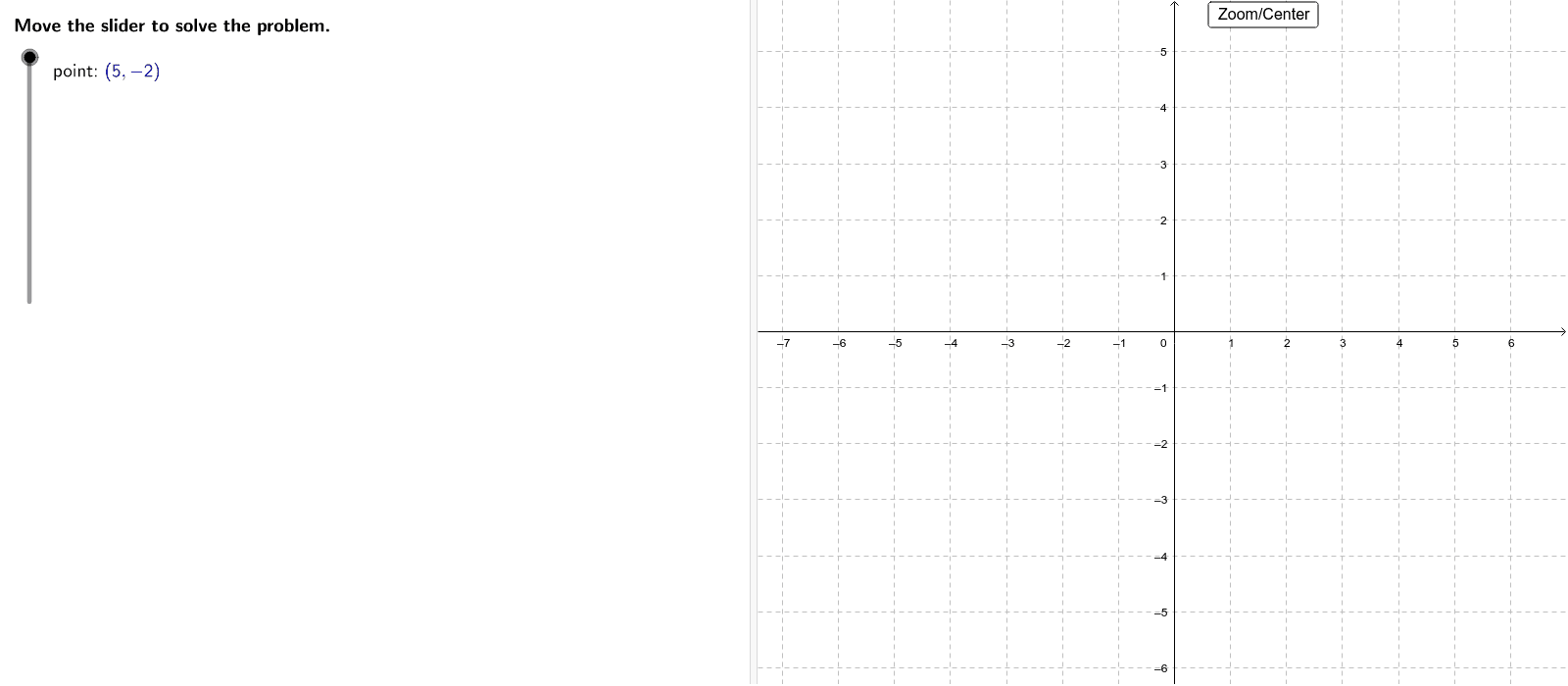
本示例演示如何在直角坐标系中给定一个点,通过构造直角三角形来求解正弦值。核心数学概念包括三角函数中的正弦函数。作图要点包括使用GeoGebra命令构造圆、线段、角度等。适合初中及以上学生学习三角函数。
GeoGebra 命令及参数
LaTeX(steps) → counterCircle(B, A) → cLaTeX("\text{Make a sketch.}") → text1Segment(B, A) → hypotenuseSegment(B, C) → AdjacentSegment(C, A) → oppositeAngle(A, B, C) → θ_1If((0 ≤ x(A)) ∧ (0 ≤ y(A)), LaTeX["\text{I}"], If[(0 > x(A)) ∧ (0 ≤ y(A)), LaTeX["\text{II}"], If[(0 > x(A)) ∧ (0 > y(A)), LaTeX["\text{III}"], LaTeX["\text{IV}"]]]) → quadrantLaTeX("\text{Pythagorean Theorem}") → text12LaTeX("\text{Square and add.}") → text16LaTeX("\text{Sine ratio}") → text22Angle((radius, 0), B, A) → θIf((0 ≤ x(A)) ∧ (0 ≤ y(A)), LaTeX["\text{A: all positive so sine is positive}"], If[(0 > x(A)) ∧ (0 ≤ y(A)), LaTeX["\text{S: sine and cosecant are positive}"], If[(0 > x(A)) ∧ (0 > y(A)), LaTeX["\text{T: tangent and cotangent are positive; sine is negative}"], LaTeX["\text{C: cosine and secant are positive sine is negative}"]]]) → signsASTCIf((0 ≤ x(A)) ∧ (0 ≤ y(A)), LaTeX["\text{y-coordinate is positive so sine is positive}"], If[(0 > x(A)) ∧ (0 ≤ y(A)), LaTeX["\text{y-coordinate is positive so sine is positive}"], If[(0 > x(A)) ∧ (0 > y(A)), LaTeX["\text{y-coordinate is negative so sine is negative}"], LaTeX["\text{y-coordinate is negative so sine is negative}"]]]) → signsCoordsIf(y(A) ≥ 0, "", "-") → signPickLaTeX("\text{Move the slider to solve the problem.}") → text0LaTeX("\text{Sketch the triangle, the angle, and the reference angle.}") → text3LaTeX("\text{The reference angle is the angle the terminal side makes with the x-axis.}") → text4LaTeX("\text{Sine is the ratio of the length of the opposite side to the length of the hypotenuse; }\cr\text{therefore, these two lengths must be determined.}") → text8LaTeX("\text{Use the buttons below to return to the original problem or}\cr\text{randomly generate a similar practice problem.}") → text32LaTeX((("\text{point: }\textcolor{#000099}{" * A) * "}")) → ProblemLaTeX((("\text{Plot }\textcolor{#000099}{" * A) * "} \text{ on a coordinate plane and draw the terminal side extending from }\cr\text{the origin through that point.}")) → text2LaTeX((("\text{The length of the opposite side is the magnitude of the y-coordinate, }\textcolor{#CC0000}{" * abs(y(A))) * ".}")) → text9LaTeX((("\text{The length of the adjacent side is the magnitude of the x-coordinate, }\textcolor{#006633}{" * abs(x(A))) * ".}")) → text11LaTeX("c^2=a^2+b^2") → text13LaTeX((("c=\sqrt{" * csq) * "}")) → text19LaTeX((((("\text{Substitute }" * abs(y(A))) * " \text{ for the opposite side }\cr\text{and }\sqrt{") * csq) * "} \text{ for the hypotenuse.}")) → text24LaTeX((("\text{The sign of sine is given by the sign of the y-coordinate. }\cr\text{The }" * signsCoords) * ".")) → text29LaTeX((("\text{The sketch shows that reference angle is in Quadrant }" * quadrant) * ".")) → text5LaTeX("\text{Use the sine of the reference angle to determine the sine of the angle }\textcolor{#CC9900}{θ}.") → text26LaTeX("\text{Determine the sign of }\sin(\textcolor{#CC9900}{θ}) \text{ by recalling the ASTC pattern or by considering }\cr\text{the signs of the x- and y-coordinates.}") → text27LaTeX((((((("\sin(\textcolor{#CC9900}{\theta})=" * signPick) * "\frac{") * abs(y(A))) * "}{\sqrt{") * csq) * "}}")) → text30LaTeX((((((((("\text{For a positive angle }\textcolor{#CC9900}{θ} \text{ in standard position with a terminal side that passes}\cr\text{through the point }" * A) * "\text{, }sin(\textcolor{#CC9900}{θ})=") * signPick) * "\frac{") * abs(y(A))) * "}{\sqrt{") * csq) * "}.}")) → text31LaTeX("\text{The magnitude of the x-coordinate is the length of the adjacent side and the }\cr\text{magnitude of the y-coordinate is the length of the opposite side.}\cr\text{The hypotenuse can be found using the Pythagorean Theorem.}") → text6LaTeX("\text{In order to find the length of the hypotenuse, find the length of the adjacent side.}") → text10LaTeX((((("c^2 = (" * abs(y(A))) * ")^2 + (") * abs(x(A))) * ")^2")) → text15LaTeX((((((("c^2 = " * bsq) * " + ") * asq) * "=") * csq) * "")) → text17LaTeX((((("\text{Substitute }\textcolor{#CC0000}{" * abs(y(A))) * "} \text{ for a and }\textcolor{#006633}{") * abs(x(A))) * "}\text{ for b.}")) → text14LaTeX("\text{Take the square root of both sides.}") → text18LaTeX("\text{Find the sine of the reference angle}.") → text20LaTeX("\text{Now that the lengths of the opposite side and the hypotenuse are known, }\cr\text{substitute these values into the sine ratio}.") → text21LaTeX("sine=\frac{\text{length of opposite side}}{\text{length of hypotenuse}}") → text23LaTeX((((("sine=\frac{" * abs(y(A))) * "}{\sqrt{") * csq) * "}}")) → text25LaTeX((((("\text{The terminal side is in Quadrant }" * quadrant) * " \text{. According to ASTC,}\cr") * signsASTC) * ".")) → text28LaTeX("\text{Determine the sign of }\sin(\theta) \text{ by recalling the ASTC pattern or by considering }\cr\text{the signs of the x- and y-coordinates.}") → text7
AI 绘图提示语参考
在直角坐标系中画一个点A,从原点通过该点画出终边,构造一个直角三角形,其中点A为直角顶点,原点为直角的另一个顶点。构造一个以点A为顶点的角θ,并找到该角的参考角。使用勾股定理计算斜边长度,然后根据对边和斜边的长度计算正弦值。注意点A的坐标符号来确定正弦值的正负。
以上提示语为根据原始绘图命令整理而来,仅供参考。