
对称与平移的剪裁与折叠探索
几何画板及绘图内容加载中,请稍等……
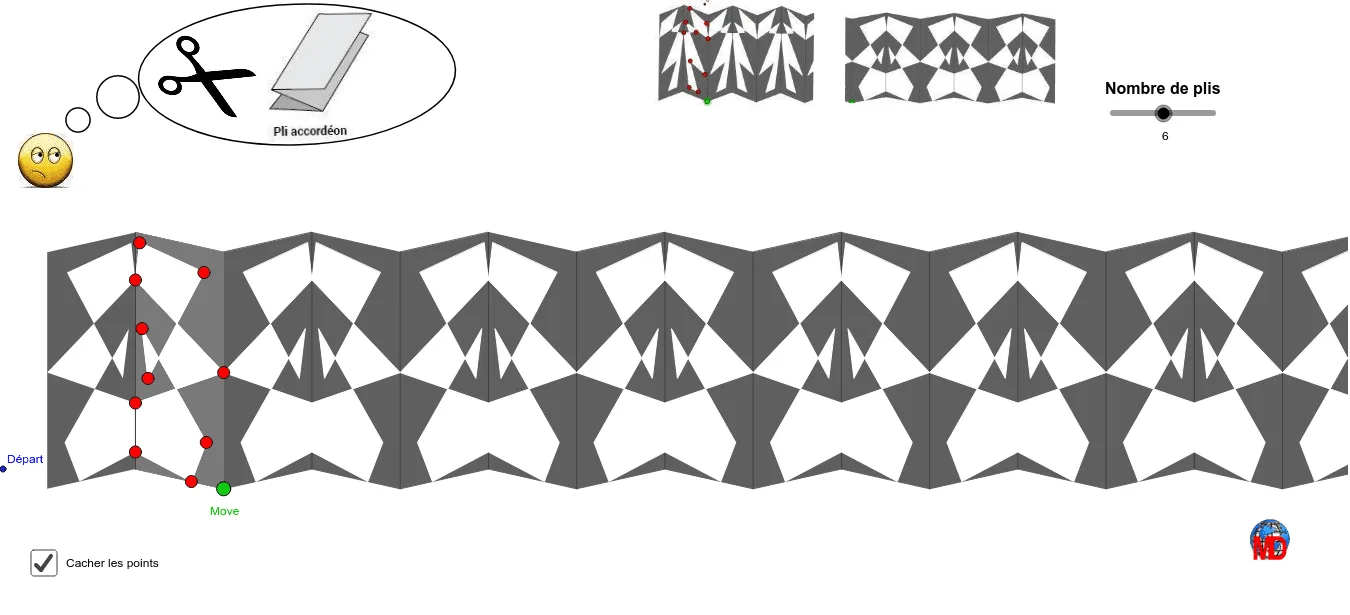
本范例通过剪裁和折叠图形来研究对称性和平移。它涉及对称、平移等核心数学概念。通过使用GeoGebra中的Circle、Line、Intersect、Mirror、Vector、Translate等命令,可以构造出一系列几何图形。适合初中及以上学生或教师使用。
GeoGebra 命令及参数
Circle(Départ, b) → eLine(Départ, xAxis) → dLine(Départ, yAxis) → b_1Intersect(e, b_1) → B, CLine(B, d) → gCircle(Départ, a) → cIntersect(c, d) → D, EMirror(Départ, E) → A'Line(E, b_1) → fIntersect(g, f) → FVector(E, F) → u_2CircleArc(F, Départ, A') → hPoint(h) → MoveTranslate(Move, u_2) → G'Midpoint(G', Move) → IPolygon(G', F, E, Move) → poly1, g', f_1, e_1, g_1Intersect(g_1, d) → HMirror(E, H) → E'Translate(E', u_2) → E''Polygon(E'', E', Move, G') → poly2, e'', e', g_2, g'_1Angle(Départ, E, Move) → αVector(Départ, E) → uLine(G', Move) → i_2Intersect(i_2, d) → I_2Vector(E, I_2) → vVector(E, E') → wSequence(Polygon[Translate[E'', Vector[(s * w)]], Translate[E', Vector[(s * w)]], Translate[Move, Vector[(s * w)]], Translate[G', Vector[(s * w)]]], s, 0, Nombre, 1) → liste2Sequence(Polygon[Translate[G', Vector[(s * w)]], Translate[F, Vector[(s * w)]], Translate[E, Vector[(s * w)]], Translate[Move, Vector[(s * w)]]], s, 0, Nombre) → liste7Segment(G', Move) → aa_1PointIn(poly1) → JPointIn(poly1) → KPointIn(poly1) → LPointIn(poly1) → MPointIn(poly1) → NPointIn(poly1) → OPointIn(poly1) → PPointIn(poly1) → QPointIn(poly1) → RPointIn(poly1) → SPolygon(J, K, M, O, P, S, R, Q, N, L) → poly3, j, l, k, m, o, p, s, r, q, n_1Mirror(J, aa_1) → J'Mirror(K, aa_1) → K'Mirror(M, aa_1) → M'Mirror(O, aa_1) → O'Mirror(P, aa_1) → P'Mirror(S, aa_1) → S'Mirror(R, aa_1) → R'Mirror(Q, aa_1) → Q'Mirror(N, aa_1) → N'Mirror(L, aa_1) → L'Polygon(J', K', M', O', P', S', R', Q', N', L') → poly3', j', l', k', m', o', p', s', r', q', n'Sequence(Polygon[Translate[J, Vector[(s * w)]], Translate[K, Vector[(s * w)]], Translate[M, Vector[(s * w)]], Translate[O, Vector[(s * w)]], Translate[P, Vector[(s * w)]], Translate[S, Vector[(s * w)]], Translate[R, Vector[(s * w)]], Translate[Q, Vector[(s * w)]], Translate[N, Vector[(s * w)]], Translate[L, Vector[(s * w)]]], s, 0, Nombre) → liste1Sequence(Polygon[Translate[J', Vector[(s * w)]], Translate[K', Vector[(s * w)]], Translate[M', Vector[(s * w)]], Translate[O', Vector[(s * w)]], Translate[P', Vector[(s * w)]], Translate[S', Vector[(s * w)]], Translate[R', Vector[(s * w)]], Translate[Q', Vector[(s * w)]], Translate[N', Vector[(s * w)]], Translate[L', Vector[(s * w)]]], s, 0, Nombre) → liste3Sequence(Segment[Translate[Move, Vector[(s * w)]], Translate[G', Vector[(s * w)]]], s, 0, Nombre) → liste4Segment(F, E) → aaSequence(Segment[Translate[E'', Vector[(s * w)]], Translate[E', Vector[(s * w)]]], s, 0, Nombre) → liste5Mirror(G', f_1) → G''Mirror(F, f_1) → F'Mirror(E, f_1) → E'_1Mirror(G', f_1) → G''_1Mirror(F, f_1) → F'_1Mirror(E, f_1) → E'_2Line(F, E) → iMirror(G', i) → G''_2Mirror(F, i) → F'_2Mirror(E, i) → E'_3Mirror(Move, i) → G'_1Polygon(G''_2, F'_2, E'_3, G'_1) → poly1', g''_2, f'_2, e'_3, g'_2Mirror(J, i) → J'_1Mirror(K, i) → K'_1Mirror(M, i) → M'_1Mirror(O, i) → O'_1Mirror(P, i) → P'_1Mirror(S, i) → S'_1Mirror(R, i) → R'_1Mirror(Q, i) → Q'_1Mirror(N, i) → N'_1Mirror(L, i) → L'_1Polygon(J'_1, K'_1, M'_1, O'_1, P'_1, S'_1, R'_1, Q'_1, N'_1, L'_1) → poly3'_1, j'_1, l'_1, k'_1, m'_1, o'_1, p'_1, s'_1, r'_1, q'_1, n'_1Ellipse(C_1, D_1, E_1) → c_1Circle(F_1, G_1) → d_1Circle(H_1, I_1) → h_1