
数值积分探索
几何画板及绘图内容加载中,请稍等……
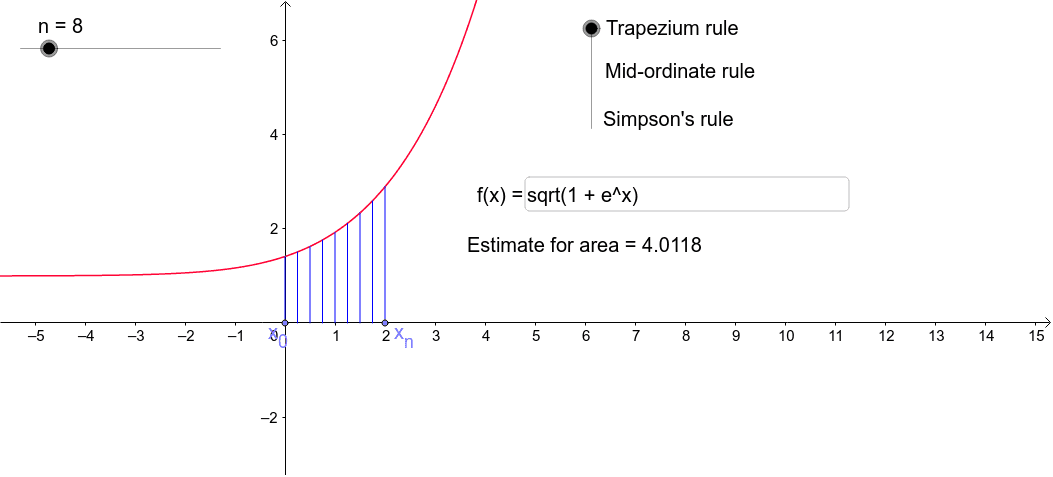
本范例通过不同步长探索三种数值积分方法。它展示了梯形法、辛普森法和矩形法的基本原理,帮助学生理解积分的概念。通过调整步长,学生可以观察到不同方法的逼近效果。该范例使用了Point、If、Sequence、Element等GeoGebra命令,适合高中数学教学。
GeoGebra 命令及参数
Point(xAxis) → x_nPoint(xAxis) → x_0If(c ≟ 0 ∧ IsInteger[(n + 1) / 2], 1, 0) → zIf(z ≟ 0, n) → n_2If(c ≟ 0, d_1, d) → d_2Sequence((i, 0), i, a, b, d_2) → LElement(L, A2) → B1Element(L, A3) → B2Element(L, A4) → B3Element(L, A13) → B12Element(L, A12) → B11Element(L, A11) → B10OrthogonalLine(x_0, xAxis) → pOrthogonalLine(x_n, xAxis) → qElement(L, A5) → B4Element(L, A6) → B5Element(L, A7) → B6Element(L, A8) → B7Element(L, A9) → B8Element(L, A10) → B9Element(L, A14) → B13Element(L, A15) → B14Element(L, A16) → B15Element(L, A17) → B16Element(L, A18) → B17Element(L, A19) → B18Element(L, A20) → B19Element(L, A21) → B20Element(L, A22) → B21Element(L, A23) → B22Element(L, A24) → B23Element(L, A25) → B24Element(L, A26) → B25Element(L, A27) → B26Element(L, A28) → B27Element(L, A29) → B28Element(L, A30) → B29Element(L, A31) → B30Element(L, A32) → B31Element(L, A33) → B32Element(L, A34) → B33Element(L, A35) → B34Element(L, A36) → B35Element(L, A37) → B36Element(L, A38) → B37Element(L, A39) → B38Element(L, A40) → B39Element(L, A41) → B40Element(L, A42) → B41Element(L, A43) → B42Element(L, A44) → B43Element(L, A45) → B44Element(L, A46) → B45Element(L, A47) → B46Element(L, A48) → B47Element(L, A49) → B48Element(L, A50) → B49Segment(B1, (x(B1), f(x(B1)))) → C1Segment(B2, (x(B2), f(x(B2)))) → C2Segment(B3, (x(B3), f(x(B3)))) → C3Segment(B4, (x(B4), f(x(B4)))) → C4Segment(B5, (x(B5), f(x(B5)))) → C5Segment(B6, (x(B6), f(x(B6)))) → C6Segment(B7, (x(B7), f(x(B7)))) → C7Segment(B8, (x(B8), f(x(B8)))) → C8Segment(B9, (x(B9), f(x(B9)))) → C9Segment(B10, (x(B10), f(x(B10)))) → C10Segment(B11, (x(B11), f(x(B11)))) → C11Segment(B12, (x(B12), f(x(B12)))) → C12Segment(B13, (x(B13), f(x(B13)))) → C13Segment(B14, (x(B14), f(x(B14)))) → C14Segment(B15, (x(B15), f(x(B15)))) → C15Segment(B16, (x(B16), f(x(B16)))) → C16Segment(B17, (x(B17), f(x(B17)))) → C17Segment(B18, (x(B18), f(x(B18)))) → C18Segment(B19, (x(B19), f(x(B19)))) → C19Segment(B20, (x(B20), f(x(B20)))) → C20Segment(B21, (x(B21), f(x(B21)))) → C21Segment(B22, (x(B22), f(x(B22)))) → C22Segment(B23, (x(B23), f(x(B23)))) → C23Segment(B24, (x(B24), f(x(B24)))) → C24Segment(B25, (x(B25), f(x(B25)))) → C25Segment(B26, (x(B26), f(x(B26)))) → C26Segment(B27, (x(B27), f(x(B27)))) → C27Segment(B28, (x(B28), f(x(B28)))) → C28Segment(B29, (x(B29), f(x(B29)))) → C29Segment(B30, (x(B30), f(x(B30)))) → C30Segment(B31, (x(B31), f(x(B31)))) → C31Segment(B32, (x(B32), f(x(B32)))) → C32Segment(B33, (x(B33), f(x(B33)))) → C33Segment(B34, (x(B34), f(x(B34)))) → C34Segment(B35, (x(B35), f(x(B35)))) → C35Segment(B36, (x(B36), f(x(B36)))) → C36Segment(B37, (x(B37), f(x(B37)))) → C37Segment(B38, (x(B38), f(x(B38)))) → C38Segment(B39, (x(B39), f(x(B39)))) → C39Segment(B40, (x(B40), f(x(B40)))) → C40Segment(B41, (x(B41), f(x(B41)))) → C41Segment(B42, (x(B42), f(x(B42)))) → C42Segment(B43, (x(B43), f(x(B43)))) → C43Segment(B44, (x(B44), f(x(B44)))) → C44Segment(B45, (x(B45), f(x(B45)))) → C45Segment(B46, (x(B46), f(x(B46)))) → C46Segment(B47, (x(B47), f(x(B47)))) → C47Segment(B48, (x(B48), f(x(B48)))) → C48Segment(B49, (x(B49), f(x(B49)))) → C49Sum(RemoveUndefined[L_1]) → tSum(RemoveUndefined[L_2]) → mIf(IsInteger[(A1 + 1) / 2], F1, 0) → G1If(IsInteger[(A2 + 1) / 2], F2, 0) → G2If(IsInteger[(A3 + 1) / 2], F3, 0) → G3If(IsInteger[(A4 + 1) / 2], F4, 0) → G4If(IsInteger[(A5 + 1) / 2], F5, 0) → G5If(IsInteger[(A6 + 1) / 2], F6, 0) → G6If(IsInteger[(A7 + 1) / 2], F7, 0) → G7If(IsInteger[(A8 + 1) / 2], F8, 0) → G8If(IsInteger[(A9 + 1) / 2], F9, 0) → G9If(IsInteger[(A10 + 1) / 2], F10, 0) → G10If(IsInteger[(A11 + 1) / 2], F11, 0) → G11If(IsInteger[(A12 + 1) / 2], F12, 0) → G12If(IsInteger[(A13 + 1) / 2], F13, 0) → G13If(IsInteger[(A14 + 1) / 2], F14, 0) → G14If(IsInteger[(A15 + 1) / 2], F15, 0) → G15If(IsInteger[(A16 + 1) / 2], F16, 0) → G16If(IsInteger[(A17 + 1) / 2], F17, 0) → G17If(IsInteger[(A18 + 1) / 2], F18, 0) → G18If(IsInteger[(A19 + 1) / 2], F19, 0) → G19If(IsInteger[(A20 + 1) / 2], F20, 0) → G20If(IsInteger[(A21 + 1) / 2], F21, 0) → G21If(IsInteger[(A22 + 1) / 2], F22, 0) → G22If(IsInteger[(A23 + 1) / 2], F23, 0) → G23If(IsInteger[(A24 + 1) / 2], F24, 0) → G24If(IsInteger[(A25 + 1) / 2], F25, 0) → G25If(IsInteger[(A26 + 1) / 2], F26, 0) → G26If(IsInteger[(A27 + 1) / 2], F27, 0) → G27If(IsInteger[(A28 + 1) / 2], F28, 0) → G28If(IsInteger[(A29 + 1) / 2], F29, 0) → G29If(IsInteger[(A30 + 1) / 2], F30, 0) → G30If(IsInteger[(A31 + 1) / 2], F31, 0) → G31If(IsInteger[(A32 + 1) / 2], F32, 0) → G32If(IsInteger[(A33 + 1) / 2], F33, 0) → G33If(IsInteger[(A34 + 1) / 2], F34, 0) → G34If(IsInteger[(A35 + 1) / 2], F35, 0) → G35If(IsInteger[(A36 + 1) / 2], F36, 0) → G36If(IsInteger[(A37 + 1) / 2], F37, 0) → G37If(IsInteger[(A38 + 1) / 2], F38, 0) → G38If(IsInteger[(A39 + 1) / 2], F39, 0) → G39If(IsInteger[(A40 + 1) / 2], F40, 0) → G40If(IsInteger[(A41 + 1) / 2], F41, 0) → G41If(IsInteger[(A42 + 1) / 2], F42, 0) → G42If(IsInteger[(A43 + 1) / 2], F43, 0) → G43If(IsInteger[(A44 + 1) / 2], F44, 0) → G44If(IsInteger[(A45 + 1) / 2], F45, 0) → G45If(IsInteger[(A46 + 1) / 2], F46, 0) → G46If(IsInteger[(A47 + 1) / 2], F47, 0) → G47If(IsInteger[(A48 + 1) / 2], F48, 0) → G48Sum(RemoveUndefined[L_3]) → sElement(L, A51) → B50Element(L, A52) → B51Segment(B50, (x(B50), f(x(B50)))) → C50Segment(B51, (x(B51), f(x(B51)))) → C51If(IsInteger[(A49 + 1) / 2], F49, 0) → G49If(IsInteger[(A50 + 1) / 2], F50, 0) → G50Textfield(f) → inputBox1
AI 绘图提示语参考
画一个函数图像,并展示三种数值积分方法:梯形法、辛普森法和矩形法。使用滑块调整步长,观察不同步长下积分的近似效果。在x轴上标记多个点,并通过正交线连接这些点与函数图像,形成积分区域。
以上提示语为根据原始绘图命令整理而来,仅供参考。