
探索交错外角 by Tim Brzezinski
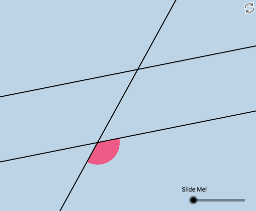
几何画板及绘图内容加载中,请稍等……
所属专题
Congruence (CO) Cluster
Congruence (Vol 2)
CCSS High School: Geometry (Congruence) Volume 2
CCSS High School: Geometry (Congruence) Volume 2
CCSS High School: Geometry (Congruence) Volume 2
Geometry (Congruence) Volume 2
CCSS High School: Geometry (Congruence) Volume 2
CCSS High School: Geometry (Congruence) Volume 2
CCSS High School: Geometry (Congruence) Volume 2
CCSS High School: Geometry (Congruence) Volume 2
CCSS High School: Geometry (Congruence) Volume 2
CCSS High School: Geometry (Congruence) Volume 2
Gail LeBlancCCSS High School: Geometry (Congruence) Volume 2
CCSS High School: Geometry (Congruence) Volume 2
CCSS High School: Geometry (Congruence) Volume 2
Parallel Lines & Related Angles
Parallel Lines & Related Angles
Logic and Parallel Lines
Geometry: Parallel Lines & Related Angles
Year 9 Mathematics
Year 7 (Angles)
Angle Congruence Intros
①本范例演示了当横截线与平行线相交时,交错外角是相等的几何现象;②涉及的核心数学概念包括角、平行线、横截线、几何证明;③作图要点——从下方『构造摘要』提炼用到了Point(点)、Line(线)、Circle(圆)、Intersect(交点)、Angle(角)等GeoGebra命令/对象;④适合高中数学教学或几何学习,用于直观理解平行线性质。
GeoGebra 命令及参数
Point(a) → BRotate(B, α, A) → B'Angle(B, A, B') → βLine(A, B') → bCircle(A, 1) → eIntersect(b, d) → CCircle(C, 1) → fIntersect(e, a) → D, EIntersect(e, b) → F, GIntersect(f, b) → H, IIntersect(f, d) → J, KCircleSector(C, J, H) → kCircleSector(C, H, K) → pCircleSector(A, F, E) → tDilate(A, If[0 < i < 1, 1 - i], C) → A'Vector(A, A') → uVector(A, C) → vMidpoint(C, A) → LRotate(A, (((-i) * 180))°, L) → A'_1Segment(L, A'_1) → gSegment(C, L) → nSegment(L, A) → sPoint(b) → MPoint(b) → NRay(C, M) → a_1Ray(A, N) → b_1Rotate(E, (((-i) * 180))°, L) → E'Ray(A'_1, E') → d_1Circle(A'_1, Distance[L, A'_1]) → e_1Intersect(e_1, d_1, 1) → ORotate(A, ((i * 180))°, L) → A'_2Rotate(D, ((i * 180))°, L) → D'Circle(A'_2, L) → k_1Ray(A'_2, D') → i_1Intersect(k_1, i_1) → P,Segment(A'_2, P) → j_1Intersect(e, b, 1) → QIntersect(f, n, 1) → RCircleSector(A, Q, E) → c_1Rotate(c_1, (((-i) * 180))°, L) → qRotate(Q, (((-i) * 180))°, L) → Q'Circle(A, g) → g_1Intersect(g_1, b_1, 1) → SIntersect(g_1, a, 2) → TSegment(A, S) → h_1Rotate(A, (((-i) * 180))°, L) → A'_3Rotate(S, (((-i) * 180))°, L) → S'Segment(A'_3, S') → l_1Segment(A, T) → m_1Rotate(A, (((-i) * 180))°, L) → A'_4Rotate(T, (((-i) * 180))°, L) → T'Segment(A'_4, T') → n_1CircleArc(A, Q, E) → p_1Intersect(e_1, a, 1) → USegment(A, U) → q_1Intersect(a, q_1) → VIntersect(a, q_1) → WIntersect(e, a, 1) → ZCircleSector(A, Z, Q) → rRotate(A, ((i * 180))°, L) → A'_5Rotate(r, ((i * 180))°, L) → r'Rotate(A, ((i * 180))°, L) → A'_6Rotate(S, ((i * 180))°, L) → S'_1Segment(A'_6, S'_1) → hSegment(L, A'_5) → r_1CircleArc(A, Z, Q) → f_1
AI 绘图提示语参考
画两条平行线,然后画一条穿过它们的直线作为横截线。在横截线与平行线的外部,标记出一对对应的外角。旋转其中一个角,观察其对应角的大小保持不变。使用点、线、圆和交点等工具,逐步构建图形,展示外角相等的性质。
以上提示语为根据原始绘图命令整理而来,仅供参考。