
等值分数探索
几何画板及绘图内容加载中,请稍等……
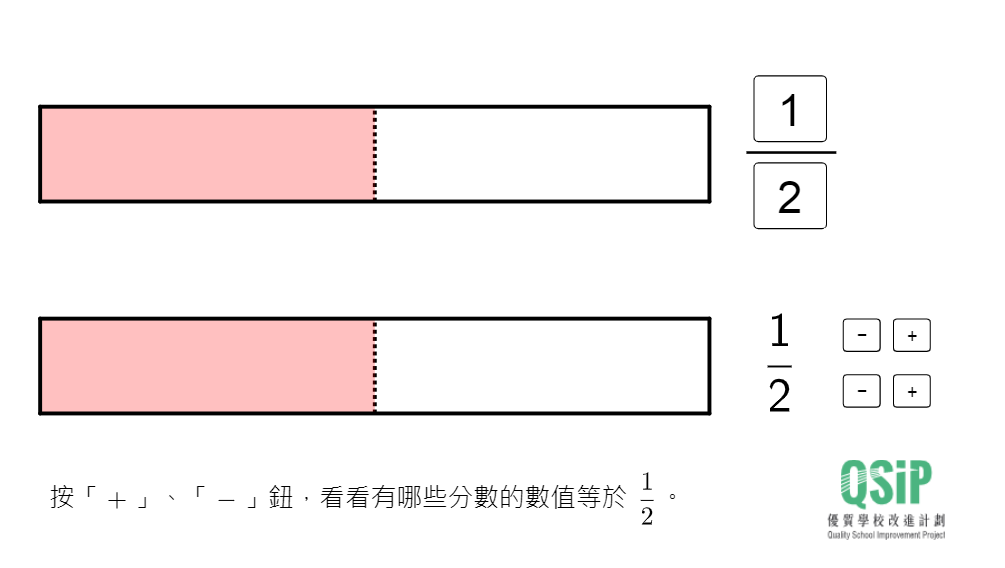
这个范例演示了如何通过变换找到等值分数。核心数学概念包括分数和等值性。使用了Sequence, If, Element, Point, Polygon, Textfield, Corner等GeoGebra命令。适合小学高年级或初中学生学习分数的基本概念和等值性。
GeoGebra 命令及参数
Sequence(B + ((i * l / q), w), i, 1, p) → list3, {(6, 1.2)}If(q > 9 ∨ p > 9, true, false) → digit2If(digit2, (9.1, -2.75), (8, -2.75)) → Q2If(digit2, (6.8, -2.75), (6, -2.75)) → Q1If(digit2, (9.1, -1.6), (8, -1.6)) → P2If(digit2, (6.8, -1.6), (6, -1.6)) → P1Element(list3, u) → PSequence(B + (i * (x(P) - x(B), 0)), i, 1, floor(l / (x(P) - x(B)))) → list4, {(6, -0.5), (12, -0.5)}Point(list4) → P'Polygon(B, B + (l, 0), B + (l, w), B + (0, w)) → poly2, a_2, b_2, c_2, d_2Polygon(A, A + (l, 0), A + (l, w), A + (0, w)) → poly1, a_1, b_1, c_1, d_1Sequence(Segment[A + ((i * l / q), 0), A + ((i * l / q), w)], i, 1, q - 1) → list1, {1.7000000000000002}Polygon(A, A + ((p * l / q), 0), A + ((p * l / q), w), A + (0, w)) → poly3, a, b, c, dPolygon(B, B + ((p1 * l / q1), 0), B + ((p1 * l / q1), w), B + (0, w)) → poly4, f, m, n, eSequence(Segment[B + ((i * l / q), 0), B + ((i * l / q), w)], i, 1, q - 1) → list2, {1.7}Textfield(p) → inputBox1Textfield(q) → inputBox2Sequence(Polygon[B + (i * (x(P) - x(B), 0)), B + ((i * (x(P) - x(B))), w), B + (((i - 1) * (x(P) - x(B))), w), B + ((i - 1) * (x(P) - x(B), 0))], i, 1, (x(P') - x(B)) / (x(P) - x(B))) → list5, {10.2}Sequence(Segment[A + ((i * l / q), 0), A + ((i * l / q), w)], i, 1, q - 1) → list1_1, {1.7000000000000002}Sequence(Sequence[Segment[B + ((i * l / q) + (j * l / ((q * r))), 0), B + ((i * l / q) + (j * l / ((q * r))), w)], i, 0, q - 1], j, 1, r - 1) → list6, {{1.7, 1.7}}If(ans1 ≟ (r * p), true, false) → correct1If(ans2 ≟ (r * q), true, false) → correct2Polygon(P1, P1 + (1.3, 0), P1 + (1.3, -1), P1 + (0, -1)) → poly5, f_1, g_1, h_1, i_1Polygon(Q1, Q1 + (1.3, 0), Q1 + (1.3, -1), Q1 + (0, -1)) → poly6, j_1, k_1, l_1, m_1Polygon(Q2, Q2 + (1.3, 0), Q2 + (1.3, -1), Q2 + (0, -1)) → poly8, s_1, t_1, e_1, f_2Polygon(P2, P2 + (1.3, 0), P2 + (1.3, -1), P2 + (0, -1)) → poly7, n_1, p_1, q_1, r_1Corner(text1, 3) → EIf(Length[list4] ≠ 1 ∧ IndexOf[P', list4] ≠ Length[list4], true, false) → arrowSequence(Segment[B + (i * (x(P) - x(B), 0)), B + ((i * (x(P) - x(B))), w)], i, 1, (x(P') - x(B)) / (x(P) - x(B)) - 1) → list7, {}Textfield(input3) → InputBox3Textfield(input4) → InputBox4If(ans4 ≟ q / div, true, false) → correct4If(ans3 ≟ p / div, true, false) → correct3If(digit2, (6.7, -2.1), (5.9, -2.1)) → HIf(digit2, (8.6, -2.1), (7.8, -2.1)) → IIf(digit2, (6.7, -3.4), (5.9, -3.4)) → JIf(digit2, (8.6, -3.4), (7.8, -3.4)) → KPolygon(H, H + (1.3, 0), H + (1.3, -1), H + (0, -1)) → poly9, h_2, j, k, g_2Polygon(J, J + (1.3, 0), J + (1.3, -1), J + (0, -1)) → poly10, j_2, i_2, k_2, l_2Polygon(I, I + (1.3, 0), I + (1.3, -1), I + (0, -1)) → poly11, i_3, m_2, n_2, p_2Polygon(K, K + (1.3, 0), K + (1.3, -1), K + (0, -1)) → poly12, k_3, q_2, r_2, s_2Textfield(input5) → InputBox5Textfield(input6) → InputBox6Textfield(input7) → InputBox7Textfield(input8) → InputBox8If(ans5 ≟ r, true, false) → correct5If(ans6 ≟ r, true, false) → correct6If(ans7 ≟ (r * p), true, false) → correct7If(ans8 ≟ (r * q), true, false) → correct8Textfield(input9) → InputBox9Textfield(input10) → InputBox10Textfield(input11) → InputBox11Textfield(input12) → InputBox12If(ans9 ≟ u, true, false) → correct9If(ans10 ≟ u, true, false) → correct10If(ans11 ≟ p / div, true, false) → correct11If(ans12 ≟ q / div, true, false) → correct12Textfield(p) → InputBox1Textfield(q) → InputBox2Sequence(Segment[B + ((i * l / q1), 0), B + ((i * l / q1), w)], i, 1, q1 - 1) → list2_1, {1.7}
AI 绘图提示语参考
画一个矩形ABCD,长度为l,宽度为w。在矩形ABCD内画一个矩形EFGH,长度为p,宽度为q。在矩形EFGH内画一个矩形IJKL,长度为p1,宽度为q1。在矩形ABCD上画一个点P,然后画一个与点P等宽的矩形MNOP。在矩形EFGH上画一个点Q,然后画一个与点Q等宽的矩形QRST。画出两个矩形之间的等分线,以及它们之间的比例关系。最后,画出一些辅助线和标记,帮助理解等分数和等分线的关系。
以上提示语为根据原始绘图命令整理而来,仅供参考。