
金字塔体积公式演示 by Anthony OR 柯志明
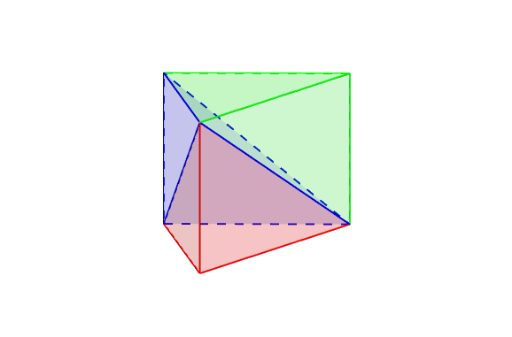
几何画板及绘图内容加载中,请稍等……
所属专题
Area, Surface Area, Volume, Cross Section, 3D
Geometry - Area & Volume
Surface Area and Volume
Surface Area and Volume
Surface Area and Volume
Volumes and Surface Areas of Pyramids, Cones and Spheres
Volumes and Surface Areas of Pyramids, Cones and Spheres
Volumes in Ancient Chinese Mathematics 中国古算中的体积
More about Volumes and Surface Areas
Volumes and Surface Areas of Pyramids, Cones and Spheres
Volumes and Surface Areas of Pyramids, Cones and Spheres
①本范例通过动态演示金字塔体积计算过程,直观展示体积公式V=1/3×底面积×高。②涉及核心数学概念包括立体几何体积、相似三角形、多边形面积计算、变换与构造。③构造过程中运用了If条件判断、Translate平移、Intersect交点、Pyramid金字塔构建、Dilate缩放、Polygon多边形绘制等GeoGebra命令与对象。④适合高中立体几何教学,用于帮助学生理解体积公式的推导过程和几何意义。
GeoGebra 命令及参数
If(s ≤ 0, (-s), 0) → s2If(s ≥ 0, s, 0) → s1Translate(C, Vector[B, D]) → C'Intersect(OrthogonalPlane[B, Segment[A, C]], Line[A, C]) → GTranslate(A, Vector[B, D]) → A'Intersect(OrthogonalPlane[B, Segment[A, C]], Line[A', C']) → HIntersect(OrthogonalPlane[C, Segment[A, B]], Line[A', D]) → FIntersect(OrthogonalPlane[C, Segment[A, B]], Line[A, B]) → ETranslate(Rotate[Translate[Rotate[C, (α * s1), Segment[A, B]], Vector[(s1 * Vector[(0, 0, 0), (0, z(D), 0)])]], ((-β) * s2), Segment[A, C]], Vector[(s2 / 2 * Vector[(0, 0, 0), (z(D), 0, 0)])]) → LTranslate(Rotate[Translate[Rotate[Polygon[A, D, A'], (α * s1), Segment[A, B]], Vector[(s1 * Vector[(0, 0, 0), (0, z(D), 0)])]], ((-β) * s2), Segment[A, C]], Vector[(s2 / 2 * Vector[(0, 0, 0), (z(D), 0, 0)])]) → poly2Pyramid(Polygon[A, B, C], D) → a, faceABD, faceBCD, faceACD_1, edgeAD, edgeBD, edgeCD_1Translate(Rotate[Translate[Rotate[D, (α * s1), Segment[A, B]], Vector[(s1 * Vector[(0, 0, 0), (0, z(D), 0)])]], ((-β) * s2), Segment[A, C]], Vector[(s2 / 2 * Vector[(0, 0, 0), (z(D), 0, 0)])]) → KTranslate(Rotate[Translate[Rotate[Polygon[A, C, A'], (α * s1), Segment[A, B]], Vector[(s1 * Vector[(0, 0, 0), (0, z(D), 0)])]], ((-β) * s2), Segment[A, C]], Vector[(s2 / 2 * Vector[(0, 0, 0), (z(D), 0, 0)])]) → poly3Pyramid(Polygon[A', D, C'], C) → b, faceA'CD_1, faceCC'D, faceA'CC', edgeA'C_1, edgeCD_2, edgeCC'Translate(Translate[Rotate[a, (α * s1), Segment[A, B]], Vector[(s1 * Vector[(0, 0, 0), (0, z(D), 0)])]], Vector[(o2 * Vector[A, B])]) → a'Pyramid(Polygon[A, D, A'], C) → c, faceACD, faceA'CD, faceAA'C, edgeAC, edgeCD, edgeA'CTranslate(Rotate[c, (α * s1), Segment[A, B]], Vector[(s1 * Vector[(0, 0, 0), (0, z(D), 0)])]) → c'Translate(Rotate[Translate[b, Vector[(o1 * Vector[A, C])]], (s1 * α), Segment[A, B]], Vector[(s1 * Vector[(0, 0, 0), (0, z(D), 0)])]) → b'Translate(Rotate[a', ((-β) * s2), Segment[A, C]], Vector[(s2 / 2 * Vector[(0, 0, 0), (z(D), 0, 0)])]) → a''Translate(Rotate[b', ((-β) * s2), Segment[A, C]], Vector[(s2 / 2 * Vector[(0, 0, 0), (z(D), 0, 0)])]) → b''Translate(Rotate[c', ((-β) * s2), Segment[A, C]], Vector[(s2 / 2 * Vector[(0, 0, 0), (z(D), 0, 0)])]) → c''Translate(Rotate[Translate[Translate[Rotate[Polygon[A, B, D], (α * s1), Segment[A, B]], Vector[(s1 * Vector[(0, 0, 0), (0, z(D), 0)])]], Vector[(o2 * Vector[A, B])]], ((-β) * s2), Segment[A, C]], Vector[(s2 / 2 * Vector[(0, 0, 0), (z(D), 0, 0)])]) → poly1Translate(Rotate[Translate[Translate[Rotate[C, (α * s1), Segment[A, B]], Vector[(s1 * Vector[(0, 0, 0), (0, z(D), 0)])]], Vector[(o2 * Vector[A, B])]], ((-β) * s2), Segment[A, C]], Vector[(s2 / 2 * Vector[(0, 0, 0), (z(D), 0, 0)])]) → IDilate(poly2, 1 - h, L) → poly2'Dilate(poly1, 1 - h, I) → poly1'Translate(Rotate[Translate[Rotate[Translate[Polygon[A', C, C'], Vector[(o1 * Vector[A, C])]], (s1 * α), Segment[A, B]], Vector[(s1 * Vector[(0, 0, 0), (0, z(D), 0)])]], ((-β) * s2), Segment[A, C]], Vector[(s2 / 2 * Vector[(0, 0, 0), (z(D), 0, 0)])]) → poly4Translate(Rotate[Translate[Rotate[Translate[D, Vector[(o1 * Vector[A, C])]], (s1 * α), Segment[A, B]], Vector[(s1 * Vector[(0, 0, 0), (0, z(D), 0)])]], ((-β) * s2), Segment[A, C]], Vector[(s2 / 2 * Vector[(0, 0, 0), (z(D), 0, 0)])]) → JDilate(poly3, 1 - h, K) → poly3'Dilate(poly4, 1 - h, J) → poly4'Polygon((-6, -6), (6, -6), (6, 6), (-6, 6)) → poly5, d, e, f, g
AI 绘图提示语参考
绘制一个三维棱锥,底面为三角形,顶点在底面上方。通过辅助平面和垂线,在棱锥内部及侧面构造多个三角形截面,展示体积公式的推导。将棱锥沿底面边旋转并平移,复制出多个全等或相似的部分,形成展开的几何组合。用滑块控制旋转角度和缩放比例,动态演示各部分如何拼合,直观体现体积等于三分之一底面积乘高。背景添加一个正方形网格平面作为参考。
以上提示语为根据原始绘图命令整理而来,仅供参考。