
等边三角形分割成矩形与杜登尼 puzzle
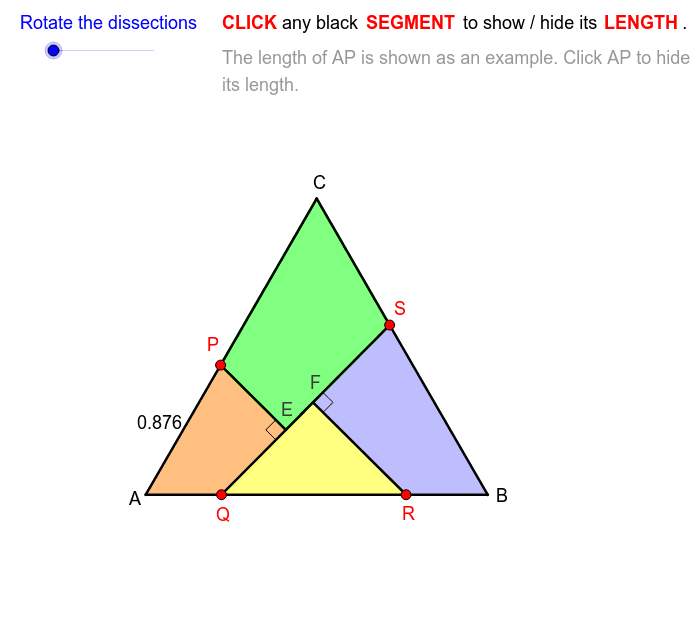
几何画板及绘图内容加载中,请稍等……
①本范例演示如何将等边三角形分割成矩形,并探究分割点的位置关系;②涉及的核心数学概念包括等边三角形、矩形、坐标几何、向量、旋转、几何变换等;③作图要点提炼自构造摘要,使用了 UnitVector, Segment, Intersect, Point, If, Circle, Rotate, Polygon, Angle, UnitOrthogonalVector, Distance, OrthogonalVector, Translate, Midpoint 等GeoGebra命令和对象;④适合高中及以上数学学习者,用于理解几何分割与变换的原理,提升空间想象能力。
GeoGebra 命令及参数
UnitVector(Vector[A, B]) → uSegment(A, B) → cSegment(C, B) → aIntersect(OrthogonalLine[Midpoint[a], c], c) → G'Point(Segment[A, G']) → EIf(x(E) < x(A + c / 2 * u), E + c / 2 * u, B) → MIf(x(E) < x(A) + c / 2, {Segment[E, M - 0.03 * c * u], M, Segment[M + 0.03 * c * u, B]}, {Segment[E, B]}) → list1Segment(A, C) → bIntersect(OrthogonalLine[Midpoint[b], c], c) → GCircle(Midpoint[a], sqrt(Distance[A, a] * a / 2)) → k_1Intersect(k_1, c) → S, TIf(γ < 180°, γ, 180*°) → θUnitVector(Vector[B, C]) → vPoint(a) → DRotate(B, θ, D) → PIf(γ < 180°, 0*°, γ - 180°) → ϕPoint(list1) → FRotate(F, Angle[B, D, P], D) → F'Rotate(E, Angle[B, D, P], D) → E'UnitVector(Vector[A, C]) → wPoint(b) → ISegment(D, E) → dRotate(D, Angle[B, D, P], D) → D'Rotate(B, Angle[B, D, P], D) → B'Polygon(D', E', B') → poly1, b', d', e'Intersect(OrthogonalLine[I, d], d) → JRotate(A, -θ, I) → KRotate(I, Angle[A, I, K], I) → I'Rotate(J, Angle[A, I, K], I) → J'Rotate(E, Angle[A, I, K], I) → E'_1Rotate(A, Angle[A, I, K], I) → A'Polygon(C, D, J, I) → poly5, c_1, d_2, j, iIntersect(OrthogonalLine[F, d], d) → LRotate(L, Angle[B, D, P], D) → L'Polygon(P, D, L', F') → poly3, e, f, g, hSegment(L, F) → kSegment(I, J) → lRotate(E', ϕ, F') → NPolygon(I', J', E'_1, A') → poly4, i', j', e'_1, a'Rotate(E', Angle[E', F', N], F') → E''_1Rotate(L', Angle[E', F', N], F') → L''_1Rotate(F', Angle[E', F', N], F') → F''_1Polygon(E''_1, L''_1, F''_1) → poly6, f''_1, e''_1, l''_1Angle(j, d) → βAngle(F, L, D) → αUnitOrthogonalVector(u) → zDistance(D, A) → DAUnitVector(Vector[F''_1, L''_1]) → u_1Segment(L''_1 + 0.15 * u_1, L''_1 + 0.4 * u_1) → a_1OrthogonalVector(u_1) → v_1Segment(Midpoint[a_1], Translate[Midpoint[a_1], Vector[(f''_1 + j') * v_1]]) → b_1Translate(a_1, Vector[(f''_1 + j') * v_1]) → d_1Midpoint(b_1) → QSegment(L''_1 - 0.15 * v_1, L''_1 - 0.4 * v_1) → e_1Segment(Midpoint[e_1], Translate[Midpoint[e_1], Vector[-(e''_1 + g) * u_1]]) → f_1Translate(e_1, Vector[-(e''_1 + g) * u_1]) → g_1Midpoint(f_1) → RMidpoint(Midpoint[a], B) → HMidpoint(Midpoint[a], C) → OUnitOrthogonalVector(Segment[Midpoint[a], Intersect[LineBisector[a], Line[A, a]]]) → nIntersect(a, OrthogonalLine[A, a]) → USegment(I, C) → mSegment(I, A) → rSegment(D, C) → pSegment(D, B) → sSegment(B, F) → tSegment(E, F) → h_1Segment(E, A) → i_1Segment(E, J) → qSegment(J, L) → j_1Segment(L, D) → l_1Circle(Midpoint[a], sqrt(Distance[A, a] * a / 2)) → p_1Segment(A, Intersect[a, OrthogonalLine[A, a]]) → m_1Segment(Midpoint[a], S) → n_1Angle(A, Intersect[a, OrthogonalLine[A, a]], B) → δSegment(I, E) → q_1Angle(I, E, A) → εSegment(F, D) → r_1Angle(D, F, B) → ζ