
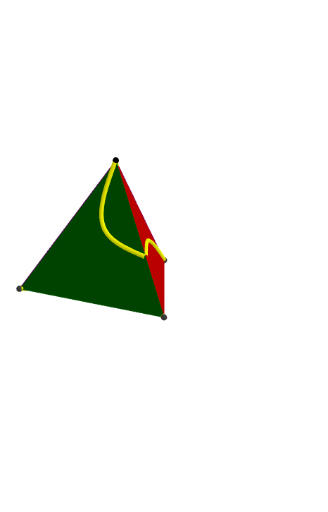
切割四面体形成展开图
几何画板及绘图内容加载中,请稍等……
本范例演示如何用 GeoGebra 将一个正四面体沿特定平面切割并展开为平面网状结构。首先介绍四面体的几何属性与切割线的生成,涉及立体几何、多边形的构建及展开图的形成。作图要点包括:使用 Vector 创建向量控制平移,Circle 绘制辅助圆,Mirror 实现对称镜像,PointIn 在体内取点,Spline 生成平滑曲线,Point 标记关键点,Translate、Rotate 实现平移与旋转,Sequence 与 Reverse 构造切割序列,Join 合并多段路径,Polygon 绘制展开面,Corner 求取棱角,Angle 测量二面角;通过滑块(Slider)驱动动画展示切割过程。适合高中及大学阶段学生学习立体几何、图形变换与 GeoGebra 操作。
GeoGebra 命令及参数
Vector(D, D') → u1Circle((0, 0), 7) → cMirror(A, B) → A'PointIn(t1(1)) → A3Spline(L4, 3) → a4PointIn(t4(1)) → A2PointIn(t3(1)) → A1Point(Segment[B, D']) → C1Spline(L1, 3) → a1PointIn(t2(1)) → A4Spline(L3, 3) → a3Spline(L2, 3) → a2Mirror(a4, B) → a4'Mirror(a1, C) → a1'Mirror(a2, C) → a2'Translate(a3, u1) → a3'Sequence(Point[a1, s], s, 0, 1, 0.05) → po1Sequence(Point[a2, s], s, 0, 1, 0.05) → po2Sequence(Point[a4', s], s, 0, 1, 0.05) → po4Sequence(Point[a4, s], s, 0, 1, 0.05) → po5Sequence(Point[a3, s], s, 0, 1, 0.05) → po6Reverse(Sequence[Point[a3', s], s, 0, 1, 0.05]) → po3Sequence(Point[a2', s], s, 0, 1, 0.05) → po7Reverse(Sequence[Point[a1', s], s, 0, 1, 0.05]) → po8Join({po1, po2, po3, po4, po5, po6, po7, po8}) → poPolygon(po) → pol1Translate(pol1, Vector[((aa - 3) * u1)]) → pol1'Rotate(pol1, If[2 < aa < 3, (pi * (aa - 2)), pi], C) → pol2Corner(1, 1) → Export_1Corner(1, 3) → Export_2Sequence({random(), random(), random()}, k, 1, númeroListas) → listaAzarAngle(F, Midpoint[A, C], D) → angRotate(a3, ((1 - a) * ang), Midpoint[A, C], Segment[A, C]) → b3Rotate(t3, ((1 - a) * ang), Midpoint[B, C], Segment[C, B]) → t3aRotate(D', ((1 - a) * ang), Midpoint[B, C], Segment[C, B]) → DDRotate(t4, ((1 - a) * ang), Midpoint[B, C], Segment[C, B]) → t4aRotate(t4a, ((1 - a) * ang), Midpoint[B, DD], Segment[DD, B]) → t4bRotate(a2, ((1 - a) * ang), Midpoint[B, C], Segment[C, B]) → b2aRotate(b2a, ((1 - a) * ang), Midpoint[B, DD], Segment[DD, B]) → b2bTranslate(pol2, Vector[((aa - 3) * u1)]) → pol2'Mirror(t3, C) → t3'Mirror(t1, B) → t1'Mirror(t4b, C) → t4b'Rotate(t2, ((1 - a) * ang), Midpoint[A, C], Segment[A, C]) → t2aRotate(a1, ((1 - a) * ang), Midpoint[B, C], Segment[C, B]) → b1