
余弦定理的几何作图与验证
几何画板及绘图内容加载中,请稍等……
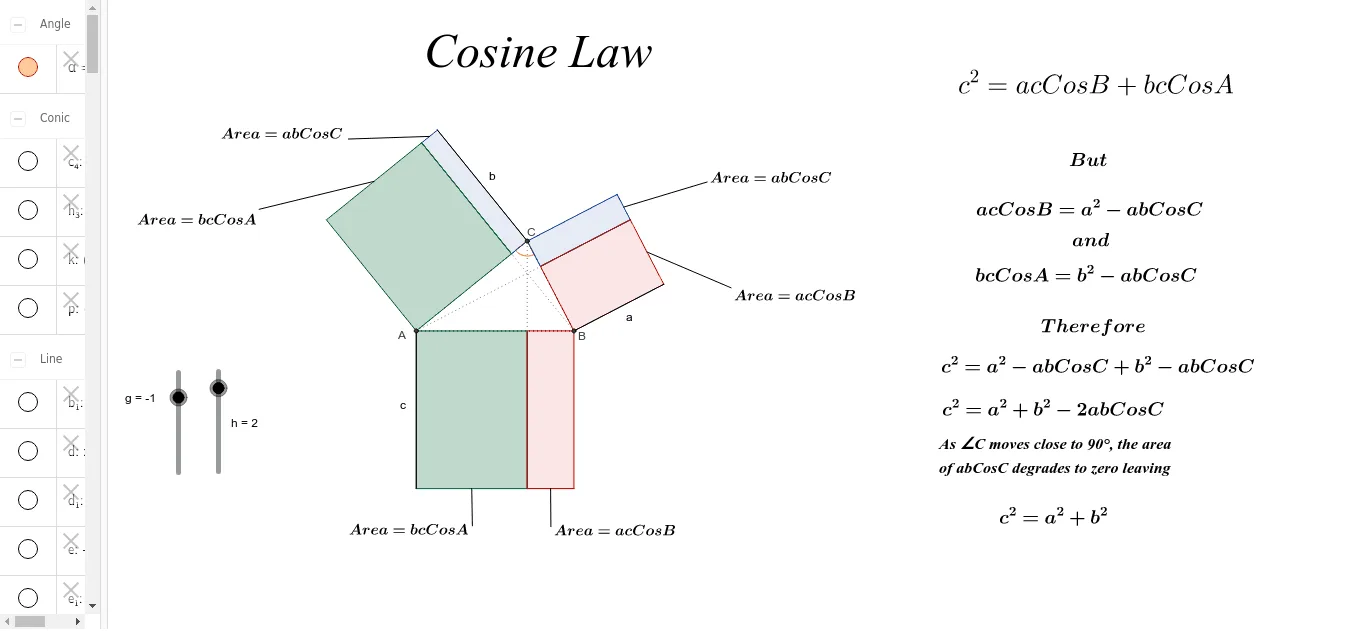
本范例通过GeoGebra演示余弦定理在三角形中的应用。核心数学概念包括三角形边角关系、余弦定理公式及几何作图技巧。作图要点涉及使用Circle、Intersect、Polygon等命令构造三角形并验证定理。适合初中生学习几何证明及高中生理解三角函数应用。
GeoGebra 命令及参数
Circle(A_1, 5) → c_4Intersect(c_4, b_1, 1) → AIntersect(c_4, b_1, 2) → BIntersect(c_4, d, 1) → CPolygon(A, C, B) → poly1, b_2, a_1, c_1Angle(A, C, B) → αOrthogonalLine(B, b_2) → eOrthogonalLine(C, c_1) → fOrthogonalLine(A, a_1) → g_3Intersect(e, b_2) → DIntersect(g_3, a_1) → EIntersect(f, c_1) → FCircle(F, c_1) → h_3Intersect(h_3, f, 2) → GSegment(F, G) → iCircle(D, b_2) → kIntersect(k, e, 2) → HSegment(D, H) → jCircle(E, a_1) → pIntersect(p, g_3, 2) → ISegment(E, I) → lLine(H, b_2) → mLine(G, c_1) → nLine(I, a_1) → qLine(C, j) → rLine(A, j) → sLine(A, i) → tLine(B, i) → d_1Line(B, l) → e_1Line(C, l) → f_1Intersect(m, r) → JIntersect(m, s) → KIntersect(q, f_1) → LIntersect(q, e_1) → MIntersect(n, t) → NIntersect(n, d_1) → OPolygon(D, H, J, C) → poly2, d_2, h_1, j_1, c_2Polygon(C, L, I, E) → poly3, c_3, l_1, i_1, e_2PointIn(poly2) → Pointpoly2PointIn(poly3) → Pointpoly3_1Polygon(A, K, H, D) → poly4, a_2, k_1, h_2, d_3Polygon(A, F, G, N) → poly5, a_3, f_2, g_1, n_1PointIn(poly5) → Pointpoly5PointIn(poly4) → Pointpoly4Polygon(F, B, O, G) → poly6, f_3, b_3, o, g_2Polygon(B, M, I, E) → poly7, a_5, m_1, i_2, e_3PointIn(poly7) → Pointpoly7PointIn(poly6) → Pointpoly6PointIn(poly3) → Pointpoly3Segment(B, D) → p_1Segment(A, E) → q_1Segment(F, C) → r_1Midpoint(h_1) → PMidpoint(k_1) → QMidpoint(g_1) → RMidpoint(o) → SMidpoint(l_1) → TMidpoint(m_1) → USegment(P, V) → s_1Segment(Q, W) → t_1Segment(R, Z) → j_2Segment(S, B_1) → k_2Segment(U, C_1) → l_2Segment(T, D_1) → m_2Segment(C, J) → bSegment(B, M) → aSegment(A, N) → c