
圆锥截线
几何画板及绘图内容加载中,请稍等……
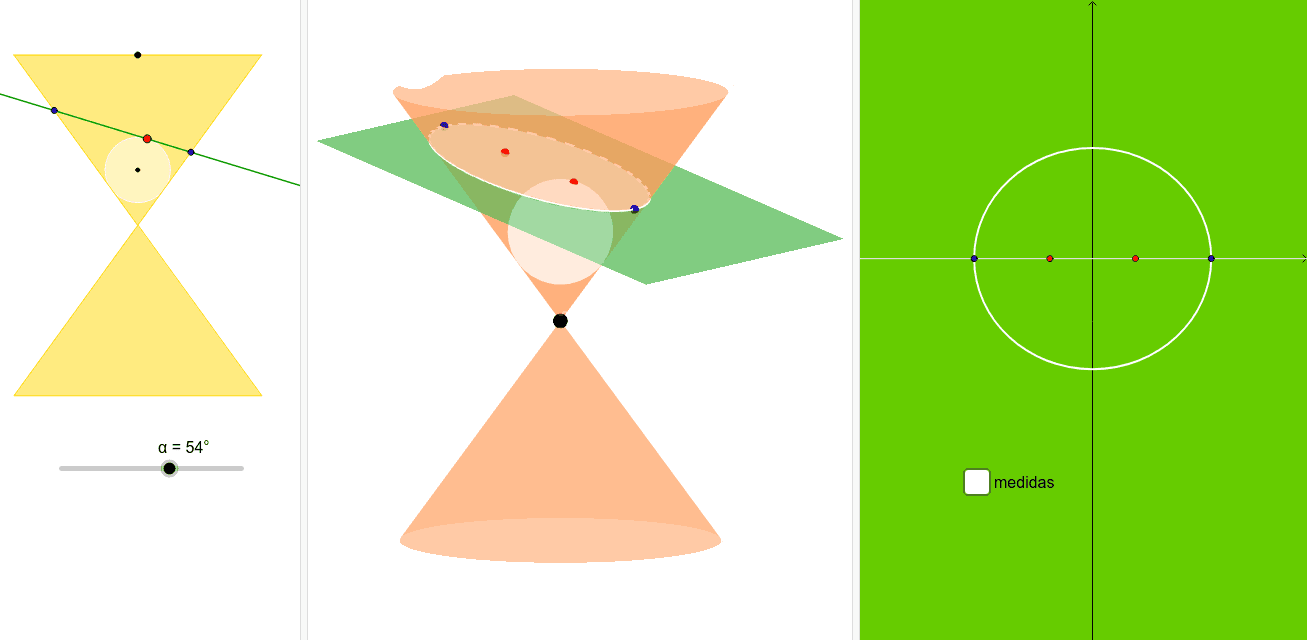
①本范例演示圆锥截线(椭圆、双曲线、抛物线)的形成与性质;②涉及核心数学概念包括解析几何、导数、几何变换等;③构造中使用了Point, Line, Intersect, Cone, Circle, Tangent, UnitOrthogonalVector, OrthogonalPlane, IntersectPath, Focus, Polygon, Mirror, Sphere, Segment, Ellipse, Hyperbola, Parabola, Angle等GeoGebra命令与对象;④适合高中及以上数学学习者和教师用于教学演示与探索。
GeoGebra 命令及参数
Point(yAxis) → HLine((0, 0), (cos(α), sin(α))) → r_1Intersect(OrthogonalLine[H, yAxis], r_1) → DCone((0, 0, y(H)), (0, 0, 0), Distance[H, D]) → superior, f, gPoint(yAxis) → C_1Intersect(OrthogonalLine[C_1, r_1], r_1) → BCircle(C_1, B) → circ_1Point(circ_1) → G_1Tangent(G_1, circ_1) → s,UnitOrthogonalVector(s) → uOrthogonalPlane((0, x(G_1), y(G_1)), Vector[(0, x(u), y(u))]) → hIntersectPath(h, superior) → c_1Focus(c_1) → F_1, F_2Circle(G_1, Distance[F_1, F_2]) → cIntersect(c, s) → I_2, I_1If(y(I_1) < y(G_1), I_1, I_2) → G_2Polygon((0, 0), D, Mirror[D, yAxis]) → pol1, a, b, dMirror(pol1, (0, 0)) → pol1'Mirror(superior, (0, 0, 0)) → inferiorSphere((0, 0, y(C_1)), Radius[circ_1]) → esf_1Corner(c_1) → F, GIntersectPath(h, inferior) → c_2Corner(c_2) → H_1, IVertex(c_1) → V_1, V_2, M, NMirror(r_1, yAxis) → r_2Intersect(s, r_2) → X_1Intersect(r_1, s) → X_2Segment(Intersect[Circle[(0, 0), D], s, 1], Intersect[Circle[(0, 0), D], s, 2]) → jMirror(A, (0, 0)) → A'Mirror(C, (0, 0)) → C'Ellipse(A, A', C) → eMirror(E, (0, 0)) → E'Hyperbola(A, A', E) → kIf(α ≟ β, (0, Distance[V_1, F_1]), (0, 0)) → JParabola(J, OrthogonalLine[(0, (-y(J))), yAxis]) → pPoint(k) → OIntersectIntersect(c_1, Circle[V_2, Distance[E, O], Vector[OrthogonalVector[h]]]) → L_1, L_2, L, PSegment(A, O) → iIf(y(O) > 0, Segment[F_2, L_2], Segment[F_2, L_1]) → mIf(y(O) > 0, Segment[F_1, L_2], Segment[F_1, L_1]) → nIf(α ≟ β, 1, If[(-α) < β < α, 2, 3]) → qPoint(e) → K_1Segment(A, K_1) → rSegment(K_1, A') → tAngle(C, (0, 0), K_1) → γIntersect(Ray[Center[c_1], Rotate[V_2, γ, Center[c_1], h]], c_1) → K_2, QSegment(F_2, K_2) → a_1Segment(K_2, F_1) → b_1Point(p) → KSegment(J, K) → e_1Segment(K, (x(K), (-y(J)))) → e_2If(α ≟ β, Line[Mirror[F_1, V_1], Tangent[V_1, c_1]]) → lSegment(O, A') → f_1IntersectIntersect(c_1, Circle[V_1, Distance[K, (0, 0)], Vector[OrthogonalVector[h]]]) → R, S, T, UIf(x(K) > 0, Intersect[l, OrthogonalLine[S, l, h]], Intersect[l, OrthogonalLine[R, l, h]]) → V